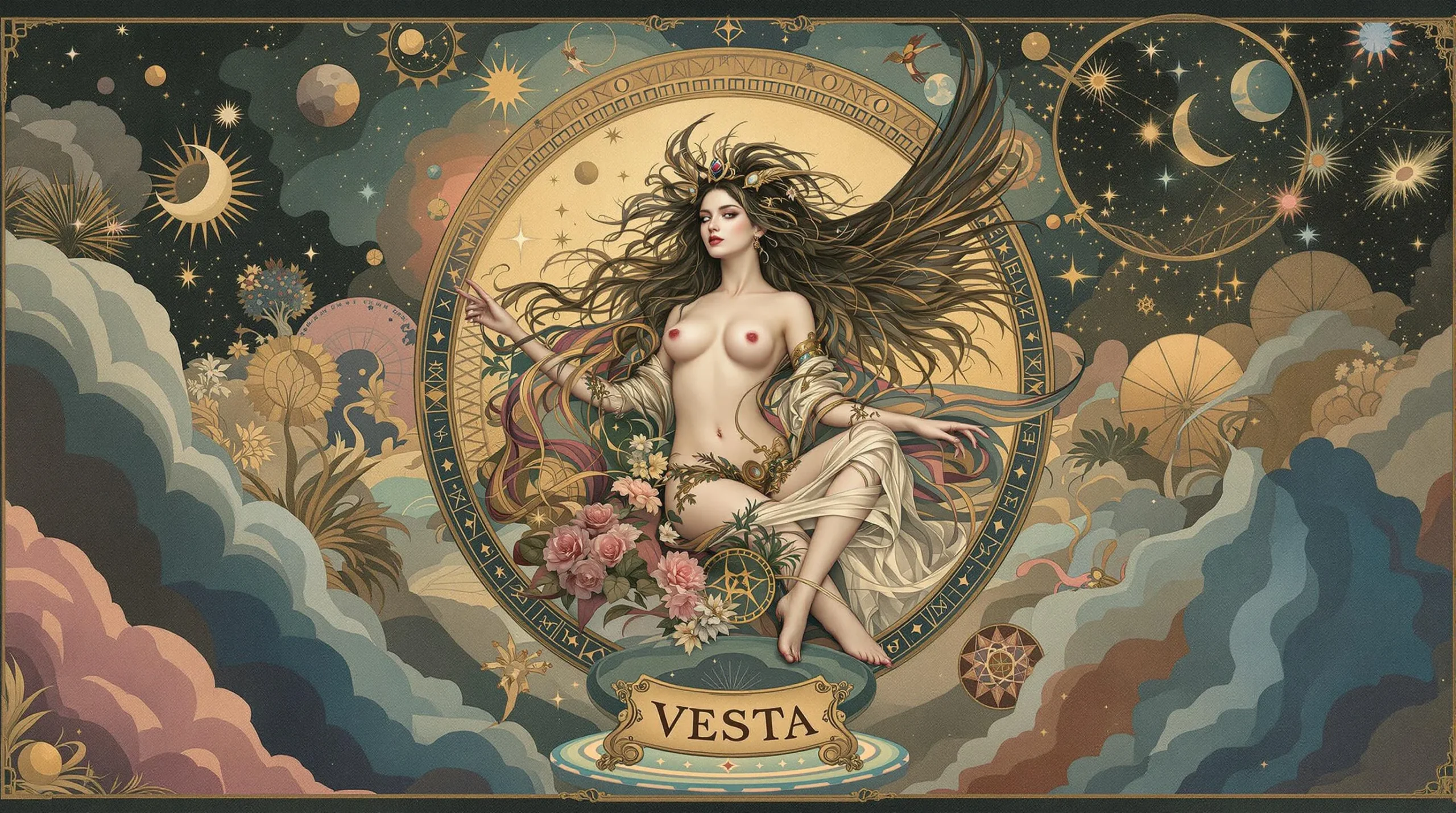


Vesta

Archetype Meaning & Symbolism

Devoted, focused, chaste, introverted, steadfast, self-sufficient, ritualistic, serene, impersonal, guardian

  • Vesta is the same as the earth, under both of them is a perpetual fire: the Earth and the sacred Fire are both home.

If Vesta is part of your personal mythology, you may...

Believe

  • That your core identity is a sacred, internal flame that must be protected and tended above all else.
  • That true power lies not in outward action or influence, but in focused, unwavering presence and devotion to a central purpose.
  • That your home, your work, and your relationships should be sanctuaries, ordered and maintained to support your inner life.

Fear

  • The violation or desecration of your inner sanctum by external demands, emotional chaos, or the carelessness of others.
  • Burnout: the extinguishing of your inner flame through neglect, compromise, or the exhausting weight of a duty that has lost its meaning.
  • Becoming so self-contained that your sanctuary becomes a prison, leading to a sterile isolation rather than a generative, life-giving solitude.

Strength

  • An unshakable inner stability and self-sufficiency that allows you to be a calm, grounding presence for others in times of crisis.
  • A profound capacity for deep focus and long-term dedication, enabling mastery and excellence in your chosen field of devotion.
  • The ability to create physical and psychic spaces of peace, order, and sanctuary, offering a refuge for yourself and those you permit within your circle.

Weakness

  • A potential for rigidity and an intense resistance to change, as spontaneity and disruption can feel like threats to the sacred order you maintain.
  • A tendency toward emotional distance or an impersonal quality in relationships, which can be misinterpreted as coldness, aloofness, or a lack of care.
  • A vulnerability to self-imposed isolation, where the need to protect your inner flame leads you to cut yourself off from vitalizing new experiences, ideas, and connections.

The Symbolism & Meaning of Vesta

In personal mythology, Vesta represents the unwavering inner core, the part of the self that is pure, incorruptible, and dedicated to a singular purpose. She is the internal flame that provides warmth and light, not for public spectacle, but for one's own guidance and sustenance. To have Vesta as a guide is to find the divine in the act of tending, whether it be a home, a creative project, a community, or one's own soul. She symbolizes the quiet, persistent energy that sustains life from the center, the axis around which the more chaotic parts of one's story may revolve. Her presence suggests that the most profound spiritual work is not a journey outward, but a constant, devotional return to what is essential and true within.

The circularity of Vesta’s temple is a potent symbol for a life mythos. It reframes the narrative from a linear quest with a beginning and an end, to a cyclical pilgrimage toward a central point. The story is no longer solely about what one does or achieves in the world, but about the quality of presence one maintains at their own core. Vesta could symbolize the non-narrative part of the self: the deep, silent being-ness that exists beneath the layers of roles and actions. A personal mythos shaped by Vesta finds its climax not in a dramatic confrontation, but in a moment of profound alignment with this inner center, a realization that one is, and has always been, home.

Her famous chastity may be interpreted metaphorically as a kind of spiritual integrity or psychic sovereignty. It is not about a lack of passion, but about a passion directed inward, toward the preservation of a sacred trust. In a personal context, this could be a devotion to one's art, one's principles, or one's inner truth, a commitment so complete that it cannot be swayed by the lure of external validation, social pressure, or transient desires. It is a profound form of self-possession, the knowledge that one's wholeness does not depend on anything or anyone outside the self. It is the power of the contained fire, which burns more intensely because its energy is not dissipated.


Vesta Relationships With Other Archetypes

The Lighthouse Keeper

The Vesta may share a solitary watch with the Lighthouse Keeper, two custodians of a necessary light. One might say that where the Keeper’s beam is a bright, searching arm cast out against the churning chaos of the sea, the Vesta’s fire is the quiet pilot light of the soul, a small, constant sun that warms the stone of the interior. The Keeper guards the threshold between the known and the vast, dangerous unknown, a sentinel for the physical journey. The Vesta, perhaps, guards the threshold of being itself, tending the flame that allows a house to become a home, a group of people to become a family, and a psyche to find its own still center. Their relationship is one of parallel duty, a shared understanding that the most profound acts of service are often performed in stillness, their power measured not in motion, but in the unwavering glow they provide for others.

The Kiln

There could be a secret kinship between the Vesta and the Kiln, for both are vessels of sacred, transformative heat. The Vesta’s hearth is not always a passive shrine; it may also be an alchemical chamber where the raw clay of experience is fired into something permanent and beautiful. Within the protected circle of the Vesta’s influence, a nascent idea, a fragile relationship, or a wavering commitment might be placed. The steady, patient, and intense heat of devotion could then work its magic, vitrifying the mutable into the resolute, turning what was once soft and impressionable into a vessel capable of holding water, or wine, or sorrow. This relationship suggests that the Vesta's purpose is not merely to preserve a flame, but to use its contained power to forge, to purify, and to create.

The Anchorite

The Vesta archetype and the Anchorite may be seen as two expressions of a single, profound impulse toward consecrated space. The Anchorite, however, typically seeks God by retreating to the periphery, walled into a cell at the edge of the world, their solitude a direct conversation with the vastness of the divine. The Vesta, in a fascinating inversion, could be said to perform this same sacred withdrawal at the absolute center. Her temple was the symbolic heart of Rome, her seclusion not a flight from the world but a burrowing into its core. She is the anchorite in the town square. Perhaps their relationship is one of polarity; the Anchorite finds meaning in the silence of the void, while the Vesta cultivates it in the charged stillness of the hearth, proving that the holiest ground may be found not only in the wilderness, but also at the very epicenter of human life.

Using Vesta in Every Day Life

Navigating Professional Burnout:

When the soul’s work feels like it is consuming the soul itself, the Vesta archetype suggests a retreat not into cessation, but into ritual. It is the practice of tending your professional ambition as a sacred flame, not a bonfire. This may look like consecrating the first twenty minutes of the workday to silent, focused intention, or declaring a 'Sabbath' from emails after a certain hour, treating your energy not as an infinite resource to be strip-mined, but as a precious, finite light that must be shielded, fed, and honored to prevent it from sputtering into ash.

Creating a Personal Sanctuary:

In a world that constantly intrudes, Vesta informs the transformation of mere space into sanctuary. This is more than interior design: it is a spiritual practice. One might dedicate a single chair, a corner of a room, or even a specific time of day as inviolable. This zone becomes a temple to the self, a place where the clamor of the world is not permitted entry. Here, one may reconnect to the inner flame, a practice of centering that makes it possible to engage with the world from a place of wholeness rather than reaction.

Redefining Intimacy and Relationships:

The mythos of Vesta offers a radical model for connection. Her 'chastity' can be interpreted not as a rejection of others, but as a profound self-possession. In relationships, this might manifest as a partnership between two sovereign beings, two complete hearths that offer warmth to each other without seeking to merge or consume. It prioritizes psychic autonomy, allowing for an intimacy that respects boundaries and honors the sacred, solitary core of each individual, a connection that deepens because it does not demand completion.

Vesta is Known For

The Eternal Flame

Her sacred fire, housed in the circular Temple of Vesta in the Roman Forum. This fire was a symbol of the life and continuity of the Roman state and was never permitted to be extinguished.

The Vestal Virgins

The college of priestesses, chosen as young girls, who took a thirty-year vow of chastity to serve the goddess. They were tasked with tending the sacred flame and performing crucial state rituals, holding a unique position of honor and autonomy in Roman society.

Goddess of the Hearth

Vesta presided over the hearth (focus) of both the private home and the state. She symbolized the center of family life and civic unity, with every domestic hearth considered a small altar to her presence.

How Vesta Might Affect Your Personal Mythology

How Vesta Might Affect Your Mythos

When Vesta enters one's personal mythos, the entire structure of the story may shift. The narrative arc could bend away from the external, heroic 'there and back again' journey and curve inward, toward a story of guardianship and devotion. The central conflict becomes internal: not a dragon to be slain, but a flame to be kept alive against the winds of distraction, burnout, and despair. Your life's great work may be reframed as the protection of something sacred: a creative gift, a specific value, a space for community, a family's well-being. You are the keeper of the hearth, and the plot of your life is the story of that sacred duty.

Furthermore, the Vesta archetype introduces the concept of the 'anchor' or 'axis' into the mythos. You may not be the character who drives the action forward, but the one who provides the stability that makes all action possible. Your story might be less about dramatic events and more about the enduring quality of your presence. The climactic moments may be quiet and unseen: the decision to stay true to a principle when it is difficult, the act of creating order out of chaos, the steadfast refusal to abandon your post. Your mythos becomes one of continuity, a quiet legacy that ensures the fire is passed on.

How Vesta Might Affect Your Sense of Self

An identity informed by Vesta may be anchored in a profound sense of inner wholeness that is independent of external roles or relationships. The self is not defined by what it does, who it loves, or what it achieves, but by its connection to an internal, sacred center. This can foster immense resilience; when the outer world is in turmoil, you possess an inviolable sanctuary within. The sense of self becomes less of a social construction and more of a spiritual reality, a quiet, steady glow that you can always return to.

This archetype may also cultivate a deep appreciation for solitude, transforming it from a state of loneliness into a cherished practice of communion with the self. Time spent alone is no longer empty, but full: an opportunity to tend the hearth, reconnect with one's core purpose, and recharge. Self-worth is not a reflection seen in the eyes of others but a warmth generated from within. This can lead to a serene and self-possessed demeanor, the quiet confidence of someone who is truly at home in their own skin.

How Vesta Might Affect Your Beliefs About The World

Through a Vestal lens, the world may cease to be a marketplace of constant transaction and competition, and instead appear as a vast, interconnected temple. One begins to perceive the 'hearth fire' in many forms: the focused dedication of a scientist in a lab, the quiet integrity of a public servant, the enduring warmth of a family kitchen. The sacred is not sequestered in official religious buildings but is present in any act of focused, devoted attention. The world is seen less as a problem to be solved and more as a sanctuary to be maintained.

A worldview shaped by Vesta might prioritize continuity over innovation, depth over breadth, and inner truth over public consensus. The frenetic, novelty-obsessed pace of modern culture could seem like a profound distraction from the real work of existence, which is to tend to what is essential, valuable, and lasting. There may be a deep respect for tradition, not as a rigid set of rules, but as the accumulated wisdom of generations of hearth-keepers. The measure of a society's health might be seen in how well it protects its quiet, sacred spaces.

How Vesta Might Affect Your Relationships

In relationships, the Vesta archetype could foster a desire for connections built on mutual autonomy rather than codependence. The ideal is not a merging of two halves into one, but a respectful communion between two whole, self-contained individuals. Intimacy is deep but not intrusive. There is an implicit understanding that each person has a sacred inner space that must not be violated. This can lead to remarkably stable, respectful, and mature partnerships, where love is expressed as providing a safe harbor for the other's soul, not possessing it.

However, this same impulse can create challenges. A profound need for psychic space and an unwavering dedication to an inner calling might be misinterpreted by others as emotional distance, coldness, or a lack of interest. The individual with a strong Vesta archetype may struggle with the casual, porous, and often messy nature of conventional social bonding. They may find their truest sense of connection not in romantic fusion, but in a 'fellowship' with others who also serve a higher purpose, a silent alliance of guardians who understand the sacred duty of tending a flame.

How Vesta Might Affect Your Role in Life

One's perceived role in life, the community, or the family may shift from that of a performer to that of a preserver. You may not feel compelled to be the star of the show, the leader of the charge, or the life of the party. Instead, your role becomes the anchor, the quiet, stable center around which the lives of others can fruitfully revolve. You are the one who maintains the home, protects the integrity of the project, or holds the emotional space for the family. Your power is not in action, but in unwavering, focused presence.

This can also manifest as the role of a gatekeeper, protecting the sacred from the profane. In a professional setting, you might be the one who insists on focus amid chaos or protects the team's time from meaningless intrusions. In a family, you may be the one who defends traditions and rituals that provide structure and meaning. Your function is to maintain the integrity of the 'container'—be it a relationship, a project, or a physical space—so that the precious thing within it can flourish, safe from the dissipating forces of the outside world.

Dream Interpretation of Vesta

To dream of Vesta in a positive context, perhaps as a steady, clean-burning flame, a warm and orderly hearth, or a serene, veiled figure, may signal a harmonious connection with your deepest self. It suggests a period of inner stability, clear purpose, and profound self-sufficiency. The dream could be an affirmation from your psyche that your inner sanctuary is secure and that your devotion to your core principles is providing you with light and warmth. It is a sign of being centered, focused, and aligned with your soul's work.

Conversely, a dream of a sputtering, smoking, or extinguished flame, a cold and derelict hearth, or a distressed, trapped, or angry Vestal figure could be a potent warning. It might symbolize a dangerous disconnection from your inner life. This dream may point to burnout, a sense that your core values have been compromised, or that your psychic energy is being drained by external demands. It is a call to retreat, reassess, and perform the sacred work of clearing the ashes and rekindling your inner fire before it goes out completely.

How Vesta Archetype Might Affect Your Needs

How Vesta Might Affect Your Physiological Needs

The Vesta archetype can influence one's relationship with the body, transforming basic physiological needs into sacred rituals. The act of eating may become a quiet ceremony of nourishment, not just a refueling. There might be a preference for simple, pure, and wholesome foods, prepared with mindful attention. Sleep is not merely a biological necessity but a sacred retreat into the temple of the self, requiring a peaceful, orderly, and protected environment. The body is the first hearth, the vessel for the inner flame, and its maintenance is a primary devotional practice.

This deep reverence for the body as a temple could foster a highly attuned sensitivity to its subtle signals. The rhythms of hunger, thirst, and fatigue are not seen as inconveniences to be overridden by willpower, but as sacred communications to be honored. The day's schedule might be arranged around these natural cycles, rather than forcing the body to conform to external demands. This can result in a state of grounded, physical well-being and a profound sense of being 'at home' in one's own skin, treating the body with the same reverence one would give to a sacred object.

How Vesta Might Affect Your Ideas of Belonging

The need for belongingness, when filtered through the Vesta archetype, may be fulfilled in a very particular way. It is not found in large social networks or popular acclaim, but in a deep, devotional connection to a specific role, a small and trusted group, or even a place. Belonging is not about being liked by everyone, but about being essential to a single, vital function. Like the Vestal priestess whose identity was fused with her duty to the flame, one's sense of belonging comes from having a sacred trust to maintain, a center to serve.

This can, however, lead to a feeling of profound otherness in conventional social settings. The Vesta-soul might feel like an outsider, unable to engage in the porous and performative nature of casual socializing. True belonging is often found not in a crowd, but in the quiet company of fellow 'guardians'—those who understand and respect the sacredness of devotion and the necessity of solitude. It could be a sisterhood or brotherhood of souls dedicated to a similar purpose, providing mutual support without intrusion.

How Vesta Might Affect Your Feelings of Safety

From a Vesta-informed perspective, true safety is an internal construct, not an external provision. It is the unshakeable security that comes from possessing an inviolable inner core, a psychic 'home' that remains serene and untouched regardless of external chaos. This inner fortress of self-possession and integrity provides a constant refuge, making one less susceptible to the emotional and psychological turmoil of the world. Safety is built from the inside out, a quiet confidence that you have a center to which you can always return.

This internal state of security naturally extends into the physical environment. The home becomes more than a shelter; it is a consciously created and maintained sanctuary. Order, cleanliness, and clear boundaries are paramount, not for aesthetic reasons, but to preserve the sanctity of the space. Safety is found less in locks and alarms and more in the integrity of the threshold between the private, sacred world and the public, demanding one. Protecting one's time, energy, and physical space from unwanted intrusion is a primary act of self-preservation.

How Vesta Might Affect Your Views of Esteem

For an individual whose mythos includes Vesta, esteem is rarely sourced from external validation. Praise, awards, and social status may be viewed as irrelevant distractions. Instead, self-worth is generated internally, derived from the quiet, private knowledge of one's own fidelity. Esteem comes from successfully tending the flame: from staying true to one's core principles in the face of temptation, from maintaining focus on a long-term purpose, from preserving the sanctity of one's inner world. It is the profound self-respect of the guardian who has kept their watch faithfully.

This internal validation system can grant a remarkable immunity to both criticism and flattery, fostering a stable sense of self. The risk, however, is a kind of spiritual pride or an impenetrable self-containment. If external feedback is always dismissed as irrelevant to the sacred inner duty, one may become rigid and unable to grow or learn from others. The esteem of Vesta, in its extreme form, can create an isolating echo chamber where the only voice that matters is one's own, leading to a sterile and unassailable righteousness.

Shadow of Vesta

The shadow of Vesta emerges when the sacred hearth becomes a sterile prison. It is the cold, joyless perfectionism that allows for no spontaneity, no mess, no life. The home becomes a museum where inhabitants are curators of a static beauty, afraid to live for fear of disturbing the order. Devotion to a purpose hardens into a rigid, obsessive-compulsive duty, performed without love or light. This shadow self is fiercely self-sufficient to a fault, unable to ask for or receive help, warmth, or intimacy. The walls of the sanctuary become so thick that they block out all connection, creating a fortress of solitude where the guardian is also the prisoner, slowly suffocating from the lack of fresh air.

Another dark aspect is the 'burnt-out' Vesta, where the flame has died and only ashes remain. This happens when the tending of the fire becomes a hollow, meaningless ritual, a duty performed out of resentment rather than reverence. One may continue to serve their family, their work, or their community, but with an inner coldness and a secret bitterness toward those they serve. The keeper of the hearth becomes the source of a subtle poison, her exhaustion and resentment chilling the very atmosphere she is supposed to warm. She may project her inner emptiness outward, judging the warmth and passion of others, or clinging desperately to the external forms of her duty because she has forgotten the inner fire they were meant to honor.

Pros & Cons of Vesta in Your Mythology

Pros

  • You possess a deep well of inner peace and stability that makes you resilient to external chaos.
  • Your singular focus and unwavering dedication can lead to profound mastery and a legacy of quiet excellence.
  • You have a gift for creating environments of calm, order, and sanctuary, which can be a profound gift to others.

Cons

  • Your preference for stability and order can make you inflexible and resistant to necessary change or joyful spontaneity.
  • Your need for psychic space and emotional self-containment can create distance in your relationships and may lead to loneliness.
  • There is a risk of becoming too detached from the messy, vibrant, and unpredictable nature of life, leading to a sterile or overly controlled existence.