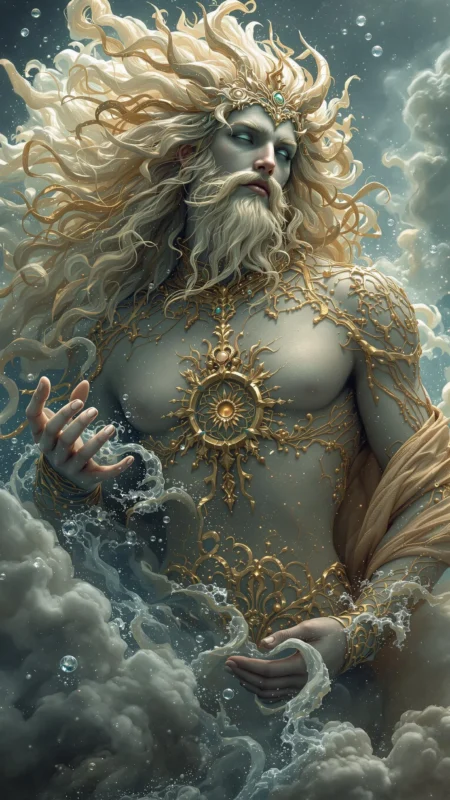
Neptune

Archetype Meaning & Symbolism

Mystical, elusive, chaotic, compassionate, deceptive, artistic, spiritual, fluid, boundless, escapist

  • Quos ego—

If Neptune is part of your personal mythology, you may...

Believe

  • There is a hidden, symbolic reality that is more potent and meaningful than the literal world we perceive with our five senses.
  • All life is interconnected in a vast, invisible web of consciousness, and the separation between selves is largely an illusion.
  • True art, deep compassion, and spiritual experiences are not products of the ego, but are transmissions from a source beyond the individual.

Fear

  • Losing your mind or your sense of self, dissolving completely into the chaos of the unconscious without ever finding your way back.
  • The ultimate disillusionment: discovering that the magic is not real, that life is meaningless, and that your deepest intuitions were just wishful thinking.
  • Being trapped in a mundane, soulless existence, cut off from inspiration and the mystical, forced to live a life of quiet desperation.

Strength

  • A profound, almost boundless capacity for empathy and compassion, allowing you to connect with others on a deep, healing level.
  • Access to a limitless well of imagination and creativity, enabling you to produce art and ideas that feel transcendent and divinely inspired.
  • An uncanny intuition, a powerful inner guidance system that allows you to navigate life by sensing the subtle undercurrents of situations and people.

Weakness

  • A powerful tendency towards escapism through fantasy, daydreaming, or substance use as a way to avoid the harshness of reality.
  • A chronic lack of practical grounding and poorly defined personal boundaries, making you susceptible to confusion, manipulation, and chaos.
  • An idealization of people and situations that inevitably leads to painful disillusionment when reality does not match the fantasy.

The Symbolism & Meaning of Neptune

To have Neptune as a central figure in your personal mythology is to build your life's temple on the shoreline, perpetually damp from the spray of the infinite. This archetype represents the universal solvent, the cosmic ocean in which all distinctions of ego, time, and form dissolve. It is the realm of dreams, of art that feels channeled rather than crafted, of spiritual ecstasy that borders on a loss of self. Neptune is the patron saint of the seventh sense: the intuition that whispers truths the other six cannot perceive. In a personal narrative, this might manifest as a life dedicated to chasing a vision, a melody, a feeling of oneness that the mundane world insists is not real. It is the fog that obscures the path, forcing a reliance on this inner compass, and the mystical tide that, when caught, can lead to shores of profound revelation.

The Neptune archetype is a paradox: the source of divine compassion and of crippling delusion. Its waters can be healing, a baptismal font for the soul, washing away the cynicism of a material world. Here lies the capacity for radical empathy, the ability to feel another's pain as if it were your own because, in Neptune's ocean, it is. But these same waters can be narcotic. They offer the sweet lure of escapism, the glamour that disguises addiction as a spiritual quest, and the beautiful mirage that shimmers just ahead, forever out of reach. Living with this archetype means constantly discerning the difference between spiritual insight and wishful thinking, between soul-level connection and a fantasy of salvation.

Ultimately, Neptune symbolizes the deep human yearning for transcendence, for a return to the source. It is the part of the psyche that rejects the finite and the defined. It governs the moments of awe before a masterpiece, the uncanny feeling of a shared dream, the quiet sorrow of nostalgia for a place one has never been. In your personal myth, Neptune is the silent patron of your imagination and your spirit. He is the force that may muddy the waters of your life, creating confusion and chaos, but he does so only to remind you that you are not the boat, nor the captain, but a current within the vast, mysterious, and interconnected sea.


Neptune Relationships With Other Archetypes

The Lighthouse

The Neptune may see in The Lighthouse a kind of stark, unforgiving clarity. Where the Neptune is the boundless, shifting sea of all possibilities, a fog of blended feeling and merging identity, The Lighthouse is a singular, piercing truth. Its beam cuts through the Neptune's very essence, offering a path, a warning, a moment of objective reality that could feel like both a rescue and a reproach. This relationship is perhaps one of wary fascination; the oceanic soul might be drawn to the Lighthouse's unwavering certainty, its promise of a solid shore, yet it may also instinctively recoil from a light that threatens to burn away its cherished mysteries and dissolve its iridescent dreams into the harsh grain of the observable world.

The Anchor

To be adrift on the Neptunian current is a state of sublime dissolution, but it carries the constant threat of being utterly lost. Herein lies the profound paradox of The Anchor. It represents a grounding force—a person, a memory, a daily ritual—that provides a life-saving connection to the solid earth beneath the endless water. The Anchor could be the brute fact that halts a descent into fantasy or addiction. Yet, this very salvation may feel, in other moments, like a terrible weight. It is the tether that prevents a complete merger with the cosmos, the sobering pull that interrupts a celestial communion. For The Neptune, The Anchor might symbolize a profound, if sometimes suffocating, love—a bargain made with the terrestrial world that secures the vessel but sacrifices a measure of its freedom to drift toward transcendent horizons.

The Ghost Ship

The Ghost Ship is less an external archetype and more a phantom limb of the Neptune’s own soul. It is the story that sails on the fog of consciousness itself, a vessel of luminescent decay crewed by memory and what-if. The Neptune does not merely observe The Ghost Ship from a distance; it may, in fact, be the very water that buoys its spectral hull and the mist that fills its tattered sails. This relationship could speak to an unexorcised grief, a romantic delusion held long past its expiration, or the beautiful, haunting glamour of a past that never truly was. The ship is a perpetual passenger in the Neptune’s inner world, forever navigating by the light of a dead star, a testament to the idea that some of the most powerful realities are those that have no place in the waking world.

Using Neptune in Every Day Life

Navigating Creative Stagnation:

When the well of inspiration feels not just dry but paved over, invoking the Neptune archetype might mean deliberately dissolving structure. It is not about forcing an idea but about creating a space for one to emerge. This could look like surrendering to a day of aimless wandering, listening to music without rhythm, or engaging in automatic drawing. It is the practice of letting the conscious, critical mind go under, allowing the deeper currents of the collective unconscious, Neptune's vast sea, to wash something new ashore. The goal is to trust the fog, to believe that within the temporary loss of direction lies the seed of a novel form.

Addressing Spiritual Emptiness:

For a soul parched by the literal and the material, Neptune offers a path back to the mystical. Weaving this archetype into one's mythos could involve seeking out experiences that blur the hard edges of the self. This may not be a formal religious practice but something more personal: long periods of silent meditation, spending time by the ocean until the rhythm of the waves syncs with one's breath, or immersing oneself in sublime art that speaks a language older than words. It is an invitation to experience reality as porous, to feel a connection not to a specific dogma, but to the great, undifferentiated mystery from which all things arise.

Coping with Overwhelming Chaos:

When life becomes a tempest, a swirl of events beyond control, the Neptunian response is not to build a stronger wall but to learn how to float. This archetype teaches the wisdom of surrender. In practice, this could mean identifying what is truly outside one's power and consciously releasing the fight against it. It is a form of radical acceptance. It is the understanding that some storms cannot be stopped, only endured. By finding a still point within, a meditative anchor, one can ride out the tsunami of external chaos without being torn apart, trusting that the waters will, eventually, recede and reveal a transformed landscape.

Neptune is Known For

Lord of the Sea

As the Roman deity analogous to the Greek Poseidon, Neptune's primary domain is the entirety of the world's waters, from the tranquil bay to the raging maelstrom. He represents the awesome power and mysterious depth of the ocean itself.

The Trident:

His iconic three-pronged spear is not merely a weapon but a tool of creation and destruction. With it, he could stir the seas into a frenzy, shatter rocks, and call forth springs from the earth, symbolizing his command over the fluid and foundational elements of the world.

Earthquakes:

Known as the 'Earth-Shaker,' Neptune's dominion extended to seismic activity. His wrath could manifest as tremors and chasms, a reminder that the solid ground beneath our feet is not as stable as it appears, and that his power runs deeper than just the surface of the sea.

How Neptune Might Affect Your Personal Mythology

How Neptune Might Affect Your Mythos

When Neptune is a key feature of your personal mythos, your life story may not follow the linear trajectory of the hero's journey. It might, instead, resemble a pilgrimage through fog. The narrative arc is not about conquering external dragons but about dissolving internal boundaries. Key plot points may be moments of profound confusion, periods of aimless drifting that, in retrospect, were sacred periods of gestation. Your personal myth might be one of a castaway who learns the language of the waves, or a channeler who translates the whispers of the collective unconscious into art, music, or healing. It is a story where reality is layered, and the most significant events happen in the unseen realms of dream, intuition, and synchronicity.

Your mythos could be defined by a central quest for something numinous: the perfect love, the ultimate truth, the lost paradise. This narrative may be colored by a sense of martyrdom or sacrifice, a feeling that you must endure a certain amount of suffering or confusion to be worthy of the transcendent state you seek. The villains in your story may not be people but states of being: disillusionment, mundane reality, spiritual dryness. The great challenge is not to slay the monster but to avoid being seduced by its beautiful, illusory song, to navigate the waters of the infinite without losing your anchor to the finite shore where life must still be lived.

How Neptune Might Affect Your Sense of Self

With Neptune shaping your self-perception, the ego's borders might feel permeable, like ink bleeding on wet paper. The sense of 'I' is less a fortress and more of a membrane, sensitive and porous. This can manifest as a profound well of compassion, an ability to absorb and understand the emotions of others with uncanny precision. You may not see yourself as a singular, separate entity, but as a wave in a vast ocean of consciousness. This view fosters a deep sense of connection to all of life, but it can also create a bewildering lack of identity. You may struggle to know where you end and another person begins, making you susceptible to absorbing their moods, problems, and even their identities.

This fluid sense of self can be both a creative gift and a psychological hazard. It allows you to be a chameleon, to channel different energies and perspectives, which is the heart of artistic and healing work. However, this same fluidity may lead to a weak sense of self-worth that is not grounded in personal achievement but is instead dependent on external validation or the intensity of a spiritual or romantic connection. The self might feel, at times, like a ghost in your own life, an observer rather than a participant, forever adrift on a sea of impressions and feelings, searching for a solid place to land.

How Neptune Might Affect Your Beliefs About The World

To see the world through a Neptunian lens is to suspect that the entire edifice of consensual reality is a grand, agreed-upon illusion. The world is not a collection of solid facts and discrete objects but a shimmering, symbolic tapestry. Meaning is not found in the manifest but in the latent, in the resonance behind the form. This worldview is inherently mystical. It allows for magic, for miracles, for meaning in coincidence. You may believe that dreams are as real as waking life, that the veil between worlds is thin, and that humanity is united by an invisible network of shared consciousness. This perspective can make the world feel enchanted, full of hidden poetry and grace.

However, this same worldview can curdle into paranoia or dissociation. If nothing is truly real, then nothing can be trusted. The belief in hidden meanings can morph into a search for conspiracies. The symbolic landscape can become a house of mirrors, where every event is a deceptive sign and every person's motive is suspect. The challenge of the Neptunian worldview is to hold onto the magic without losing your footing. It is to appreciate the symbolic nature of reality without denying the tangible consequences of action, to see the poetry in the mundane without becoming so lost in the verse that you can no longer navigate the prose of daily life.

How Neptune Might Affect Your Relationships

In the realm of relationships, a Neptune-inflected soul seeks not a partner, but a soulmate: a mystical union that transcends the profane details of shared bills and household chores. You may project an otherworldly glamour onto a new love, seeing them not as they are, but as the embodiment of a longed-for ideal. Relationships can become the primary canvas for spiritual and creative expression, a sacred space where two souls merge and dissolve into one another. This can lead to moments of sublime, ecstatic connection, a feeling of having finally come home to a cosmic counterpart. The bond feels fated, ancient, and deeply meaningful.

This yearning for merger, however, is fraught with peril. The permeable boundaries that facilitate such deep connection can also lead to codependency and a painful loss of self. You may find yourself in rescuer-victim dynamics, drawn to partners who seem wounded or in need of saving, mistaking pity for compassion and enmeshment for intimacy. When the initial glamour inevitably fades and the idealized partner reveals their flawed humanity, the disappointment can be crushing. The Neptunian challenge in relationships is to love the person, not the projection; to find the sacred in the real, not just in the fantasy; and to maintain the integrity of your own shoreline even as you invite the waters of another to wash over you.

How Neptune Might Affect Your Role in Life

If Neptune steers your personal myth, your perceived role in life is rarely a conventional one. You are not the builder of cities but the dreamer of them. You may feel called to be the artist, the musician, the poet: one who translates the ineffable into form. Or perhaps you are the mystic, the healer, the therapist, whose work involves navigating the subtle, unseen currents of the human psyche and spirit. These are roles that operate on the fringes of society, often misunderstood or undervalued by a world that prizes the tangible and the profitable. Your purpose feels less like a career and more like a calling, a sacred duty to keep a channel open to another dimension of reality.

This pull towards the ethereal can also manifest in more challenging roles. You may be the perpetual wanderer, the outcast, unable to find a place in the structured world. There is a danger of becoming the addict, using substances to artificially induce the dissolution of self that you crave. Or you might assume the role of the martyr, believing your sensitivity requires you to suffer for the sake of others or for your art. The essential task is to find a way to ground your visionary capacity, to build a vessel sturdy enough to carry your mystical gifts without being capsized by the very waters you are meant to navigate.

Dream Interpretation of Neptune

In a positive context, Neptune's appearance in a dream, often symbolized by vast, clear, and beautiful bodies of water, suggests a healthy and flowing connection to your intuition, creativity, and spiritual life. Dreaming of swimming effortlessly in a calm ocean, discovering a hidden cove, or communicating with aquatic creatures may indicate a period of profound inspiration and emotional clarity. It can signal a dissolution of old, rigid ego structures in a way that is cleansing and liberating. Such dreams may be an invitation from your unconscious to trust the direction your soul is taking you, even if the destination is not yet clear. It is the psyche affirming its connection to the universal, the personal drop merging happily with the cosmic sea.

Conversely, when Neptune's influence in a dream is negative, the water becomes a source of terror. Dreaming of drowning, being pulled under by a powerful current, or facing a tsunami signifies being overwhelmed by emotions, anxieties, or situations beyond your control. Murky, polluted, or stagnant water can point to confusion, deception, or escapist tendencies like addiction. These dreams may be a warning that your porous boundaries are causing you to absorb too much psychic debris from your environment, or that you are lost in a fog of illusion and self-deception. It is the unconscious screaming for an anchor, for solid ground, for a way to escape the suffocating embrace of chaos.

How Neptune Archetype Might Affect Your Needs

How Neptune Might Affect Your Physiological Needs

When Neptune is a dominant force in one's personal mythology, the body and its physiological needs may be treated as a secondary concern, an inconvenient vessel for the soul's journey. There can be a tendency to neglect the basics: proper sleep, regular meals, physical exercise. These earthly requirements may feel like a distraction from the more pressing work of creative expression or spiritual seeking. The body is not seen as a source of strength but as a hyper-sensitive instrument, a psychic antenna that can be easily overwhelmed. This might lead to a genuine, heightened sensitivity to foods, chemicals, and environments.

This de-emphasis on the physical can also manifest as a belief that the body's state is a direct reflection of the spirit's. Illness may be interpreted not as a biological event, but as a spiritual crisis or a physical manifestation of emotional turmoil. The approach to health might lean towards the energetic and the esoteric: faith healing, vibrational medicine, or cleansing rituals, sometimes at the expense of practical medical care. The fundamental need is not just for sustenance, but for 'pure' sustenance, for anything ingested—food, information, media—to be free of 'toxic' vibrations that might disrupt the delicate inner equilibrium.

How Neptune Might Affect Your Ideas of Belonging

The need for love and belonging, under Neptune's influence, transforms into a quest for universal oneness. Belonging is not about fitting in with a tribe or a community; it's about dissolving into the whole of humanity. You may feel a profound kinship with the outcasts, the misfits, the artists, and the mystics of the world, feeling more at home with them than with your own family or local community. The longing is for a connection that bypasses the superficialities of personality and social convention, aiming directly for a soul-to-soul merger. This can result in a feeling of boundless compassion for all living things.

Yet, this search for universal belonging can be intensely lonely. While feeling connected to everyone in theory, you may struggle to form tangible, lasting bonds with anyone in practice. The ideal of a perfect, spiritual union can make ordinary human relationships feel disappointing and shallow. There's a risk of feeling like an alien on your own planet, understood by no one, forever yearning for a mystical home you can't quite find. The sense of belonging is abstract and immense, yet the concrete experience of it can be painfully absent, leaving you feeling like a ghost at the feast of human connection.

How Neptune Might Affect Your Feelings of Safety

For the Neptunian soul, safety is not found in a bank account, a locked door, or a secure job. These worldly anchors can feel like traps, prisons for the spirit. True safety, in this mythos, is a matter of faith. It is the radical trust that the universe will provide, that a higher power is guiding the ship, or that surrendering to the flow of life is the only rational response to an inherently unpredictable world. This can lead to a life of seemingly reckless abandon, where one drifts from place to place, job to job, with a serene faith that everything will work out. Safety is an internal state of grace, not an external set of circumstances.

However, this disregard for material security can easily slide into a state of perpetual crisis and anxiety. The lack of a stable foundation can create a constant, low-grade fear of dissolution, a feeling of being unmoored in a chaotic sea. Instead of faith, there is paranoia. The need for safety might then manifest as a desperate search for a savior: a guru, a partner, or a belief system that promises absolute protection from the harsh realities of life. The challenge is to differentiate between divinely guided surrender and a simple, dangerous lack of foresight. It is to build a raft, however humble, before casting oneself into the ocean.

How Neptune Might Affect Your Views of Esteem

Esteem, in a Neptunian framework, is rarely tied to the conventional metrics of success. A promotion, a new car, a public award—these things may feel hollow, like trinkets from a foreign land. Self-worth is derived from more ethereal sources: the quality of one's creative output, the depth of one's spiritual insights, the purity of one's compassion. You might feel a sense of 'specialness' derived from your sensitivity, from the belief that you perceive a level of reality that others miss. Esteem comes from feeling that you are a clear channel for something divine or beautiful, and your greatest accomplishment is to get your ego out of the way.

This can be a fragile foundation for self-worth. Because it is not based on tangible achievements, it can dissolve in an instant. A creative block or a spiritual doubt can trigger a catastrophic collapse of self-esteem. Furthermore, this can lead to a martyr complex, where self-worth becomes entangled with suffering, believing that pain ennobles you or purifies your art. There is a constant danger of spiritual pride, a subtle ego-inflation based on being 'more sensitive' or 'more enlightened' than others. The path to healthy esteem lies in valuing the effort of staying open and compassionate, rather than basing one's worth on the fleeting and unpredictable nature of inspiration or spiritual states.

Shadow of Neptune

The shadow of Neptune is a siren's song, a beautiful melody that lures ships to their doom on the rocks. It is not an overt evil but a subtle, creeping poison of illusion. When this shadow takes hold, the quest for spiritual release becomes a flight into addiction. The compassionate desire to heal others warps into a martyr's complex, a self-sabotaging need to be the designated victim, finding a perverse sense of identity in suffering. The artist doesn't just channel inspiration; they become utterly lost in their own fantasy world, unable to function, mistaking their delusions for genius. The fog of mystery no longer inspires wonder; it suffocates, creating a paranoid world where nothing is trustworthy and everyone is wearing a mask.

In its shadow form, Neptune's waters are not cleansing; they are stagnant and toxic. Here resides the cult leader who peddles glamour and promises enlightenment but delivers only psychological enslavement. Here is the pathological liar who has come to believe their own fabrications. The shadow of Neptune is the refusal to see things as they are, the willful embrace of a beautiful lie over a difficult truth. It is the deep, seductive pull of chaos, the urge to let everything dissolve not into divine oneness, but into a meaningless, hopeless mess. It is the moment you realize you have been navigating by the reflection of a star in the water, and have been sailing in circles for years.

Pros & Cons of Neptune in Your Mythology

Pros

  • You may possess a rare ability to tap into the collective unconscious, yielding profound creative works and spiritual insights that can inspire and heal others.
  • Your capacity for compassion is nearly limitless, allowing you to form deep, soulful bonds and forgive in ways that others might find impossible.
  • You have the ability to find meaning and beauty in all of life's experiences, seeing the world as an enchanted, symbolic poem.

Cons

  • You may be chronically ungrounded, struggling with the practical demands of daily life, from finances to deadlines.
  • Your porous personal boundaries make you vulnerable to emotional contagion, codependent relationships, and being taken advantage of by others.
  • You are highly susceptible to delusion, self-deception, and periods of deep confusion, making it difficult to distinguish intuition from wishful thinking.