Believe
 Fear
Fear Strength
 Weakness
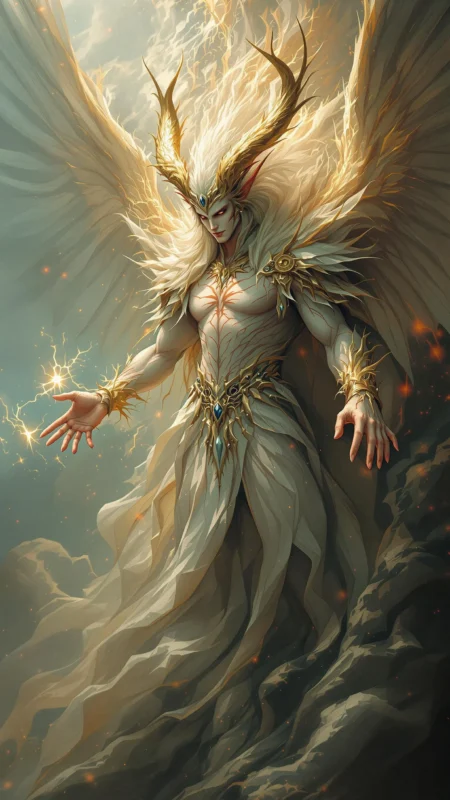
Samael represents the principle of severe judgment, the cosmic function of opposition. He is not chaos, but a terrible, divine rigor. In personal mythology, he is the part of you that insists on the highest standard, the inner prosecutor who exposes every convenient lie and self-serving motive. His presence suggests that truth is not a gentle dawn but a lightning strike that shatters the oak. To walk with this archetype is to accept that some angels carry swords not for comfort, but for severance. He is the guardian at the gate who does not ask for a password, but for a piece of your soul you thought you could hide, proving your worthiness by your willingness to be seen in your entirety.
He is also the venom that holds the antidote. The name Samael itself is sometimes interpreted as 'the poison of God,' but within that poison is the medicine for complacency. He may symbolize the necessary crisis, the illness that reveals a deeper imbalance, the rock bottom that becomes the solid foundation for a new life. In a personal narrative, he could be the force behind a painful divorce that leads to self-discovery, or the failure that forces a complete re-evaluation of one's life purpose. He is the alchemical fire that burns away the dross, a process that feels like destruction from within the crucible but is, from a distance, the act of purification.
The archetype could also represent a seductive, dangerous form of knowledge. Samael is linked to the serpent in Eden, the tempter who offers the fruit of knowledge not out of pure malice, but perhaps because knowledge itself is a double-edged sword. To have him in one's mythos is to be drawn to the edges, to forbidden subjects, to the parts of life polite society ignores. It is a hunger for a truth that is disruptive and untamable, a wisdom that might isolate you from the blissfully ignorant. It is the acceptance that to truly see, one must risk being blinded by the light or consumed by the darkness.