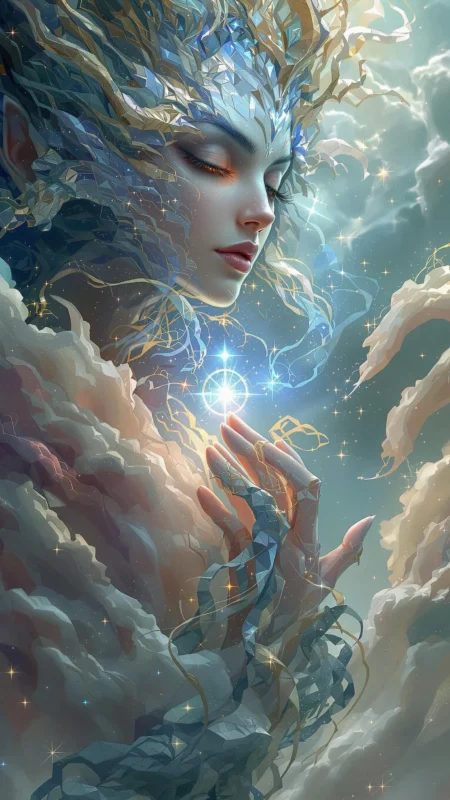
Mani

Archetype Meaning & Symbolism

Luminous, cyclical, pursued, melancholic, steady, observant, reflective, mysterious, guiding, temporal

  • My path is laid to count the years for men, a silent traverse for the sake of time itself.

If Mani is part of your personal mythology, you may...

Believe

  • There is profound wisdom to be found in silence, shadow, and reflection.
  • Life's most meaningful journeys are cyclical, not linear, and every phase has its purpose.
  • Endurance, not aggression, is the truest measure of strength, and consistency is its own form of magic.

Fear

  • Being utterly consumed by the darkness, anxiety, or sadness that perpetually pursues you.
  • That your quiet light is too faint to make a difference or provide any real guidance.
  • The finality of the cycle's end, the moment of Ragnarök when the wolf finally catches its prey and the sky goes black.

Strength

  • An unwavering consistency and reliability, especially in the face of adversity or chaos.
  • A deep well of intuition, introspection, and creative insight drawn from the subconscious.
  • The ability to be a calming, steadying presence for others, offering comfort and guidance in their darkest times.

Weakness

  • A tendency towards melancholy, passivity, or a resigned fatalism.
  • A reluctance to step into the spotlight or assert yourself, even when your perspective is needed.
  • A feeling of being perpetually hunted by anxiety, which can be emotionally and physically draining.

The Symbolism & Meaning of Mani

To find the Mani archetype within your personal mythology is to acknowledge the rhythm that underpins the noise, the quiet light that persists in the dark. He is not the sun, a bombastic, life-giving hero demanding attention. He is the patron of the subtle, the reflected, the inferred. Mani is the part of the psyche that thrives in solitude, that understands the geography of shadow and finds a strange, melancholic beauty in it. His journey suggests a life lived with a quiet duty, a path followed not for glory, but for the sake of the cycle itself. He represents a consciousness that is reflective rather than active, one that gains wisdom by observing the world from a cool distance, illuminating just enough for the next step to be taken.

His perpetual pursuit by the wolf Hati is not merely a footnote; it is central to his meaning. This is the archetype of functioning with anxiety, of carrying on with a necessary task while the threat of being consumed looms just behind. The wolf could be a past trauma, a persistent fear, or the existential dread of meaninglessness. Mani’s power lies not in defeating the wolf, but in continuing his journey regardless. He teaches that poise and purpose can be maintained even when one is hunted. In a modern context, he is the silent courage required to get out of bed, to file the report, to be kind to the cashier, all while the private wolves of the heart are howling.

The waxing and waning of Mani’s charge speaks to the cycles of the inner life. There will be times of fullness, of bright, intuitive clarity where the path is obvious. And there will be times of the new moon, of darkness and withdrawal, where the light seems to have vanished entirely. Having Mani in one’s mythos is to trust this rhythm. It is to know that the darkness is not an end, but a phase. It fosters an acceptance of one's own fallow periods, seeing them not as failures but as a necessary part of a larger, more mysterious pattern of renewal and retreat.


Mani Relationships With Other Archetypes

The Still Lake

The Mani may find its most profound and perplexing relationship with The Still Lake. Where The Mani is a frantic water-bug skittering across the surface tension of reality, all nervous energy and chaotic vectors, the Lake is a placid, reflecting void. The Mani’s arrival could be seen as a flung stone, shattering the perfect mirror with a concentric riot of activity. Yet, the Lake inevitably absorbs the splash, its depths unmoved, the ripples eventually quieting into the same profound silence. This dynamic might suggest a mutual, unspoken need: The Mani, in its whirlwind, may secretly yearn for the Lake’s impossible peace, while the Lake, in its stoic calm, is perhaps only truly defined by the occasional, beautiful disruption that proves it is water and not glass.

The Unfinished Symphony

There exists a peculiar, symbiotic bond between The Mani and The Unfinished Symphony. The Mani could be understood as the Symphony’s frantic composer, a conduit for a divine torrent of melodic ideas, harmonic colors, and rhythmic pulses. It writes a thousand brilliant opening bars but may never orchestrate a finale, perpetually enchanted by the seduction of the next new theme. The Symphony, in turn, is the ghostly architecture of sound that gives The Mani’s genius its form, however fleeting. It is a cathedral of potential, its spires dissolving into mist, a testament to a creativity so vast and restless that to complete any single phrase would feel like a betrayal of the infinite music yet to be played.

The Jester's Skull

The relationship The Mani has with The Jester's Skull is one of a frantic dance before a silent interlocutor. The Skull, a memento mori in a fool’s cap, represents the final, unblinking audience for whom all performances must end. The Mani’s dizzying display of wit and motion, its cascade of voices and ideas, could well be a feverish attempt to outrun this quiet observer, to fill the air with so much life that the silence of the void is momentarily deafened. Every laugh The Mani earns may be a desperate handful of earth thrown against a closing coffin lid. The Skull, for its part, lends The Mani’s act its essential poignancy; without its silent, patient gaze, the manic energy might be mere chaos, but in its presence, it becomes a brave, beautiful, and utterly human defiance.

Using Mani in Every Day Life

Navigating Periods of Melancholy

When a fallow or depressive period descends, one might invoke the story of Mani not to fight the darkness, but to endure it with grace. His mythos suggests that the journey through the night is the purpose itself. Rather than demanding the sun's immediate return, you could find a quiet rhythm within the gloom, understanding that your steady movement, however slow or shadowed, is a form of resilience. This is not about finding a cure, but about embodying a celestial constancy, a trust that your internal light, though faint, continues its necessary transit across the sky of the soul.

Breaking Creative Blocks

For the artist or thinker facing a sterile expanse, Mani offers an alternative to the lightning bolt of inspiration. He represents the generative power of the subconscious, the ideas that gather in quietude. To channel this archetype, one might forsake the frantic search for a new idea and instead create a ritual of reception: a silent walk at dusk, a journal kept only by moonlight, a commitment to simply observing the world without demand. The Mani mythos posits that creativity may not be a thing to be captured, but a tide that comes in when you are still enough to notice the shore.

Establishing Foundational Rhythms

In a life that feels chaotic and unmoored, Mani’s unwavering orbit could serve as a blueprint for stability. His journey is not exciting; it is profoundly reliable. To integrate this, you might focus on one small, inviolable routine: a ten-minute silence at the end of each day, the brewing of a specific tea, the reading of a single poem. This is not about rigid self-discipline for its own sake, but about creating a single, predictable point in the chaos, a personal moon around which the scattered debris of daily life can begin to find a gentle, dependable orbit.

Mani is Known For

The Lunar Chariot

Mani is the eternal driver of the chariot that pulls the moon across the heavens, a celestial journey that dictates the tides and marks the months.

Pursued by Hati

His nightly course is a perpetual chase, as he is relentlessly hunted by the wolf Hati Hróðvitnisson, who seeks to devour the moon at Ragnarök.

Keeper of Time

Along with his sister Sól, his journey is functional, not merely aesthetic. It is by their celestial passage that humanity is able to measure the passage of time, from days to years.

How Mani Might Affect Your Personal Mythology

How Mani Might Affect Your Mythos

When Mani becomes a central figure in your personal mythos, your life story may shift from a heroic epic to a quiet, lyrical poem. The plot is no longer about slaying the dragon, but about outlasting the wolf that chases you. Your narrative may be one of endurance, of quiet influence, of being the steady, guiding light for others navigating their own darkness. Major life events might be seen not as battles won or lost, but as phases of the moon: the full moon of a great love, the waning crescent of a necessary ending, the dark moon of grief, and the waxing sliver of a new beginning. Your story becomes less about what you achieve in the bright light of day, and more about the wisdom you gather in the reflective quiet of the night.

Your personal mythos might also be defined by a core duty, a celestial circuit you feel compelled to complete, day after day, regardless of applause or recognition. This could be the raising of a child, the dedication to an artistic craft, or the quiet work of maintaining a community. The conflict in your story is internal: the struggle to maintain this rhythm against the howling chaos of the world or the gnawing of your own private fears. The climax of your myth is not a single, explosive event, but the cumulative power of your consistency over a lifetime, the realization that by simply holding your course, you have become a fixed point of reference, a source of quiet wonder in someone else’s sky.

How Mani Might Affect Your Sense of Self

An affinity with Mani may shape a self-concept built on interiority and intuition. You may see yourself not as the main character in the sunlit drama of life, but as the thoughtful observer, the keeper of the night's secrets. This can foster a profound sense of self-reliance, a comfort with solitude that others might find unsettling. Your self-worth might be tied to your consistency, your ability to remain calm and steady while all around you is in flux. You might perceive your own emotions to be like the tides, pulled by forces you don't always understand but have learned to navigate with a patient wisdom. There may be a vein of melancholy in your disposition, but it is not the consuming grief of tragedy; it is the pensive, silvery sadness of deep reflection, a byproduct of seeing the world in all its transient beauty.

This self-image could also involve a sense of being secondary, of existing in relation to a more brilliant, 'solar' personality in your life—a partner, a sibling, a friend. Yet, the Mani mythos reframes this not as a deficit, but as a vital, symbiotic role. You are the one who reflects the light into the shadows, who provides the balance, who makes the brilliance of the sun bearable by offering the respite of the cool night. You may understand that your power is not lesser, just quieter. Your identity is rooted in this subtle but essential function, knowing that without the moon, the night would be one of utter, terrifying blackness.

How Mani Might Affect Your Beliefs About The World

To view the world through Mani’s eyes is to see it as a place of cycles, rhythms, and subtle energies, rather than a linear path of progress or a chaotic series of random events. You may find more meaning in the turning of the seasons than in the fluctuations of the stock market. You might believe that true understanding comes not from dissecting and analyzing things under a harsh glare, but from sitting with them in the half-light, allowing their deeper nature to reveal itself in its own time. This worldview values patience and observation over aggressive action. It is a perspective that finds profundity in patterns: the way a conflict waxes and wanes, the way a societal mood shifts like a tide, the way history seems to circle back on itself.

This perspective may also foster a certain fatalism, a deep awareness of the 'wolf' that is always in pursuit. You may see that every system, every life, every civilization is shadowed by its own eventual demise, its own Ragnarök. Yet, this is not necessarily a cause for despair. Instead, it could instill a quiet urgency to the present moment, an appreciation for the beauty of the journey itself. The world is seen as a vast, nocturnal skyscape where every point of light, no matter how small or temporary, is engaged in a noble, desperate, and beautiful race against the inevitable dark. It is a worldview that finds its central truth in the act of carrying on.

How Mani Might Affect Your Relationships

In relationships, the Mani archetype may manifest as a preference for depth and quiet understanding over performative passion. You might be the calm center in your partner’s emotional storm, the one who listens in the dark without needing to offer immediate solutions. These bonds are not forged in grand, sunlit gestures, but in the shared silences, the intuitive knowing, the countless small acts of steady presence. You may provide a space of emotional safety for others, a non-judgmental darkness where they can reveal the parts of themselves they keep hidden during the day. Your love might be less of a bonfire and more of a constant, gentle moonlight: not always warming, but always, always there.

This archetype could also incline you towards relationships that have a cyclical nature, with periods of intense closeness followed by necessary distance and retreat. You understand that intimacy, like the moon, must wax and wane to remain healthy. There might be a challenge, however, in being drawn to intensely 'solar' partners. While the balance can be profound, you may risk feeling eclipsed, your quiet light completely washed out by their brilliance. The core relational task becomes learning how to maintain your own orbit, how to offer your reflective gifts without losing yourself in the other person's gravitational pull.

How Mani Might Affect Your Role in Life

If Mani informs your life's role, you are likely not the king, but the king's most trusted advisor, the one who speaks truth in the quiet hours after the court has gone home. You may find yourself as the keeper of institutional memory, the historian, the therapist, the nocturnal artist, the silent partner who provides the steady hand that makes the whole enterprise possible. Your role is defined by its reliability. You are the one who shows up, who remembers the details, who maintains the standard when no one is watching. Your authority is not derived from a title, but from your undeniable consistency and the quiet wisdom it has afforded you.

This role may often be thankless, operating behind the scenes. The world celebrates the sun, the harvest, the victory. It rarely builds monuments to the quiet passage of the moon that made it all possible. Therefore, your sense of purpose must come from within, from the satisfaction of the journey itself. You may see your function as providing context, reflection, and a touch of mystery to a world obsessed with clarity and forward momentum. You are the guardian of the pause, the advocate for the unspoken, the one who reminds everyone else to look up and notice the silent, steady passage of time across the face of the heavens.

Dream Interpretation of Mani

To see Mani or the moon he guides in a dream, in a positive context, may signal a time of heightened intuition and creative fertility. It might suggest that the answers you seek are not in the external world of logic and data, but in the internal world of feeling, memory, and the subconscious. A bright, full moon could represent the culmination of a cycle, a moment of powerful clarity, or the illumination of something long hidden. Following Mani’s chariot might imply that you are on the right path, even if it feels dark or lonely, and that you should trust the rhythm of your own unfolding journey. It is an invitation to embrace the more reflective, mysterious aspects of your nature.

Conversely, Mani appearing in a dream under a negative light could symbolize a gnawing, persistent anxiety. If you are in the chariot with him and the wolf Hati is close behind, it may reflect a feeling of being relentlessly pursued by a problem, a trauma, or a fear you cannot shake. A dim, obscured, or blood-red moon might point to a loss of hope, a clouded intuition, or a warning of impending emotional turmoil. To see the moon fall from the sky could be a powerful symbol of a core belief system collapsing, a loss of your guiding principles, or the fear that the darkness is finally winning.

How Mani Archetype Might Affect Your Needs

How Mani Might Affect Your Physiological Needs

When Mani's archetype is woven into your personal mythology, your relationship with your physiological needs, especially rest, becomes sacred. Sleep is not a void or a waste of time; it is the other half of life, as essential and meaningful as the day. You might cultivate a deep respect for your body's circadian rhythms, seeing them as a microcosm of the grand celestial cycle. Your mythos may insist on the necessity of true darkness for sleep, a retreat from the blue light and constant stimulation of the modern world. This is about honoring the body’s ancient need for the night, for the period of cellular repair, memory consolidation, and psychic digestion that can only happen when the 'sun' of conscious activity has set.

This archetype may also foster a quiet attunement to other bodily cycles, valuing the ebb and flow of energy throughout the month and seasons. Rather than pushing through exhaustion with caffeine and sheer will—a solar approach—the Mani way might be to yield to it, to understand that periods of lower energy are not a weakness but a necessary waning phase. Nourishment could also take on a rhythmic quality, perhaps valuing simple, consistent meals over elaborate feasts. It is a mythology that grounds the self in the quiet, reliable mechanics of the body, finding a profound spirituality in the simple, repeated acts of self-maintenance and rest.

How Mani Might Affect Your Ideas of Belonging

Belonging, for one with Mani in their mythos, is not found in the boisterous camaraderie of the daytime crowd. It is a quieter, more selective affair. You may feel you belong with the night-thinkers, the poets, the astronomers, the lonely souls—anyone who understands the beauty of the half-light. Love and friendship may be defined by a shared comfort in silence, an intuitive understanding that needs no loud proclamations. You feel a sense of kinship not necessarily with a group of people, but with a certain mood, a particular time of night, or the grand, silent cycle of the universe itself. You belong to the rhythm of things.

This need for belonging may manifest in seeking out one or two deep, resonant connections rather than a wide social network. You may feel most loved and seen when someone is willing to sit with you in your darkness, not trying to fix it or turn on a light, but simply sharing the space. The challenge is that this can lead to isolation, a feeling that very few people understand your inner world. The sense of belonging is therefore precious and fiercely protected, a small, luminous circle of trust in a vast, indifferent darkness.

How Mani Might Affect Your Feelings of Safety

From a Mani perspective, safety is not the absence of threats, but the ability to navigate them with unshakable consistency. The wolf is always there. Safety, therefore, is not a high wall or a locked fortress, but the internal compass and the resilience to keep moving on your prescribed path despite the presence of danger. It is the security found in profound familiarity with your own 'darkness'—your fears, your weaknesses, your anxieties. By knowing this terrain intimately, you are less likely to be ambushed by it. Safety is the predictability of your own rhythm in an unpredictable world.

This archetype might also define safety as a form of inconspicuousness. While the sun draws attention, attack, and admiration, the moon moves in a quieter, less obtrusive way. You might find security in not being the center of attention, in blending into the background, in observing from a safe, reflective distance. The danger comes when your light is too bright, or when you deviate from your path. Thus, safety is maintained through a kind of disciplined quietude, a refusal to engage in the loud, chaotic battles of the day, preferring the strategic, silent navigation of the night.

How Mani Might Affect Your Views of Esteem

Esteem, in the mythology of Mani, is cultivated internally. It is not derived from the applause of the crowd or external accolades, which are fickle and belong to the world of the sun. Instead, self-worth comes from the quiet pride of fulfilling one's duty, from the knowledge of one's own reliability. You might build esteem by keeping the promises you make to yourself, by maintaining your personal rituals, by being a dependable presence for others. It is the esteem of the craftsman, the long-distance runner, the sentry: it is earned through endurance and fidelity to the task at hand.

This can be a robust and resilient form of self-esteem, as it is less dependent on outside validation. However, it can also be subtle to the point of being invisible to others. You may do your best work in private, and your greatest strengths—patience, intuition, resilience—may not be things that society readily rewards. The journey for the Mani individual is to learn to value their own light, no matter how faint it may seem in comparison to others, and to find their worth in the simple, profound act of completing their circuit, night after night.

Shadow of Mani

The shadow of Mani emerges when the quiet melancholy curdles into a deep, stagnant depression. It is a retreat from the world not for reflection, but for utter withdrawal, an emotional cryogenics where all feeling is frozen to avoid the pain of the wolf's pursuit. Here, the life-giving rhythm becomes a deadening, mechanical routine, a joyless and compulsive circling of the same psychic territory without any hope of dawn. The individual may become emotionally unavailable, distant, and cold, their reflected light offering no warmth whatsoever. They may use their 'duty' as an excuse to avoid intimacy and real-world engagement, becoming a ghost in their own life, forever orbiting a world they refuse to touch.

Conversely, the repressed Mani archetype manifests as a frantic, sleepless existence. It is a life lived under a perpetual, unblinking sun, terrified of the dark and the silence it brings. This person may chase constant stimulation, noise, and social activity to avoid being alone with their own thoughts. They lose all sense of inner rhythm, leading to burnout, anxiety, and a complete disconnection from their own intuition and bodily needs. They lack the capacity for deep reflection, and so their life, while busy, may feel shallow and meaningless. Without the balancing coolness of Mani, the solar fire of the ego rages unchecked, consuming all resources and leaving behind only ash.

Pros & Cons of Mani in Your Mythology

Pros

  • You cultivate a profound inner life, rich with intuition, creativity, and self-awareness.
  • You are a source of stability, calm, and quiet wisdom for yourself and for those you care about.
  • You learn to find beauty and meaning in all phases of life, embracing the dark and fallow times as necessary parts of the cycle.

Cons

  • You may be prone to feelings of melancholy, isolation, or a sense of being secondary to more 'solar' personalities.
  • You might be perceived by others as passive, distant, emotionally cold, or lacking in ambition.
  • The constant, low-grade feeling of being pursued by an inner 'wolf' can lead to chronic anxiety and exhaustion.