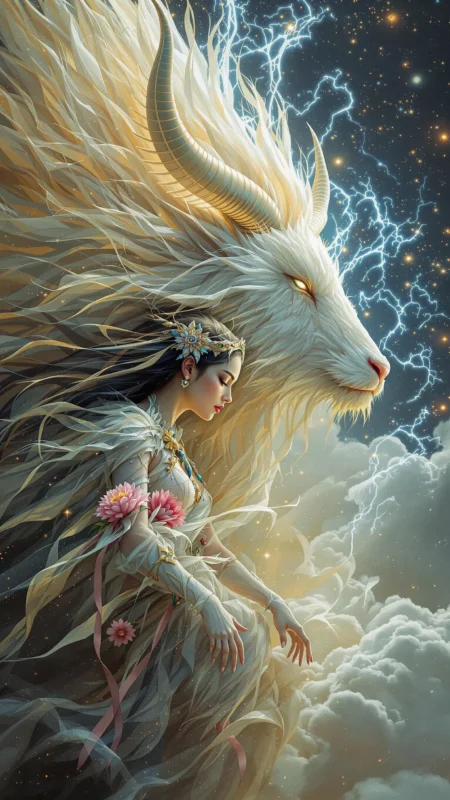


White Buffalo Woman

Archetype Meaning & Symbolism

Sacred, Generative, Law-bringer, Peacemaker, Prophetic, Ceremonial, Transformative, Abundant, Unifying, Demanding

  • With this sacred pipe, you will walk upon the Earth; for the Earth is your Grandmother and Mother, and She is sacred. Every step that is taken upon Her should be as a prayer.

If White Buffalo Woman is part of your personal mythology, you may...

Believe

  • You may believe that your life is not your own, but rather a sacred trust given to you for the benefit of all your relations.
  • You may believe that peace is not the absence of conflict, but the presence of a sacred process for moving through it.
  • You may believe that the entire world is a living scripture, and your primary task is to learn how to read it with a reverent heart.

Fear

  • You may fear that you will profane the sacred, either through ignorance or a moment of weakness, and cause a disharmony that you cannot repair.
  • You may fear that the modern world's noise and cynicism will deafen you to the quiet voice of Spirit, causing you to lose your path.
  • You may fear that you are a lone practitioner of a forgotten way, and that the promise of a restored, harmonious world will not come to pass in your lifetime.

Strength

  • An almost preternatural ability to remain centered and peaceful in the midst of chaos, acting as a calming presence for others.
  • A profound and unwavering integrity; your actions, words, and beliefs are in deep alignment, giving you a powerful presence.
  • The capacity to create sacredness anywhere, transforming mundane moments into opportunities for deep connection and meaning.

Weakness

  • A tendency towards spiritual seriousness that can make it difficult to engage with playfulness, irony, or the absurd messiness of human life.
  • A potential for impatience or judgment towards those who do not share your reverence, leading to a subtle form of spiritual elitism.
  • A deep sorrow or ecological grief for the state of the world that can, if not properly managed, lead to despair or burnout.

The Symbolism & Meaning of White Buffalo Woman

To find the White Buffalo Woman appearing in the personal mythology of a modern individual is to witness an urgent call for the re-sacralization of a life. She may emerge not as a literal figure, but as a felt sense that the world has been stripped of its magic and that one’s soul has been starved in the process. She symbolizes the end of a profane era and the dawn of a personal one grounded in reverence. Her presence suggests a life organized not around acquisition or achievement, but around ceremony. The morning commute could become a pilgrimage, a business negotiation a council for peace, a simple meal a sacrament. She is the force that insists your very breath is a prayer, your body an altar, and your attention the most sacred offering you can make.

The pipe she carries, the Chanunpa, is perhaps one of the most potent metaphors for psychological and spiritual integration available to the human imagination. It is the union of opposites: earth and sky, masculine and feminine, the individual and the community, all made one through the breath of spirit. For a person wrestling with internal fragmentation, the pipe is a symbol of wholeness. It suggests that peace is found not by eliminating conflict but by holding it in a sacred container, allowing a third, transcendent element to emerge. To live by the code of the pipe is to commit to speaking truthfully, listening deeply, and treating every interaction as an opportunity to connect the mundane world with the Great Mystery.

Furthermore, the White Buffalo Woman is a harbinger of abundance, but not in the way a capitalist society would define it. Her abundance is spiritual, a richness that flows from living in right relationship with all things. She may signal a shift in personal mythology from a story of scarcity and struggle to one of trust and provision. This is the faith that if you honor your own nature, your community, and the Earth that sustains you, you will be sustained in turn. Her prophecy is not just for a people, but for a soul: that by walking the sacred path, you will usher in an era of inner peace and profound purpose, restoring a harmony that you perhaps feared was lost forever.


White Buffalo Woman Relationships With Other Archetypes

The Wasteland

The White Buffalo Woman may not arrive in a verdant garden, but rather at the parched edge of The Wasteland, a place where the spiritual aquifers have run dry and the people wander, mouths agape with a thirst for meaning. The Wasteland is the canvas of cracked earth upon which her purpose is drawn; it is the silent, desperate prayer that summons her. One could say her archetype is not merely in opposition to this desolation but is born from its specific hunger. She is the slow, sure rain that does not flood the canyon but seeps deep into the soil, promising a future greening. Her relationship with this barrenness is one of cosmic reciprocity: the depth of the void, perhaps, determines the magnitude of the grace that arrives to fill it, making her presence less an intrusion and more a profound and necessary homecoming.

The Sacred Pipe

With The Sacred Pipe, her relationship is not one of a wielder to a tool, but of a soul to its most perfect vessel. The Pipe, the Chanunpa, is arguably her legacy made tangible, a spiritual technology left in the hands of the human. It is the compact, the covenant, the very grammar of connection she teaches. The breath drawn through its stem may be seen as the inhalation of wisdom, and the smoke that rises, a prayer made visible, mingling with the great, silent expanse. The Pipe could be understood as the distillation of her being—its stone bowl the enduring earth, its wooden stem the rootedness of the living world, the feathers the freedom of the sky. In this way, she does not simply give an object; she imparts a piece of her own archetypal structure, leaving behind a way for the finite to commune with the infinite long after she has vanished over the horizon.

The Trickster

The relationship between The White Buffalo Woman and The Trickster is one of a profound, if dissonant, harmony, like the tension between a river's current and its banks. Where she arrives to weave the sacred design of ritual and law, The Trickster, in figures like Coyote or Iktomi, perpetually tugs at the threads, testing the weave's integrity. He is the agent of chaos, the embodiment of entropy, the force that reminds humanity that all patterns, even sacred ones, can become prisons if held too rigidly. Yet, his chaos may be precisely what clears the ground. The Trickster’s foolishness might expose a people’s hubris, creating the humility necessary to receive her wisdom. He is, perhaps, the erratic lightning that shatters the old, dead tree, and she is the one who comes to plant a new seed in the cleared, consecrated ground. Together, they may represent the universe’s essential pulse—the ceaseless rhythm between the dissolution of form and its sacred re-creation.

Using White Buffalo Woman in Every Day Life

Navigating Communal Discord

When a community, be it a family or a workplace, is fractured by conflict, the White Buffalo Woman archetype offers a path beyond assigning blame. It suggests the creation of a council, a sacred space for speaking and listening. You may find yourself proposing a new way to communicate: one person speaks, holding a symbolic object, while others listen not to rebut, but to understand. The goal is not victory, but the restoration of right relationship, the mending of the communal hoop. Your role becomes that of the peacemaker, reminding everyone that their connection is more vital than their disagreement.

Overcoming Creative Barrenness

In moments of creative emptiness, when the well of inspiration seems dry, this archetype could suggest that the issue is not a lack of ideas but a loss of reverence. To embody her principles is to treat creativity as a sacred act. You might create a small ritual before you begin your work: lighting a candle, offering a moment of gratitude, or simply acknowledging the materials before you as gifts from the Earth. Your art, your writing, your project, ceases to be a product for consumption and becomes an offering, a prayer made manifest. The pressure to perform may fall away, replaced by a simple devotion to the act itself.

Establishing Personal Meaning

For the soul adrift in the currents of a secular world, feeling a lack of purpose, the White Buffalo Woman provides a blueprint for building a cathedral of meaning within your own life. You may begin to establish personal ceremonies. Your morning coffee could become a ritual of intention. A weekly walk in nature, a pilgrimage to honor your connection to the land. These are not empty gestures; they are the threads you use to weave the sacred into the fabric of the mundane. Your life story stops being a random series of happenings and starts to follow a sacred calendar, marked by personal rites that affirm your place in the cosmos.

White Buffalo Woman is Known For

The Sacred Pipe

Her primary gift, the Chanunpa, is a living symbol of the cosmos in miniature. The bowl represents the Earth and the female, the stem represents the sky and the male, and the smoke of the sacred tobacco carries prayers to the Creator. It is the ultimate instrument of peace and right relationship.

The Seven Sacred Rites

She established the foundational ceremonies for the Lakota people, providing a spiritual roadmap for life. These rites cover everything from purification (the sweat lodge) to seeking vision (the vision quest) to creating relatives, ensuring that every major facet of life is lived in a sacred manner.

Prophecy and Transformation

Her arrival was a momentous, world-altering event, and her departure included a prophecy of her eventual return to restore harmony to a broken world. She herself is a figure of transformation, changing shape as she leaves, reminding all that form is temporary but spirit is eternal.

How White Buffalo Woman Might Affect Your Personal Mythology

How White Buffalo Woman Might Affect Your Mythos

When the White Buffalo Woman enters your personal mythos, your life story may cease to be a linear narrative of cause and effect. It transforms, perhaps, into something more like a medicine wheel: cyclical, holistic, and oriented around a sacred center. Past traumas may be re-contextualized not as mere wounds, but as initiations, the painful gateways through which you had to pass to receive a deeper wisdom. Your biography is no longer a simple chronicle of events; it becomes a sacred text, filled with omens, rituals, and covenants. You might find yourself looking back and seeing not mistakes, but necessary lessons in the great ceremony of your becoming. Your future is not a destination to be reached, but a prayer to be lived into, moment by moment.

Her arrival also introduces a profound sense of law and consequence into your narrative. This is not the sterile law of human courts, but a living, cosmic principle of reciprocity and balance. Your personal myth may now be governed by an understanding that every action, thought, and word sends a ripple through the web of life. There is a newfound weight to your choices. The story is no longer just about your own happiness or survival; it is about your role in maintaining or disrupting the harmony of the whole. This can feel like a heavy burden, but it is also the source of immense dignity: your life matters not just to you, but to the cosmos itself.

How White Buffalo Woman Might Affect Your Sense of Self

The presence of the White Buffalo Woman may fundamentally alter your perception of self, shifting it from a separate, ego-driven entity to a sacred vessel. You could begin to see your body not as a machine to be optimized or an object to be judged, but as a living piece of the Earth, holy in its very substance. This archetype fosters a quiet reverence for your own existence. The inner critic’s voice may be replaced by the whisper of an elder self who knows your inherent worth is not contingent on your productivity, your appearance, or the approval of others. You are sacred simply because you are. This is not narcissism; it is the quiet, bedrock foundation of spiritual self-esteem.

This archetype also dismantles the illusion of the isolated self. To walk with her is to understand yourself as a convergence point of relationships: a child of your ancestors, a custodian for future generations, a sibling to the trees and the stones. The Lakota phrase 'Mitákuye Oyásʼiŋ'—all my relations—becomes your personal mantra. Your identity expands beyond your skin, weaving itself into the fabric of your community and your ecosystem. The self is no longer an island but a vital node in a vast, interconnected network of being. Loneliness may recede, replaced by a profound and sometimes overwhelming sense of kinship with all that is.

How White Buffalo Woman Might Affect Your Beliefs About The World

To see through the eyes of this archetype is to view the world not as a dead collection of resources, but as a living, breathing, and sacred entity. A forest is no longer timber; it is a standing nation of sentient beings. A river is not just water; it is the lifeblood of the Mother. The world becomes animated, infused with spirit, and every part of it deserves respect. This perspective could make it difficult to participate in the casual exploitation that modern life often demands. You may find yourself becoming a quiet advocate for the voiceless, for the land itself, because you perceive its inherent right to exist in a state of health and harmony.

The White Buffalo Woman may also reshape your perception of time. The relentless, linear march of the clock could soften into a more cyclical, ceremonial understanding. You might begin to experience time not as a commodity to be spent, but as a medium for sacred engagement. The changing seasons become high holidays. The phases of the moon mark opportunities for reflection and release. History is not something that is over; it is alive in the present moment, accessible through ritual and remembrance. Your life is no longer a race against time, but a slow, deliberate dance with eternity.

How White Buffalo Woman Might Affect Your Relationships

In the light of the White Buffalo Woman, relationships are transformed from contracts of convenience or possession into sacred covenants. A friendship, a partnership, a marriage: these may be seen as living ceremonies, opportunities to practice the art of right relationship. Communication itself becomes a ritual akin to the smoking of the sacred pipe. The goal is not simply to exchange information or to win an argument, but to create a shared understanding that honors the spirit in each person. You may find yourself listening more than you speak, valuing silence, and choosing your words with the care of a poet, knowing they have the power to build or to break a sacred trust.

Your very definition of family could expand exponentially. The concept of 'Mitákuye Oyásʼiŋ' (all my relations) might move from an abstract idea to a lived reality. Your sense of responsibility and kinship may extend beyond your human family to your neighborhood, your city, and your bioregion. Even your adversaries could be viewed in a new light: not as enemies to be vanquished, but as relatives with whom you are in a state of disharmony. The work, then, is not to destroy them, but to find a way back to peace, however difficult that path may be. Relationships become the primary ground for your spiritual practice.

How White Buffalo Woman Might Affect Your Role in Life

Your perceived role in the world may undergo a radical shift. The titles of job, parent, or citizen might feel inadequate. Instead, you could begin to see yourself as a tender of the sacred fire, a ceremonialist of the everyday, or a carrier of the pipe for your community, whether they know it or not. Your purpose is no longer defined by what you achieve in the material world, but by the quality of presence and reverence you bring to your life. Your work, whatever it is, becomes your ministry. Your home becomes your temple. Your life becomes your offering.

You might also feel a sense of being a bridge: between the ancient ways and the modern world, between the spiritual and the material, between the human community and the more-than-human world. This is a role of profound responsibility. It may require you to translate sacred concepts into a secular language, to embody a peace that the world has forgotten, and to hold a vision of a harmonious future even when the present seems bleak. You are not just living your life; you are keeping a promise made by the ancestors to the generations yet to come.

Dream Interpretation of White Buffalo Woman

To dream of the White Buffalo Woman, or a luminous white buffalo, in a positive context is a powerful affirmation. It may arrive during a time of confusion or despair as a sign that you are on the right path, that your prayers have been heard. The dream could be an annunciation, a calling to step more fully into a role of peacemaker, healer, or spiritual leader within your community. It often signals the imminent arrival of a period of peace, abundance, and restored harmony after long strife. The dream is a promise: what was broken will be mended. It is an invitation to accept your sacred purpose with grace and humility.

A dream of a sick, wounded, or angry White Buffalo Woman, or one who is fleeing from you, serves as a solemn warning. It may reflect a profound disconnect from your own spiritual core, a violation of your deepest values in your waking life. Perhaps you have broken a sacred trust, acted without integrity, or allowed cynicism to poison your worldview. The dream is a mirror showing you the state of your soul or the soul of your community. It is a powerful call to account, urging you to identify the source of the disharmony and begin the difficult work of atonement, repair, and returning to the sacred way.

How White Buffalo Woman Archetype Might Affect Your Needs

How White Buffalo Woman Might Affect Your Physiological Needs

When this archetype informs your mythos, the physiological needs of the body—for food, water, air, shelter—are reframed as sacred duties. The body is the first temple, the primary altar upon which the ceremony of your life is conducted. The act of breathing may become a conscious practice of taking in the spirit of the world and offering your own spirit back. Food is no longer mere fuel; it is a communion with the entire web of life that gave itself so that you might live. You may find yourself drawn to simpler, more natural foods, eating with a gratitude that transforms consumption into a sacrament.

This perspective fosters a deep listening to the body’s wisdom. Aches, illnesses, and fatigue are not just malfunctions to be suppressed, but messages from the soul, communicated through the flesh. The need for rest is not a weakness, but a sacred requirement for integration and renewal, akin to a ceremonial retreat. Caring for your body—through movement, through nourishment, through rest—ceases to be a matter of vanity or performance and becomes a fundamental act of spiritual devotion. You are tending to the holy ground of your own being.

How White Buffalo Woman Might Affect Your Ideas of Belonging

Belongingness, under the influence of this archetype, transcends the human social sphere and becomes a cosmic state of being. You may feel an unshakable sense of kinship that extends to all of creation. The loneliness that can haunt modern life may dissipate, replaced by the constant companionship of what the Lakota call 'Tȟuŋkášila,' the grandfather rocks, and 'Uŋčí Makȟá,' grandmother earth. You belong not because you are accepted by a particular group, but because you are a part of everything. This is a profound antidote to alienation, a belonging that cannot be revoked by social rejection or isolation.

Within human relationships, the need for love and belonging is met through the practice of creating sacred community. Love is not a feeling to be chased, but a principle to be lived. It is the act of honoring the divine spark in another, of creating a space where they can be their truest self. Intimacy may be seen as a sacred ceremony, a merging of spirits that mirrors the unity of the cosmos. Your 'tribe' might not be defined by blood or geography, but by a shared commitment to walking this sacred path together. You give and receive love by tending to the health of this communal circle.

How White Buffalo Woman Might Affect Your Feelings of Safety

True safety, in the worldview of the White Buffalo Woman, is not found in material wealth, fortified homes, or weapons of defense. It is a byproduct of living in right relationship. Your security may become rooted in the strength of your connections: to your community, to the Earth, and to the Great Spirit. Safety is the peace that comes from knowing you have acted with integrity, that you have honored your covenants, and that you have a place within the great, turning wheel of life. It is the trust that even in hardship, you are held by a web of relations far stronger than any lock or wall.

This does not imply a passive approach to danger. Rather, it suggests that the most powerful tool for creating safety is the one she brought: the pipe, a symbol of respectful dialogue and peacemaking. When faced with a threat, your first instinct may be not to build a higher wall, but to open a channel for communication, to seek understanding, to establish sacred boundaries through mutual agreement rather than force. Your safety becomes an active creation, woven from threads of respect, honesty, and a courageous commitment to peace, even with those you perceive as a threat.

How White Buffalo Woman Might Affect Your Views of Esteem

Esteem, in this context, is entirely disconnected from the metrics of the external world. Your worth is not measured by your accomplishments, your status, or the praise of others. It flows from a single, unshakeable source: your inherent sacredness. To internalize the message of the White Buffalo Woman is to understand that you were born with a dignity that can never be tarnished or diminished. You are a unique expression of the Great Spirit, and that alone is the foundation of a profound and quiet self-respect. This is not pride or ego; it is the humble recognition of the divine light that shines within you.

This inner esteem naturally radiates outward as esteem for others. Because you recognize the sacred in yourself, you cannot help but see it in everyone and everything else. Respect is no longer something to be earned by others; it is their birthright, and your spiritual duty is to offer it freely. You may find yourself honoring the wisdom in a child, the dignity in an elder, and the spirit in an adversary. By holding others in high esteem, you affirm the sacred web that connects you all, and in doing so, your own sense of worth is deepened and validated in a cycle of mutual reverence.

Shadow of White Buffalo Woman

When the White Buffalo Woman archetype casts a long shadow, it may manifest as a brittle and sanctimonious piety. The individual may become a caricature of the spiritual purist, judging the 'profane' world from a self-constructed pedestal of enlightenment. Rituals, once vibrant with meaning, could become rigid, hollow obligations performed for spiritual status rather than genuine connection. There might be an intolerance for human messiness, a fear of contamination by the gritty realities of life, love, and compromise. In this state, the sacred pipe is not a tool for peace but a gavel for judgment, and the pursuit of harmony leads paradoxically to a sterile isolation from the very world one is meant to serve.

Conversely, the shadow can appear through the utter degradation of this sacred archetype. This is the path of spiritual materialism, where the sacred is commodified and sold. The White Buffalo Woman becomes a logo, her teachings reduced to inspirational quotes on a coffee mug. The individual may appropriate sacred traditions without understanding or respect, using them to build a personal brand rather than a genuine spiritual life. This profanation leads to a deep inner emptiness and cynicism. The knowledge that something is sacred exists, but it has been violated. The result is a haunted existence, a world stripped of all meaning where the promise of peace feels like a cruel joke.

Pros & Cons of White Buffalo Woman in Your Mythology

Pros

  • Life is imbued with a profound sense of meaning and purpose; there are no ordinary moments.
  • You possess a clear and powerful ethical framework for navigating complex relationships and moral dilemmas.
  • A deep and abiding connection to the natural world provides a constant source of wisdom, solace, and belonging.

Cons

  • You may experience a sense of alienation or dissonance with mainstream, secular culture and its values.
  • The weight of your perceived spiritual responsibilities can feel immense, leading to a feeling of being burdened.
  • Others may perceive you as overly intense, dogmatic, or detached from the practical concerns of everyday life.