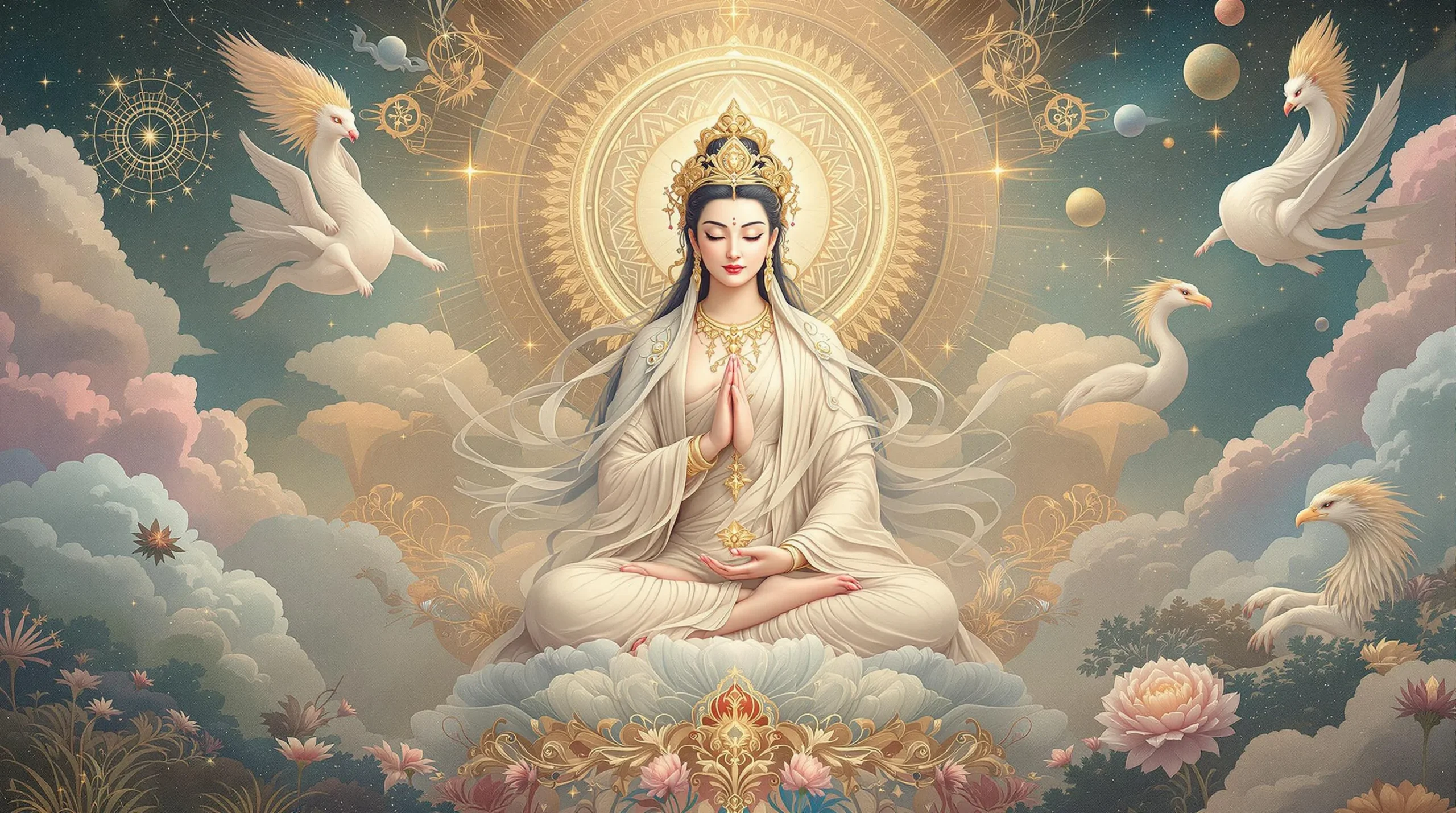


Guanyin

Archetype Meaning & Symbolism

Compassionate, listening, patient, fluid, merciful, enduring, silent, observant, all-seeing, formless

  • The most profound prayer is not spoken, but heard. Listen to the world's suffering, and you will find your own voice has always been the answer.

If Guanyin is part of your personal mythology, you may...

Believe

  • You may believe that every cry for help, whether spoken aloud or buried in silence, is a sacred text that deserves to be read with full attention.

    You may believe that true power lies not in forceful action but in the unwavering ability to be present with suffering, your own and others'.

    You may believe that stillness is a dynamic force and that listening is one of the most profound forms of creation, as it allows new possibilities to emerge from the space you hold.

Fear

  • You may fear becoming deaf to the sorrows of the world, that your heart will calcify and you will lose the very quality that defines you.

    You may fear that your compassion is a finite well that will one day run dry, leaving you empty and unable to answer the calls you hear.

    You may fear that in holding the pain of others, you will dissolve completely, losing your own identity in a sea of collective suffering.

Strength

  • You likely possess a seemingly limitless capacity for empathy, allowing you to form genuine connections with people from all walks of life.

    You may have an immense reserve of patience, an ability to remain centered and calm in emotionally turbulent or chaotic situations that would overwhelm others.

    You often have the ability to create a palpable sense of peace and psychological safety for others, sometimes simply through your quiet, non-judgmental presence.

Weakness

  • You may have a pronounced tendency toward self-neglect, consistently prioritizing the needs of others to the detriment of your own physical and emotional health.

    You could struggle with setting and enforcing healthy boundaries, which may lead to emotional burnout and being taken advantage of by others.

    Your default mode of gentle passivity might be misinterpreted as weakness or indecisiveness, and it may be ineffective in situations that require immediate, assertive action.

The Symbolism & Meaning of Guanyin

In the architecture of a modern personal myth, Guanyin may no longer be a deity on a distant altar but an active principle within the self. She represents a radical empathy that transcends mere sympathy. It is the capacity to not just feel for another, but to feel with them, to hold their suffering without judgment or the frantic need to 'fix' it. Guanyin’s symbolism is one of profound receptivity. The willow branch she carries suggests a flexibility, the ability to bend without breaking in the face of life's harsh winds. The water she pours is a cleansing agent for the soul, suggesting that compassion has the power to wash away the grime of resentment, bitterness, and trauma, both for the giver and the receiver.

Her fluidity is perhaps her most potent modern symbol. In a world that often demands rigid identities and clear allegiances, Guanyin’s ability to manifest in any form necessary—male, female, or otherwise—speaks to a psychological and spiritual adaptability. For the individual, this could translate into a release from the prison of a fixed persona. One is not just a 'professional,' a 'parent,' or a 'partner,' but a fluid consciousness that can adopt the form needed for the moment. This archetype suggests that our true nature is not a static thing to be discovered, but a dynamic potential for connection to be expressed.

The 'Cries of the World' she hears are no longer just the pleas of ancient mariners or farmers, but the quiet desperation of a colleague in a Zoom call, the unexpressed grief of a family member, the systemic suffering embedded in a news headline. To build a mythos around Guanyin is to tune one's inner ear to these subtle frequencies. It is to accept that the most heroic act one can perform may not be a grand gesture of conquest, but the quiet, revolutionary act of truly listening to another person's pain and reflecting their humanity back to them.


Guanyin Relationships With Other Archetypes

The Wounded Healer

The Guanyin's compassion may not be the sterile, unblemished grace of a being who has never known pain, but rather the luminous, transfigured empathy of the Wounded Healer. Her mercy could be seen as a pearl, formed layer by patient layer around the grit of universal suffering. In this way, the archetype does not offer a platitude from a distant shore, but a quiet understanding from the water itself. The Wounded Healer knows the precise architecture of a broken heart because their own has been meticulously reassembled. Their scars, perhaps, become a kind of braille through which they can read another's sorrow. The Guanyin’s relationship with this archetype suggests that the deepest well of compassion is dug by the sharp spade of personal ordeal, and the water drawn from it is all the more sacred for the darkness from which it came.

The Storm

In the face of the Storm—that archetype of pure, untamed chaos, of grief’s gale and anger’s thunder—the Guanyin is not the wall that breaks the wind, but perhaps the deep-rooted willow that bends with it. She does not promise to still the tempest, an act of hubris against the nature of existence, but instead offers to be the silent, unshakable eye of the hurricane. Her presence suggests that peace is not contingent upon the absence of turmoil. One might say her relationship with the Storm is a dance of profound acceptance; she is the ship's ballast, allowing the soul to navigate the highest waves without capsizing. The Guanyin archetype, then, could be a testament to a resilience found not in opposition to life’s fury, but in the cultivation of a quiet center that holds steady while the world rages on.

The Still Lake

The Guanyin may share her deepest resonance with the archetype of the Still Lake, a body of water whose defining quality is its capacity for perfect reflection. She who "Hears the Cries of the World" is, in essence, a vast and silent surface upon which the most turbulent skies—the fleeting clouds of joy, the heavy weather of despair—can be rendered with perfect fidelity, yet without disturbing the water's own profound quiet. This relationship is not one of action, but of being. The Still Lake does not judge the reflection, nor does it try to change it; it simply holds it. In a world that clamors for reaction and response, the Guanyin’s mirroring presence could be the ultimate act of grace, offering a space where a being can finally see themselves, complete and unadorned, in the compassionate gaze of another.

Using Guanyin in Every Day Life

Navigating Interpersonal Conflict

Instead of arming yourself with arguments, you might choose to embody the listener. You don't absorb the anger directed at you; you hold it, like Guanyin's vase holds water, allowing the other person's turbulent emotions to settle into clarity. Your silence is not concession but a space for truth to emerge, disarming aggression not with force, but with the quiet power of being truly seen and heard.

Processing Personal Failure

When faced with a deep personal or professional setback, the Guanyin archetype offers a path of self-compassion. Rather than self-flagellation, you might turn your thousand eyes inward, looking upon your own pain with the same mercy you would offer a stranger. You anoint the wound with acceptance, understanding that this failure is but one cry in a universe of suffering, and your gentle attention to it is a form of healing.

Finding Calm in Overwhelm

In moments of profound anxiety, when the world feels like a cacophony of demands and disasters, this mythos provides a focal point of stillness. You may visualize yourself as the serene figure on the lotus, untouched by the muddy waters below. The endless to-do list, the barrage of bad news: these are merely sounds. By focusing on the singular act of compassionate presence, for yourself or another, you find your center and the chaos recedes to a manageable hum.

Guanyin is Known For

The Bodhisattva of Compassion

Her defining vow is to remain in the worldly realm, postponing her own final enlightenment until all sentient beings have been liberated from suffering. She is the ultimate listener to the cries of the world.

The Thousand Arms and Eyes

These represent her omnipresent ability to witness suffering in its countless forms and her boundless capacity to offer aid. Each hand may hold a different symbolic instrument, ready for any specific need.

The Vase of Pure Water

She often carries a sacred vase containing the dew of compassion. This water has the power to purify defilements, heal the sick, and grant peace, symbolizing the restorative power of unconditional love.

How Guanyin Might Affect Your Personal Mythology

How Guanyin Might Affect Your Mythos

When Guanyin becomes a central figure in one’s personal mythos, the entire narrative structure of a life may shift. The story is no longer a linear 'hero’s journey' defined by dragons slain, treasures won, and territories conquered. Instead, the mythos might become a spiral, or a web. The key events, the narrative tentpoles, are not moments of personal triumph but moments of profound connection and alleviated suffering. Your life story may be chronicled not by your promotions, but by the times you were a safe harbor for a friend in a storm; not by your acquisitions, but by the burdens you helped others lay down.

This archetype reframes the protagonist. You are not the warrior, but the witness. Not the king, but the quiet counselor in the corner of the throne room whose wisdom is sought when all else fails. Your personal myth might be filled with characters who are not villains to be vanquished, but suffering souls to be understood. The central conflict of your story could be internal: the struggle to keep the heart open in a world that seems to reward cynicism, to maintain the flow of compassion without being drowned by the sorrow you witness. Your epic is one of an ever-deepening capacity for presence.

How Guanyin Might Affect Your Sense of Self

Incorporating the Guanyin archetype may profoundly alter one's sense of self, dissolving the ego's rigid boundaries. The self is perceived less as a fortress to be defended and more as a vessel to be filled. Self-worth is not tethered to achievement or external validation but to the depth of one's capacity for compassion. There may be a feeling of being a conduit, a channel through which a larger, universal mercy can flow. This could foster a deep and abiding inner peace, a quiet confidence that is not easily shaken by criticism or failure, as the 'I' is no longer the central character in the drama.

This perspective might also engender a sense of fluid identity. Like Guanyin, who appears in whatever form is needed, you may feel less attached to a specific gender, role, or personality. The self becomes a versatile instrument of compassion. This can be liberating, freeing you from the pressure to perform a consistent persona. However, it may also lead to a sense of porousness, where the line between your own emotions and the emotions of others becomes blurred, requiring conscious effort to remain grounded and not lose oneself in the currents of collective feeling.

How Guanyin Might Affect Your Beliefs About The World

With Guanyin as a guide, one’s worldview may transform from a competitive arena into a sacred space of interconnected suffering and potential healing. The world is not a collection of objects and adversaries, but a chorus of sentient beings, each with their own story of struggle and longing. This perspective does not necessarily ignore the world's harshness and injustice; rather, it sees these as 'cries' that call for a compassionate response, not a combative one. It fosters a belief that no situation is beyond hope, because the act of bearing witness is, in itself, a powerful form of intervention.

This worldview could cultivate a kind of radical patience. Social and personal problems are not seen as equations to be solved quickly, but as deep wounds that require slow, gentle, and persistent care. There is a trust in the process of unfolding, a belief that the right conditions for healing can be created through stillness and presence. The measure of a society's health, from this viewpoint, is not its GDP or military might, but its capacity to attend to its most vulnerable members. It is a worldview that finds power not in dominance, but in tenderness.

How Guanyin Might Affect Your Relationships

In relationships, the Guanyin mythos prioritizes presence over performance. Your role may become that of the deep listener, the one who can hear the unspoken feelings beneath a loved one’s words. You might create an atmosphere of unconditional acceptance where others feel safe to be their most vulnerable selves. This can lead to relationships of extraordinary depth and intimacy. The goal is not to fix, advise, or rescue, but to simply 'be with,' offering the powerful medicine of non-judgmental witnessing. Your connections are less about shared hobbies and more about a shared understanding of the human condition.

However, this relational stance carries its own challenges. You may become a magnet for those who are emotionally draining, who see your compassion not as a gift but as an infinite resource to be consumed. The line between compassion and enabling can become dangerously thin. The primary work becomes learning to embody Guanyin's serenity as well as her mercy: to maintain your own center, to keep your own vase full, and to discern when compassionate withdrawal is the most loving act of all. It requires the wisdom to know that you cannot pour from an empty vessel.

How Guanyin Might Affect Your Role in Life

Adopting the Guanyin archetype may redefine one’s perceived role in life, shifting it from actor to atmosphere. Your purpose is not necessarily to 'do' great things, but to 'be' a certain way: a source of calm, a point of stillness in a turbulent world. This role may not come with a title or a salary, yet it is a profound vocation. You could be the family member who diffuses tension, the coworker who listens without judgment, the neighbor whose quiet presence is a comfort. Your function is to create sacred space wherever you are, allowing healing and understanding to occur organically.

The role is characterized by a gravitational pull rather than a forward thrust. People may be drawn to you not for what you can offer them materially, but for the quality of your attention. This is the role of the Bodhisattva, who chooses to remain engaged with the world's messiness out of love. Your life's work may be largely invisible, a quiet ministry of presence whose effects are felt but not always seen. It is the vital role of the anchor, which does its work beneath the surface, holding the ship steady amidst the waves.

Dream Interpretation of Guanyin

To dream of Guanyin in a state of serene and benevolent presence could be a powerful affirmation from the subconscious. It may signify that you are successfully integrating the qualities of compassion and mercy into your life. The dream might be an encouragement to trust your intuition, to continue listening deeply to yourself and others, and to recognize the profound inner resources for peace that you possess. Her appearance, perhaps offering you water from her vase or simply gazing at you with kindness, may signal a period of emotional or spiritual healing, a washing away of old griefs, and an awakening to a deeper sense of purpose rooted in connection.

A troubled dream of Guanyin—seeing her weeping, turning away, shattered, or with her thousand arms tangled and helpless—could serve as a potent warning. This may reflect a state of compassion fatigue or emotional burnout, a sign that your empathy is being exploited or that you have neglected your own well-being in the service of others. It could also suggest a hardening of your own heart, that you have become deaf to the 'cries of the world' and, most importantly, to your own suffering. Such a dream is not a condemnation, but an urgent call to turn your compassion inward, to replenish your own spirit, and to examine whether your mercy has become a form of martyrdom.

How Guanyin Archetype Might Affect Your Needs

How Guanyin Might Affect Your Physiological Needs

From the standpoint of personal mythology, the Guanyin archetype could reshape one's relationship with the body and its fundamental needs. There may be a deep-seated trust that, through quiet attunement rather than frantic striving, one's basic needs for sustenance and rest will be met. This is not a passive waiting, but an active listening to the body's signals and a faith in the universe's reciprocal generosity. One might eat more mindfully, sleep more gratefully, seeing these acts not as mere biological functions but as ways of honoring the physical vessel that allows for compassionate action in the world.

Conversely, a strong identification with this archetype may lead to a transcendental neglect of physiological needs. The body can be viewed as secondary, a mere vehicle for the more important work of alleviating the suffering of others. In the drive to answer every cry for help, one might forget their own body's cries for food, water, or sleep. This self-abnegation, while appearing virtuous, ultimately depletes the very resource of vitality needed to practice compassion sustainably. The mythos then demands a difficult lesson: caring for the self is not selfish, but a prerequisite for caring for others.

How Guanyin Might Affect Your Ideas of Belonging

The Guanyin archetype provides a solution to the need for belonging that is both radical and all-encompassing. Belonging is not found by joining an exclusive group or tribe, but by realizing one's intrinsic connection to all of existence. The sense of family expands to include all sentient beings, and kinship is forged not through shared backgrounds, but through the shared experience of suffering and joy. This perspective dissolves loneliness at its root, for how can one be lonely when the cries of the entire world are a constant companion, a constant call to connection?

This universal belonging fosters a love that is unconditional and boundless. Relationships are not based on what one can get, but on what one can give: the gift of presence and understanding. It can create a profound sense of being 'at home' in the universe. The risk, however, is a feeling of being connected to everything and yet intimate with no one. The love can become so diffuse, so universal, that it lacks the specific, focused attachment that characterizes deep personal bonds. The work is to learn how to be a Bodhisattva for all while still being a present, grounded partner, parent, or friend to the few.

How Guanyin Might Affect Your Feelings of Safety

Within the Guanyin mythos, safety is not found in fortification but in radical openness. True security is not a matter of locks, alarms, or defensive postures, but an internal state of peace that cannot be fundamentally threatened by external events. It is the safety of water, which yields to any blow and remains unbroken. This perspective may allow an individual to navigate potentially dangerous or volatile situations with a disarming calm, meeting aggression not with counter-aggression, but with an unexpected and often confusing empathy that disrupts the cycle of conflict.

This approach redefines security as a psychological and spiritual condition. The belief may be that by emptying oneself of fear and defensiveness, one becomes a less compelling target for hostility. You are safe because you have nothing to defend. This can be a source of immense strength and courage, allowing one to enter spaces of conflict as a peacemaker. The potential peril, however, is a naivete regarding genuine threats, a vulnerability that comes from assuming all 'cries' are honest pleas rather than manipulative tactics. The challenge is to pair the open heart with the thousand eyes of discernment.

How Guanyin Might Affect Your Views of Esteem

Esteem, when viewed through the lens of Guanyin, is entirely decoupled from the metrics of the external world. Accolades, status, wealth, and power become irrelevant. Self-worth is cultivated internally, measured by the sincerity of one's compassion and the depth of one's listening. It is the quiet, unshakable esteem of the vessel, which finds its value not in its ornamentation, but in its capacity to hold what is given. This fosters a profound and stable sense of self that is immune to both praise and criticism.

This form of esteem is deeply private and often invisible to others. A person with this mythos may appear humble or even lacking in ambition by conventional standards, yet possess a powerful inner core of self-respect. Their greatest achievements are silent: a moment of conflict averted through patience, a quiet word that heals a hidden wound, the ability to sit with another's despair without flinching. The challenge is living in a world that rarely recognizes or rewards this form of value, requiring a steadfast commitment to one's own internal compass of worth.

Shadow of Guanyin

When the Guanyin archetype falls into shadow, it curdles into a form of passive tyranny. The compassionate listener becomes the 'suffering sponge,' pathologically absorbing the pain of others until it becomes a toxic identity. This can manifest as a subtle martyrdom complex, where one's goodness is measured by one's proximity to suffering, creating a codependent need for others to be in crisis. The self becomes a black hole of empathy, drawing in others' pain not to heal it, but to feed its own sense of purpose. This shadow figure weaponizes their gentleness, using silent disappointment and displays of pained endurance to manipulate others, making them feel guilty, crude, or unenlightened by comparison.

The other facet of the shadow is a profound and crippling passivity. It is the belief that any assertive action, any boundary, any 'no,' is a violation of the compassionate ideal. This can lead to a complete abdication of personal responsibility, allowing harm to occur under the guise of non-interference. It becomes a bystander's spirituality. In this state, the thousand-armed Bodhisattva becomes paralyzed, witnessing suffering but doing nothing, mistaking inaction for peace and powerlessness for enlightenment. The pure water of compassion becomes stagnant, a breeding ground for resentment and unspoken bitterness.

Pros & Cons of Guanyin in Your Mythology

Pros

  • You cultivate exceptionally deep and meaningful relationships, as people feel truly seen, heard, and accepted in your presence.

    You possess a resilient inner peace and a quiet strength that allows you to navigate life's challenges with grace and composure.

    You have a clear and unwavering sense of purpose that is not dependent on external validation, rooted in the meaningful work of alleviating suffering and fostering connection.

Cons

  • You are highly susceptible to emotional burnout, compassion fatigue, and absorbing the trauma of those you seek to help.

    You may find it extremely difficult to advocate for your own needs, set boundaries, or take decisive, assertive action when required.

    Your empathetic nature can make you a target for emotionally manipulative or parasitic individuals who see your kindness as a resource to be exploited.