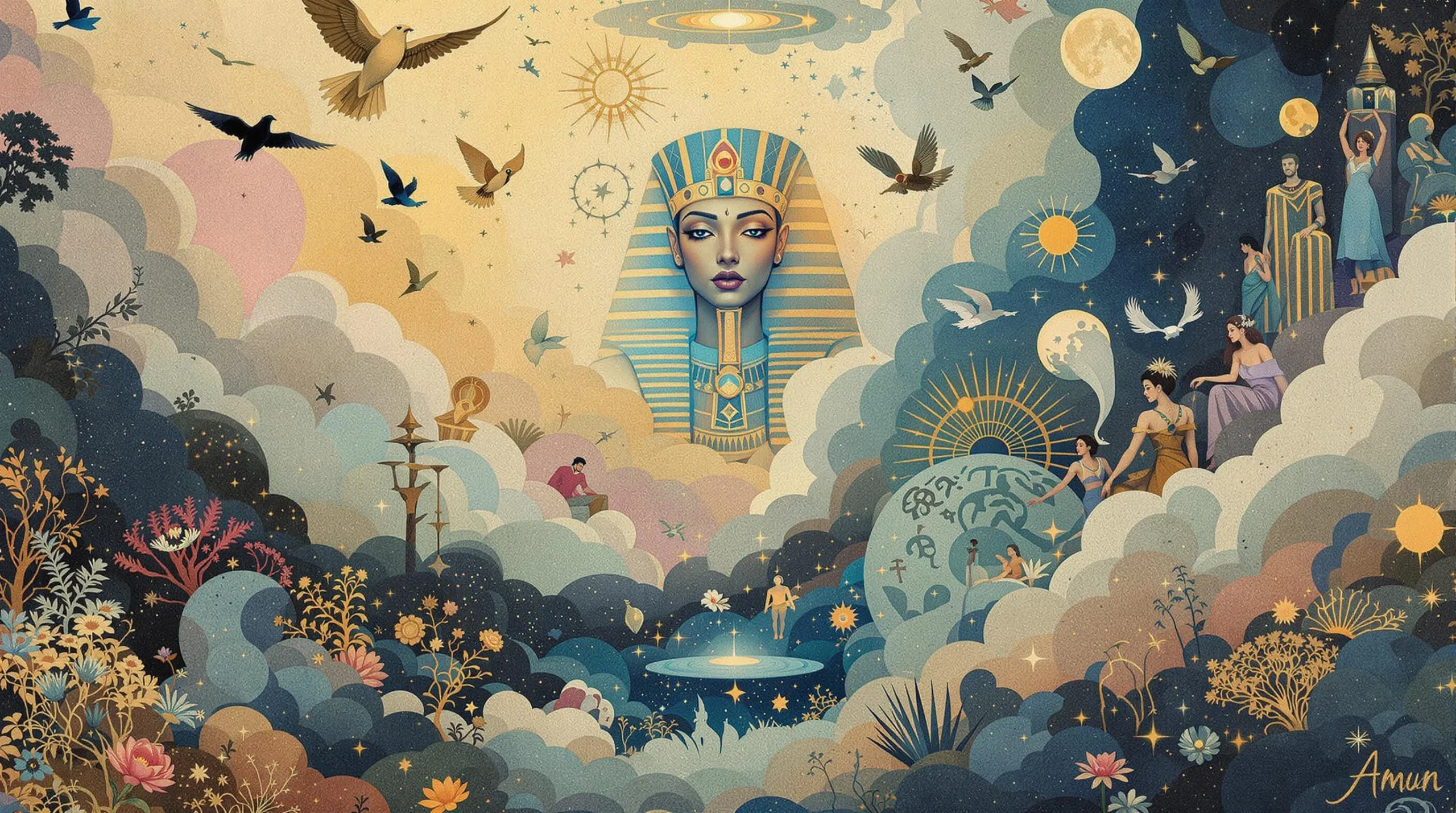


Amun

Archetype Meaning & Symbolism

Unseen, Primordial, Creative, Hidden, Sovereign, Silent, Comprehensive, Transcendent, Elusive, Fertile

  • The universe whispers its secrets not to those who shout, but to those who learn the language of the wind.

If Amun is part of your personal mythology, you may...

Believe

  • The most powerful and creative forces in the universe are, by their nature, unseen and silent.
  • True identity is not a fixed thing to be performed, but a mysterious presence to be discovered within.
  • Silence is not an emptiness to be feared, but a fertile space filled with potential and wisdom.

Fear

  • A deep-seated fear that your true, inner self will never be fully perceived or understood by another person.
  • The terror that being 'unseen' by the world ultimately means you are insignificant or that you do not truly exist.
  • A suspicion that the hidden forces guiding the universe, and your own life, are not benevolent but are indifferent, chaotic, or manipulative.

Strength

  • An unshakable inner composure. You possess a profound internal stability that is not easily disturbed by external chaos or drama.
  • A visionary's perception. You have the ability to see the latent potential in people, ideas, and situations that others dismiss or overlook.
  • A masterful sense of timing. Guided by a deep intuition, you know when to wait in stillness and when to make a subtle, decisive move for maximum impact.

Weakness

  • A tendency toward passivity. You may wait for an intuitive sign or a perfect moment that never comes, when bold, decisive action is what is required.
  • An aura of aloofness. Your comfort with silence and your hidden inner world can make you appear distant, secretive, or unapproachable to others, leading to unintended isolation.
  • A difficulty with self-advocacy. You may struggle to articulate your needs, desires, or accomplishments, operating under the assumption that your value and contributions should be self-evident to everyone.

The Symbolism & Meaning of Amun

In the modern psyche, Amun is the archetype of pure potentiality. He is the quiet hum of electricity in the walls, the vast, dark matter that holds galaxies together, the pregnant silence between two thoughts. To have Amun in your personal mythology is to acknowledge the source code of reality, the unseen architecture upon which your life is built. He is not a god who acts upon the world in overt ways: he is the set of conditions that allows action to be possible. He is the blank canvas, the uncarved block of marble, representing the profound truth that everything that is was once a silent, hidden possibility.

The archetype of Amun champions the power of invisibility in an age obsessed with personal branding and perpetual visibility. He suggests that true influence is not loud but subtle, not overt but foundational. It is the quiet work done behind the scenes, the anonymous act of kindness, the idea planted in a conversation that blossoms years later. For one whose mythos contains Amun, power may be found in what is not said, in the strategic retreat, in the wisdom of being underestimated. It is a quiet sovereignty, a confidence that requires no external validation because it is rooted in the very fabric of being.

Amun’s famous syncretism with the sun god Ra speaks to a sophisticated psychological process: the integration of one’s hidden self with one’s manifest self. Amun is the deep, interior world of dreams, intuition, and unspoken truth, while Ra is the bright, active, conscious self that engages with the world. To be Amun-Ra is to achieve a wholeness where your actions in the light are perfectly aligned with the truth of your hidden depths. It is the ultimate synthesis of being and doing, a state where the inner god and the outer king are one and the same.


Amun Relationships With Other Archetypes

The Wind

The Wind may be the most intimate correlate to The Amun, less a separate entity and more a direct, albeit formless, expression. It is, perhaps, the breath of the hidden, the sound of absence given a voice that can stir the sea or whisper through a keyhole. One does not see The Wind, only its work: the worried leaves, the sculpted dune, the sail that bellies with purpose. In this way, The Wind could be seen as The Amun’s engagement with the material world—a power that possesses no body of its own, but borrows the forms of everything it touches, leaving behind the irrefutable evidence of an invisible passage. It is the caress or the fury of a force that refuses to be named, yet insists on being felt.

The Mask

With The Mask, The Amun finds a curious and perhaps necessary partner. If The Amun is the infinite, unseeable self, The Mask is the finite face presented to the world—a single, curated truth carved from an endless mystery. This relationship may not be one of deception, but of concession. The Mask could be the only way The Amun’s vastness can enter into dialogue with the specific; it is a ritual object that contains and channels a presence that might otherwise dissipate. It is the persona, the role, the quiet agreement to be, for a time, just one thing. In this, The Mask is not a lie, but a poem—a condensed and beautiful form that hints at the untranslatable epic from which it was born.

The Echo

The Echo could be understood as the memory of The Amun’s touch upon the world. It is a presence defined by its own departure, a sound that proves a source by proclaiming its emptiness. Where a direct statement is a confrontation, The Echo is a resonance, a secondary vibration that carries the truth of the initial act through time and space, often altering it in its journey. The Amun’s power, then, might not lie in the first shout, but in the final, fading reply that haunts a canyon or a culture for generations. It is the lingering scent in a vacant room, the ghost of a feeling, the consequence that arrives long after its cause has dissolved back into the hidden whole.

Using Amun in Every Day Life

Navigating Uncertainty

When the path forward is obscured, the Amun archetype allows you to trust the process that you cannot yet see. It is the faith that a seed is germinating in the dark soil, that the intricate threads of your life are being woven by a hidden hand. You may find comfort in not knowing, allowing the narrative to reveal itself in its own time, rather than trying to force a premature conclusion. This is the art of inhabiting the question, of finding a home in mystery.

Overcoming Creative Blocks

To have Amun in your personal mythology is to have direct access to the great void of creation itself. When faced with a blank page or an empty canvas, you might not feel terror but a sense of homecoming. You could tap into this archetype by cultivating silence, by allowing your mind to empty. The ideas do not come from you: they emerge from the fertile nothingness that Amun represents, the silent, primordial hum from which all forms arise.

Countering Feelings of Insignificance

In a world that prizes the visible and the loud, it is easy to feel small. The Amun archetype offers a powerful antidote. It suggests your true significance is not in your public persona but in your connection to the vast, unseen totality of existence. Your quiet influence, your unspoken integrity, your hidden potential: these are your true measures. You are not a single, isolated note, but a crucial, resonant chord in the silent music of the cosmos.

Amun is Known For

The Hidden One

His name's very meaning, reflecting the core of his being as the god of unseen forces, the wind, and the air. He is the mysterious potential that exists before and within all creation.

Syncretism with Ra

The merging into Amun-Ra, a transcendent and all-encompassing solar creator deity who represented the union of the seen (Ra, the sun) and the unseen (Amun, the hidden). This established him as the supreme king of the gods in the Egyptian pantheon.

The Oracle of Siwa

A famously powerful and respected oracle in the Libyan desert. Its most noted consultation was by Alexander the Great, who was reputedly declared the son of Amun, confirming his divine right to rule.

How Amun Might Affect Your Personal Mythology

How Amun Might Affect Your Mythos

If Amun is a character in your personal story, your life may not read like a hero’s journey but more like a mystical text, a slow revelation. The plot advances not through a series of escalating conflicts but through the gradual unveiling of what was true all along. Major turning points might feel less like choices you made and more like moments of profound seeing, where the invisible pattern of your life suddenly becomes clear. Your mythos is not about becoming something new, but about realizing the potent, hidden self that has been directing the story from behind the curtain since the beginning.

Your narrative might be defined by a sense of a 'hidden hand' or a benevolent, guiding conspiracy. You may interpret serendipity not as random chance but as a whisper from the deep structure of your own story, a nudge from the unseen author. The greatest adventures in your mythos are perhaps internal: journeys into the vast, quiet spaces within, seeking not a treasure to be won but a presence to be known. Your legend is written in invisible ink, legible only to those, including yourself, who have learned to see beyond the surface of events.

How Amun Might Affect Your Sense of Self

Your concept of self may be rooted not in your personality, your achievements, or your relationships, but in a silent, formless core of being. This is the 'I' that exists before thought, before emotion, before action. It is a vast, quiet space within, a wellspring of potential. You might feel that your true identity is this hidden presence, and that everything else—your name, your job, your body—is a temporary manifestation, a costume worn by this eternal, unseen self. This could grant you a profound sense of stability, as your essence is not tied to the fluctuating fortunes of the external world.

This may also lead to a self-perception that is fluid and elusive. You might resist being defined or categorized, feeling that any label is a reduction of your true, comprehensive nature. This can be a source of quiet strength and freedom. However, it may also create a challenge in articulating who you are to others, or even to yourself. You might feel most yourself not when you are expressing, but when you are simply being: a silent observer, a conduit for a presence larger than your individual personality.

How Amun Might Affect Your Beliefs About The World

You may perceive the world not as a collection of inert objects but as a living, breathing mystery animated by invisible forces. You see the patterns beneath the chaos, the silence that holds the noise, the intricate web of connections that binds everything together. Cause and effect might seem less like a game of billiards and more like the subtle, unpredictable currents of the wind. Reality is a revelation, a continuous act of creation emerging from an unseen source.

This worldview could cultivate a deep sense of reverence for the unknown. You might not feel the need to solve every puzzle or explain every phenomenon. Meaning is found not just in answers, but in the richness of the questions themselves. The world is a temple, and its holiest sanctuaries are the empty spaces, the dark corners, the phenomena that defy easy explanation. Truth is not something to be conquered and possessed, but a vast presence to be approached with humility and awe.

How Amun Might Affect Your Relationships

In relationships, you may value unspoken understanding above all else. The deepest bonds, for you, are forged in shared silence, in the comfortable quiet that says more than words ever could. You might feel closest to someone when you can perceive their inner state without them having to articulate it. Love, in this context, is a resonance between two hidden selves, a recognition of another's deep, silent core. The space between two people is not an emptiness to be filled, but a sacred field of connection.

This can make you a profoundly accepting and non-judgmental partner or friend. You are able to see beyond a person's surface-level flaws or persona to the potential that lies hidden within. However, your preference for subtlety and quiet communion might also make you seem distant, aloof, or difficult to know. You might struggle with partners who require constant verbal affirmation, as you believe the truest connection is self-evident and requires no announcement.

How Amun Might Affect Your Role in Life

Your perceived role in life might not be the protagonist in the spotlight but the quiet power behind the throne, the éminence grise. You may find satisfaction in creating the conditions for others to succeed, in setting the stage and arranging the elements so that magic can happen. Your contribution is foundational, like the architect who designs a beautiful space but is not present when it is inhabited. You understand that the source of the river is as important as the river itself.

You could see yourself as a guardian of potential. In your family, community, or workplace, you might be the one who nurtures fragile beginnings, protects nascent ideas, and holds a space of quiet possibility until others are ready to step into it. Your role is not to lead the charge but to ensure the ground is fertile. You are the keeper of the silence that allows the new and the vital to emerge, a steward of the unseen.

Dream Interpretation of Amun

To dream of an invisible yet benevolent presence, or to find yourself in a vast, peaceful, and empty space, could be a powerful affirmation from the Amun archetype. It may suggest that you are in alignment with your deepest, most authentic self. The dream could be a message to trust the unseen processes at work in your life, to have faith in the unfolding of your destiny even if the path is not clear. It might be an invitation to embrace a period of quiet contemplation, to retreat from the noise of the world and connect with your inner wellspring of creativity and potential.

Conversely, a dream of a menacing invisibility, of being watched by an unseen entity, or of feeling lost in a suffocating void could signal the shadow aspect of Amun. This might reflect a fear of the unknown aspects of yourself, a sense of being controlled by hidden motives, either your own or others'. It could also point to a dangerous level of detachment from the world, where your 'hiddenness' has become a form of isolation and your inner void has turned from creative potential into a nihilistic emptiness. The dream may be a warning that you have become a ghost in your own life, and a call to become more present and visible.

How Amun Archetype Might Affect Your Needs

How Amun Might Affect Your Physiological Needs

The Amun mythos may foster a profound appreciation for the body's silent, autonomous wisdom. Your physiological well-being could be linked to honoring these unseen processes. The simple, rhythmic act of breathing might become a meditative practice, a direct connection to the invisible air that sustains you. You may find a deep sense of security in the steady, quiet beat of your heart, recognizing it as the engine of your physical existence, running silently in the background.

Nourishment could be understood as more than just food: it is also the quiet and stillness required for the body to do its work. You might prioritize rest not as mere inactivity, but as a sacred state in which the body’s hidden intelligence can repair, regenerate, and balance itself. The quality of the air you breathe, the silence in your environment, the peace in your nervous system: these invisible factors may be considered as crucial to your health as any tangible substance.

How Amun Might Affect Your Ideas of Belonging

Your need for belonging may be fulfilled not by joining a specific club or identifying with a visible social group, but by feeling a connection to a larger, unseen order. You might feel a profound kinship with the totality of nature, the collective unconscious, or a spiritual tradition that emphasizes transcendence. Your 'tribe' might be formless, composed of all beings who recognize the hidden unity behind diverse forms. You belong to the mystery itself.

In intimate relationships, this need is met through a deep, unspoken rapport. You feel you belong with someone when you can share a space in comfortable silence, when your inner worlds seem to resonate without the need for constant mediation through language. Love is a secret garden, a shared universe that is invisible to the outside world. Belonging is not about being seen with someone, but about feeling 'seen' at the deepest, most hidden level of your being.

How Amun Might Affect Your Feelings of Safety

For you, safety may be found not in fortified walls or visible alarms, but in a state of strategic obscurity. You might feel most secure when you are unassuming, able to move through the world without attracting undue attention. True safety is not about building a fortress but about becoming like the wind, present but unseen. It's the security of being underestimated, of holding your most valuable assets in a place no one would think to look: your own quiet, inner world.

This can also manifest as a deep reliance on intuition as a primary security system. You might trust the subtle, non-verbal cues from your environment, the quiet 'knowing' that warns of danger or signals trustworthiness. Your safety net is woven from invisible threads of awareness. You listen for the silence that precedes a threat, and you trust the gut feeling that arises from the hidden depths of your consciousness, a direct line to the protective aspect of the Amun archetype.

How Amun Might Affect Your Views of Esteem

Your self-esteem is likely not built on a foundation of external achievements, praise, or social status. These things are seen as fleeting and superficial. Instead, your esteem arises from a quiet, internal connection to your own intrinsic worth. It is a private confidence, a self-respect that is independent of the world's fluctuating opinions. You know your value because you are in touch with the vast, creative potential within you, the hidden god that is your true self.

You might measure your accomplishments not by their visibility but by their foundational impact. Esteem is earned by being a good steward of your own potential and by creating the conditions for potential to flourish in the world around you. Did you plant a seed that will grow into a mighty tree long after you are gone? Did you provide the silent, stable presence that allowed someone else to find their voice? Your sense of worth comes from being a worthy, if unseen, co-creator of reality.

Shadow of Amun

The shadow of Amun manifests as a tyranny of the unseen. It is the puppet master who delights in control without accountability, the manipulative actor who operates from behind a curtain of plausible deniability. This shadow expresses itself as chronic passive-aggression, as secrets that become toxic and corrosive, or as a refusal to be truly known that serves as a form of profound arrogance. The hidden self ceases to be a sacred source of potential and becomes a fortified bunker from which to judge, control, and influence the world without ever risking vulnerability or facing consequences. It is power without presence, influence without integrity.

Another facet of the shadow is a complete abdication of self, a fading into non-existence. Here, the archetype's hiddenness is twisted into a pathology of invisibility. It is the person who becomes a ghost in their own life, so detached and observant that they never participate. This is not enlightened transcendence but a profound fear of engagement, a spiritual bypass where one claims to be above the messy fray of life. The creative void of Amun becomes a nihilistic emptiness. Potential is hoarded but never spent, and life is witnessed rather than lived, resulting in a quiet, hollow despair.

Pros & Cons of Amun in Your Mythology

Pros

  • You possess a deep well of inner resilience, allowing you to remain centered and calm amidst external turmoil and public opinion.
  • You are a natural strategist, capable of perceiving underlying currents and patterns that others miss, enabling you to act with subtle and effective precision.
  • Your calming, non-judgmental presence creates a safe space for others, encouraging them to lower their own defenses and reveal their authentic selves.

Cons

  • You may find it difficult to make your accomplishments and needs visible, often leading to being overlooked, undervalued, or misunderstood in personal and professional settings.
  • Your natural inclination towards subtlety and indirectness can be perceived by others as evasiveness, secretiveness, or a lack of straightforwardness.
  • You might risk becoming overly detached from the tangible, embodied world, preferring the clean, idealized realm of your inner life to the messy reality of human relationships and responsibilities.