Believe
 Fear
Fear Strength
 Weakness
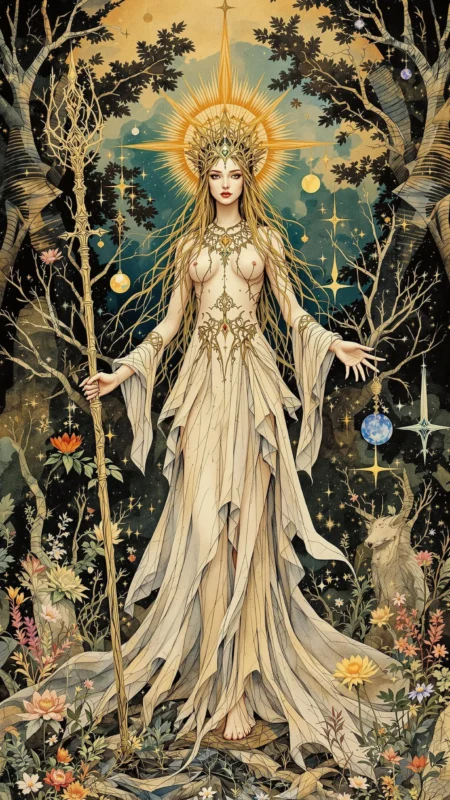
The modern resonance of Brigid is not confined to the pastoral landscapes of her origin; she lives now in the flicker of the cursor on a blank page, the sterile fire of a surgeon's laser, the focused heat of a protestor's righteous anger. She is the archetype of skilled transformation. Brigid represents the point of contact between raw potential and intentional craft. She is the alchemical force that believes no material is without possibility: silence can be woven into a poem, trauma can be forged into resilience, disparate individuals can be melded into a community. In your personal mythology, she may be the patron of your specific craft, the quiet whisper that insists the thing you make, mend, or nurture is a sacred act.
Her dominion over thresholds—dawn, dusk, the shoreline, the cusp of seasons—makes her a profound guide for a life of perpetual becoming. To have Brigid in your mythos is to feel at home in the liminal. You may find significance in the spaces between things: the pause between breaths, the moment before a decision is made, the transition from one life chapter to the next. These are not voids to be rushed through but her sacred territories, where the most potent magic resides. She teaches that transformation is not a single, dramatic event, but a constant, subtle state of being, like a candle flame that is never the same from one moment to the next.
Ultimately, Brigid symbolizes a fierce and intelligent hope. It is not a passive, waiting hope, but an active, hands-on, fire-in-the-belly conviction that what is broken can be mended, what is cold can be warmed, and what is fallow can be brought to life. She is the marriage of the heart and the hands, the belief that compassion without action is a sentiment, but compassion with skill can change the world. She is the patron of the midwife, the activist, the artist, the engineer, the healer: anyone who looks upon the raw stuff of the world and sees not what it is, but what it could become with the application of fire and will.