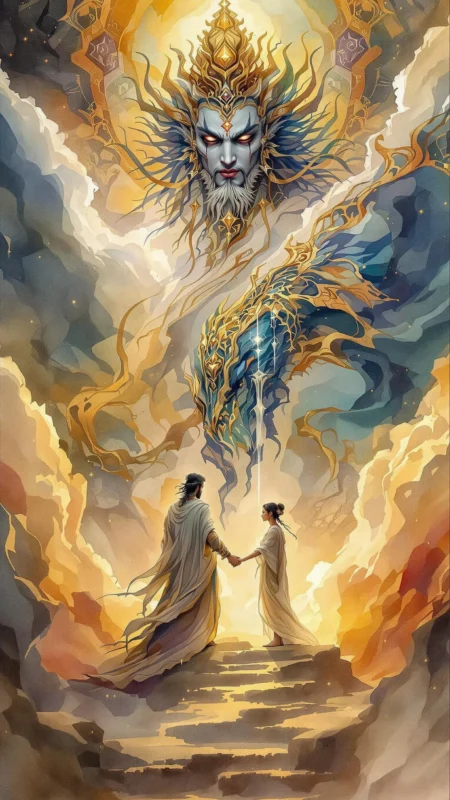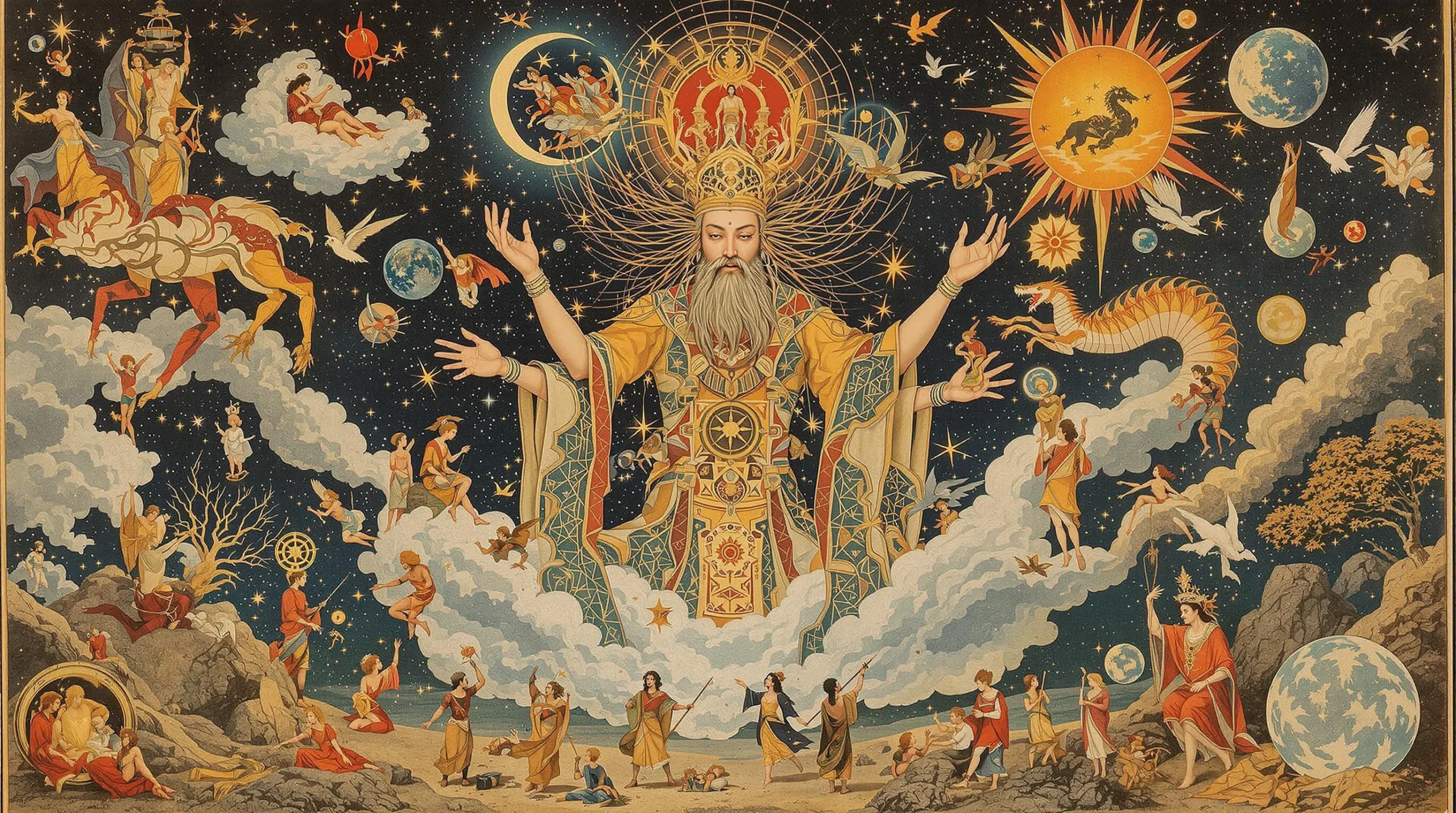


Shangdi

Archetype Meaning & Symbolism

Sovereign, ancestral, ordering, distant, just, celestial, moral, absolute, inscrutable, foundational

  • The stars do not ask for your attention to chart their course. Tend to the virtue of your own orbit, and the heavens will arrange themselves around you.

If Shangdi is part of your personal mythology, you may...

Believe

  • There is a fundamental, non-negotiable moral order to the cosmos, and my purpose is to align myself and my actions with it.
  • True authority is not seized but earned through virtue, and I have the right to govern my own life only so long as I do so with integrity.
  • My life is not an isolated event but a link in a great chain of ancestry and legacy; my actions have consequences that ripple through time.

Fear

  • Committing a moral transgression that proves me unworthy of my own 'Mandate of Heaven,' leading to a collapse of my inner world.
  • A fundamental chaos in the universe, the discovery that there is no ultimate justice or order, and that my principles are built on empty sky.
  • Being judged by a higher power—or my own conscience—and being found wanting; the shame of having failed in my sacred duty.

Strength

  • An almost unshakeable moral compass that provides clarity and resolve in complex situations.
  • The capacity to remain calm, objective, and decisive in the midst of chaos, acting as a stabilizing force for others.
  • A powerful sense of personal responsibility and the ability to build and lead systems based on principle and long-term vision.

Weakness

  • A tendency toward emotional distance and aloofness, making it difficult to connect with others on a messy, human level.
  • Rigidity and a dogmatic attachment to rules and principles, which can manifest as harsh judgment of self and others.
  • The immense pressure of perceived responsibility can lead to a fear of failure, an inability to delegate, and chronic stress.

The Symbolism & Meaning of Shangdi

In the modern psyche, Shangdi surfaces as the quiet, persistent search for a unifying principle. In an age of fractured narratives and digital noise, this archetype represents the silent, sky-like consciousness that watches above the fray. It is the part of you that believes, perhaps against all evidence, in a fundamental moral architecture to the universe. To have Shangdi in your personal mythos is to feel the weight and solace of this architecture in your own bones. You may find yourself drawn to systems, codes, and philosophies that promise a grand, organizing truth, seeing your life not as a personal improvisation but as a single, crucial note in a cosmic symphony that was composed long before your arrival.

The archetype speaks to a kind of impersonal love: a benevolent but distant regard for creation. It is the love of the gardener for the entire garden, not for a single rose. This symbolism could manifest as a profound sense of responsibility for the collective. You might feel a calling to create systems of justice, fairness, or beauty, whether in your family, your workplace, or your art. This is the impulse to build something that will outlast you, to establish an order that is so self-evidently good and true that it needs no signature. It is the quiet confidence of knowing your role is to align things correctly and then step back, allowing the inherent harmony of the universe to flow through the channels you have carved.

Ultimately, Shangdi symbolizes the seat of sovereignty within the self. It is the inner emperor, the final arbiter of your own moral conduct. This archetype suggests that true power is not imposed from without but emanates from a core of unshakeable integrity. When you consult this part of yourself, you are accessing a tribunal that is older than your own anxieties and wiser than your immediate desires. It is the source of the ‘Mandate of Heaven’ for your own life, the deep, intuitive knowledge that as long as you act with virtue and clarity, you have the right to rule the kingdom of your own being.


Shangdi Relationships With Other Archetypes

The Emperor

The Emperor may stand in relation to Shangdi as a borrowed voice to an infinite silence. He is the Son of Heaven, a title that suggests not so much a familial intimacy as a profound and precarious delegation. His throne could be seen as a stage erected in the vast, unseen coliseum of the cosmos, his every edict and ritual a performance for an audience of one, whose judgment is rendered not in applause, but in the subtle turning of fortune’s tide—a famine, a flood, a rebellion. The Emperor, in all his gilded splendor, is perhaps merely a vicarious monarch, a mortal conduit for an authority so immense it can only be expressed on Earth through an ephemeral human form. His mandate is a lease on power, held only so long as his actions align with the silent, celestial grammar of virtue, a grammar he can only ever hope to intuit, never to fully command.

The Oracle Bone

If Shangdi is the unwritten law of the universe, the Oracle Bone is the desperate attempt to coax from it a single, legible clause. It represents a frantic, fiery negotiation with a power that does not speak in human tongues. The cracks that splinter across the scorched turtle shell or ox scapula could be a kind of divine script, a momentary and cryptic revelation from a being otherwise content with its own sublime remoteness. The relationship is one of translation, where the diviner is a poet working with the most stubborn of materials—the will of the heavens. Each fissure may be a syllable of fate, a Rorschach blot onto which the anxieties of an entire dynasty are projected, a fragile bridge of heat-cracked bone thrown across the chasm between the mortal and the absolute.

The Peasant Farmer

The Peasant Farmer may have the most direct, if least acknowledged, relationship with the Shangdi archetype. While the Emperor communes through elaborate ceremony, the farmer converses with this higher order through the medium of the earth itself. His scripture is the sky; his prayers are the seeds cast upon the soil. For him, the mandate of heaven is not a political abstraction but the felt reality of a timely rain or a devastating drought. Shangdi, in this context, is the great, impersonal quiet of the seasons, a force that gives and takes with an even-handedness that borders on indifference. The farmer’s life is a testament to this power’s scope—a testament written not in ink, but in the lines of worry etched around his eyes as he scans the horizon, waiting for a verdict from the clouds.

Using Shangdi in Every Day Life

Navigating a Moral Dilemma

When faced with a choice that pits personal gain against principle, the Shangdi archetype prompts a retreat to a higher vantage point. It asks you to act not as the person who benefits or loses, but as the impartial ancestor-king who must legislate for the health of the entire kingdom: your soul. The decision becomes less about immediate desire and more about which path aligns with the enduring, cosmic law you wish to see reflected in your life.

Responding to Systemic Chaos

In times of social or political turmoil, when the world feels like a ship without a rudder, this archetype offers a personal mandate. Instead of being swept up in the maelstrom, you may focus on establishing perfect order and justice within your immediate sphere of influence. You become a small, sovereign state of reason and compassion, believing that the restoration of macrocosmic harmony begins with the unimpeachable integrity of the microcosm.

Defining Your Legacy

When contemplating your life's work, the Shangdi archetype reframes the question from “What do I want to do?” to “What order am I called to create?” Your career, your family, your art: these are not just activities but acts of governance. You are not merely building a resume; you are establishing a dynasty of values, and every action is a decree that will echo in the lives of those who come after.

Shangdi is Known For

The Mandate of Heaven (天命)

The philosophical concept that heaven grants a ruler the right to rule based on their moral uprightness. It is not an unconditional right; it can be lost through corruption and incompetence, justifying rebellion and the transfer of the mandate to a new, worthy dynasty. In personal mythology, this is the authority you feel to govern your own life, an authority contingent on your integrity.

Supreme Ancestor

Shangdi was considered the ultimate progenitor, the distant, original ancestor from whom all nobility, and perhaps all humanity, descended. This positions the individual not as an isolated being, but as the current regent of a very long, sacred bloodline, with a duty to both the past and the future.

Cosmic and Moral Order

Known for being the ultimate source of order, both in the patterns of nature (seasons, stars) and in the moral laws of human society. Shangdi does not haggle or intervene capriciously but presides over a system of cause and effect, where virtuous action supports cosmic harmony and vice invites natural correction.

How Shangdi Might Affect Your Personal Mythology

How Shangdi Might Affect Your Mythos

When Shangdi is a presiding force in your personal mythos, your life story ceases to be a picaresque journey of happenstance and becomes a dynastic chronicle. Each chapter is a reign, measured by its justice, wisdom, and the order it maintained. Your personal history is read not for its emotional highs and lows but for its moral trajectory: moments of losing and gaining the 'mandate,' periods of wise governance and seasons of internal rebellion. Major life events are framed as cosmic appointments or tests of virtue. A new job is not just a job; it is an investiture. A difficult relationship is not a drama; it is a challenge to your statecraft. Your narrative arc bends, inexorably, toward justice and the establishment of a lasting legacy of principle.

You may see yourself as the founder of a lineage, whether of blood or of ideas. Your mythos is concerned with foundations, with building structures of meaning that can support future generations. The story you tell about yourself is one of responsibility, of being called to a great and solemn task. The central conflict in your myth is often internal: the struggle to remain a just and benevolent ruler over the chaotic and often seditious provinces of your own impulses, fears, and desires. The ultimate triumph is not happiness, but harmony: a life brought into perfect, resonant alignment with a cosmic and moral truth.

How Shangdi Might Affect Your Sense of Self

To view yourself through the lens of Shangdi is to perceive an imperial self, a sovereign consciousness that is distinct from the fleeting weather of your emotions. You may identify with a core of profound stillness and authority, a part of you that is the observer, the lawgiver, and the judge. This can cultivate a powerful sense of integrity and self-possession. You are not at the mercy of your moods; you are the emperor who notes their passing. This perspective could foster a quiet, unshakable self-respect that is not dependent on the approval of others, for your legitimacy comes from a higher, internal source: your alignment with principle.

However, this can also engender a sense of isolation. The emperor is, by definition, alone on the throne. You may feel a distance from the more common, messy, and relatable aspects of your own humanity. There can be a pressure to be infallibly just, wise, and composed, creating a split between the idealized imperial self and the flawed human being. This internal dynamic might lead to a life of immense self-control and dignity, but also one where you struggle to forgive your own trespasses, seeing them not as simple mistakes but as acts of treason against your own inner state.

How Shangdi Might Affect Your Beliefs About The World

Your worldview, informed by the Shangdi archetype, may be one of inherent order and moral consequence. The universe is not a cold, random chaos but a vast, self-regulating kingdom governed by invisible laws. You might look for the hand of this order everywhere: in the precision of physics, the cycles of history, and the karmic balance of human affairs. This is not necessarily a religious belief in a personal God, but a philosophical conviction that reality has a moral grain, and that moving with this grain leads to harmony, while moving against it leads to dissolution. Events are not meaningless; they are messages from the system, feedback on the state of its equilibrium.

This perspective fosters a deep-seated trust in justice, even when it is not immediately apparent. You may believe that truth, like water, will always find its level. This can provide immense fortitude and patience in the face of widespread injustice or turmoil. You see the current state of affairs not as the final word, but as a temporary imbalance that the larger cosmic system will, in its own time, correct. Your role is not to rage against the storm, but to embody the principle of order that will inevitably be restored. Your gaze is fixed on the horizon, waiting for the celestial mechanics of justice to complete their turn.

How Shangdi Might Affect Your Relationships

In relationships, you may operate as a benevolent, if somewhat distant, sovereign. You approach connections with a sense of duty, propriety, and a desire for harmony. You are likely the person who mediates disputes, who upholds family traditions, and who provides the stable, moral center for your social circle. Love and friendship are understood as sacred compacts, alliances that require mutual respect, clear roles, and righteous conduct. The health of the relationship is paramount, sometimes even more so than the immediate, passionate feelings of its participants. You seek balance and fairness, acting as a just ruler who ensures all parties are treated with the dignity their role requires.

This can create relationships of incredible stability and integrity, built on a foundation of shared values rather than shifting emotions. However, it may also inhibit a certain kind of intimacy. The emperor does not typically confide his deepest fears to his subjects. You might struggle to be vulnerable, to express messy or 'unjust' emotions, or to engage in the kind of playful chaos that bonds people together. Others may see you as wise, reliable, and fair, but also as inscrutable or emotionally remote. The challenge is to learn that true harmony sometimes requires descending from the throne and admitting that you, too, are part of the messy, beautiful, and unpredictable human territory.

How Shangdi Might Affect Your Role in Life

Your perceived role in life is likely that of a regent or a steward, appointed by a higher authority—be it God, fate, or your own conscience—to a specific sphere of governance. This sphere could be your family, a company, a creative project, or a community. You do not simply 'have a job'; you hold an office. This infuses your work with a profound sense of seriousness and purpose. You are not motivated by mere ambition or profit, but by the mandate to create order, uphold standards, and serve the well-being of your 'kingdom.' This can make you a natural leader, one who inspires trust through competence and unwavering principle.

The weight of this role can be significant. You may feel that you carry the burden of responsibility for the success or failure of your domain, and that any lapse in your own virtue could jeopardize the entire enterprise. This creates a powerful drive toward excellence and ethical conduct, but also a potential for burnout or a rigid perfectionism. Your role is to be the fixed point, the North Star around which others can orient themselves. You find your meaning not in self-expression, but in the faithful execution of your sacred duty, believing that in doing so, you are contributing to the harmony of the entire cosmos.

Dream Interpretation of Shangdi

In a positive context, dreaming of Shangdi, or elements that symbolize it, may feel like a profound affirmation. You might dream of a vast, clear blue sky, of being handed a scepter or a seal of office, or of looking down from a great height upon a landscape that is perfectly ordered and verdant. Such dreams could signify that you are in alignment with your 'Mandate of Heaven.' They suggest a period of clarity, righteous authority, and a sense that your life is on its correct course. It is the subconscious confirming that the kingdom of your life is well-governed and you are at peace with your role as its steward.

In a negative context, a Shangdi-related dream could be one of judgment or cosmic disorder. You might dream of a collapsing sky, of a throne that is empty or crumbling, or of a faceless, booming voice from the heavens listing your moral failures. These dreams may surface when you fear you have lost your integrity or strayed from your path. They can represent a deep anxiety about your own authority and worthiness, a sense that you have 'lost the mandate.' It is your psyche's way of signaling a profound internal crisis, a fear that the moral foundation of your world is unstable and you are no longer fit to rule.

How Shangdi Archetype Might Affect Your Needs

How Shangdi Might Affect Your Physiological Needs

When the Shangdi archetype informs your personal mythos, your physiological needs are met with a sense of dignified order and ritual. Sustenance is not a matter of frantic consumption but of right measure. You might approach food as a way of maintaining the physical vessel that houses your sovereign spirit, preferring simple, pure, and balanced meals over decadent excess. The body is the foundation of the kingdom, and its health is a prerequisite for clear judgment and wise rule. Neglecting it is not just a personal failing; it is an act of poor governance that threatens the stability of the entire state.

Rest and physical activity are similarly framed as essential functions of statecraft. Sleep is not a surrender but a strategic retreat, a necessary process for the ruling consciousness to restore its vitality. Exercise might be rhythmic and disciplined, like tai chi or long-distance running, seen as a way of aligning the body's energies with the larger, rhythmic patterns of the cosmos. The goal is not brute strength but balanced harmony, ensuring the physical machine operates with quiet, efficient grace, ready to execute the will of its ruler.

How Shangdi Might Affect Your Ideas of Belonging

Belongingness is achieved not through merging with a group, but through finding and fulfilling your correct place within a structured whole. Like a celestial body in its proper orbit, you belong by contributing to the harmony of the system. Your connections are defined by roles, duties, and mutual respect within a hierarchy, whether in the family, the workplace, or the community. Love, in this context, is often expressed as unwavering loyalty, reliability, and the steadfast fulfillment of responsibility. It is the love of a just monarch for their people: a commitment to their well-being and a desire for their flourishing within the established order.

This can create deeply stable and secure bonds, where everyone knows where they stand and what is expected of them. However, it can also create a sense of distance. The archetype can struggle with the modern ideal of love as a partnership of equals, defined by spontaneous affection and shared vulnerability. You might feel most connected when you are serving or leading, but feel lost or uncomfortable in situations that call for simple, unstructured peer-to-peer intimacy. Belonging is a function of the system, and you may feel a profound sense of alienation if that system breaks down or if you find yourself without a clearly defined role.

How Shangdi Might Affect Your Feelings of Safety

Safety, from a Shangdi perspective, is fundamentally a matter of moral and cosmic security, not just physical protection. Your primary fortress is your own integrity. The belief is that by living a virtuous life, in alignment with the natural order of things, you place yourself under the protection of that order. You attract stability and repel chaos through right action. This can foster a profound sense of inner calm and fearlessness, a conviction that as long as you are true to your principles, no ultimate harm can befall your essential self. You worry less about locks on the doors and more about the uprightness of your character.

This view may lead you to feel secure in situations others would find threatening, trusting that cosmic justice will ultimately prevail. You find safety in patterns, principles, and predictability. The potential vulnerability, however, lies in a possible disregard for practical, mundane threats. You might be so focused on maintaining moral order that you neglect the chaotic, amoral reality of physical danger. The shadow of this belief is a kind of magical thinking where righteousness is expected to be a literal shield, leaving one unprepared when the universe proves to be indifferent to one's virtue.

How Shangdi Might Affect Your Views of Esteem

Self-esteem is sourced from an internal, incorruptible tribunal. It is the quiet, profound satisfaction that comes from having acted in accordance with your own highest principles. Praise from others is pleasant but incidental; censure is noted but not definitive. Your worth is measured by a single criterion: have you governed your personal kingdom with justice, wisdom, and integrity? This fosters an esteem that is remarkably stable and resilient, as it is not contingent on external success, popularity, or the fleeting opinions of others. It is the silent, solid confidence of the master craftsman who knows his work is true, regardless of who sees it.

The challenge to this form of esteem arises from its absolutism. Because your self-worth is tied to moral flawlessness, any perceived failure can be devastating. A single act of injustice or weakness can feel like a complete forfeiture of your right to rule, a loss of the 'mandate.' This can lead to a harsh inner critic and an inability to forgive yourself for normal human errors. Esteem is not something you have, but something you must perpetually earn through vigilant self-governance, which can be an exhausting and unforgiving path.

Shadow of Shangdi

The shadow of Shangdi emerges when the benevolent emperor becomes a tyrant. The unwavering commitment to a moral order curdles into self-righteousness, and the lawgiver becomes an executioner. In this shadow aspect, you may use your principles not as a guide for your own conduct, but as a weapon to judge, condemn, and control others. Your personal 'kingdom' becomes a police state of rigid rules and merciless sentences, where no transgression is forgiven. The desire for harmony becomes a demand for absolute conformity, and you might rationalize cruel or isolating behavior as necessary for maintaining 'order.' The distance of the sovereign becomes a cold, unfeeling detachment from the suffering of others, who are seen merely as flawed subjects in your grand, righteous scheme.

Alternatively, the shadow can manifest as a complete abdication. The weight of the mandate becomes too much to bear, and the emperor flees the throne. This is a collapse into its opposite: chaos, nihilism, and a surrender of all responsibility. Having held oneself to an impossible standard of perfection, a single, significant failure can shatter the entire edifice. The fall is not graceful; it is a plunge into profound cynicism. If the system is not perfect, it must be worthless. If you cannot be a perfectly just ruler, you will be nothing at all. This shadow is a desolate landscape where the sky has fallen and there are no laws, no meaning, and no reason to even try.

Pros & Cons of Shangdi in Your Mythology

Pros

  • It provides a powerful, coherent framework for a life of integrity, purpose, and meaning.
  • It fosters natural leadership abilities and the capacity to create stability, structure, and fairness for oneself and for others.
  • It can cultivate a deep sense of inner peace and resilience, rooted in the belief in a just and ordered universe.

Cons

  • Its absolutism can lead to a rigid, judgmental worldview that struggles with moral ambiguity, nuance, and compassion for human frailty.
  • The immense pressure of fulfilling a 'mandate' of perfection can lead to chronic anxiety, burnout, and a crushing fear of failure.
  • It can foster an emotional aloofness and a discomfort with vulnerability that may inhibit deep, intimate relationships.