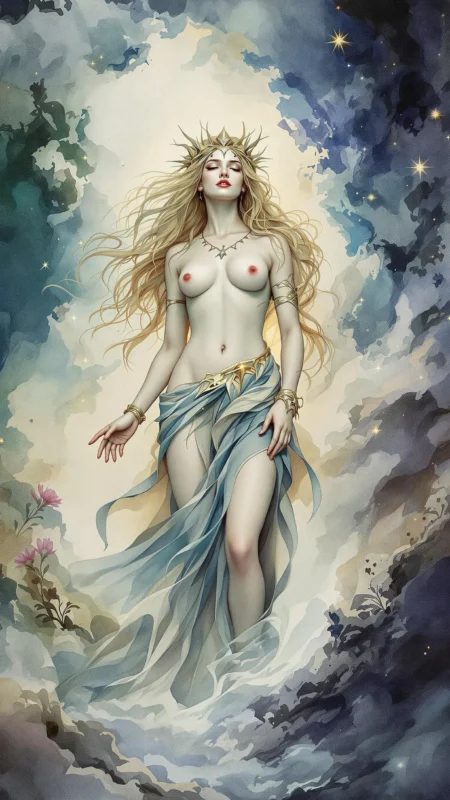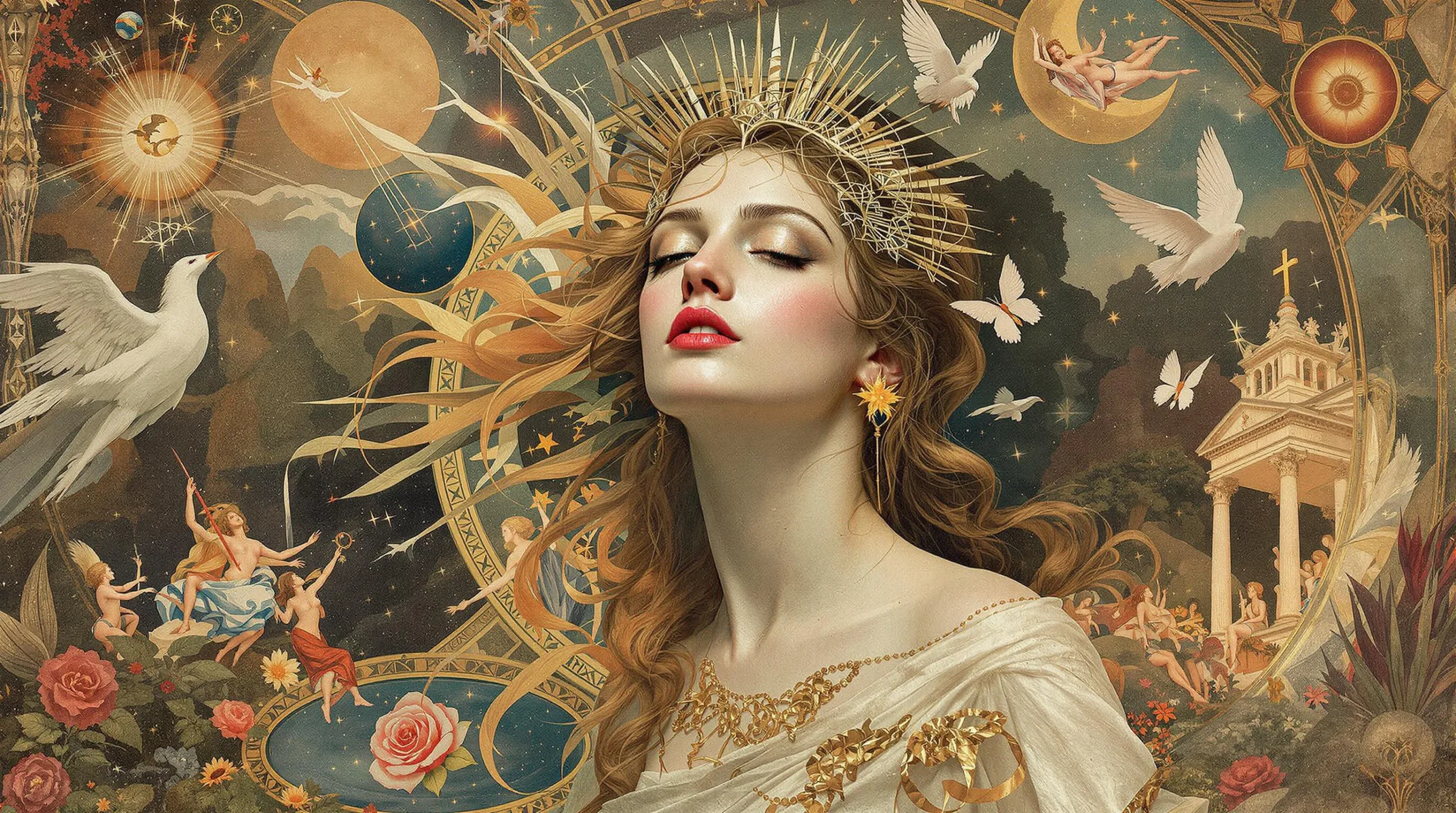


Diana

Archetype Meaning & Symbolism

Sovereign, focused, wild, chaste, solitary, protective, lunar, fierce, untamed, self-possessed

  • My path is my own. The forest does not ask the mountain for permission, nor does the moon ask the sun for its light.

If Diana is part of your personal mythology, you may...

Believe

  • My focus is my sacred instrument; where I point my attention, I create my world.
  • I am a sovereign nation of one, and my borders are not negotiable.
  • Solitude is not emptiness, but a state of profound connection with myself and the wild truth of the world.

Fear

  • Being trapped in a role not of my own choosing, a slow domestication of my spirit.
  • Losing my aim, becoming distracted and squandering my energy on things that do not matter.
  • The violation of my inner world, of having my solitude breached and my psychic space occupied by another's demands.

Strength

  • An almost supernatural ability to focus on a single goal, blocking out all distraction to achieve it.
  • A profound and resilient self-reliance that allows you to navigate life with courage and autonomy.
  • The clarity and will to establish and maintain strong, healthy boundaries in all areas of your life.

Weakness

  • A tendency toward emotional aloofness, making true vulnerability and deep intimacy a significant challenge.
  • A default setting of solitude that can easily slip into isolation, cutting you off from nourishing connection.
  • A merciless inner critic and a punitive stance toward weakness, both in yourself and in others, which can lack compassion.

The Symbolism & Meaning of Diana

In the modern psyche, Diana represents the inviolable territory of the self. She is the part of you that was never colonized by family expectation, social conditioning, or the gaze of another. This is your inner wilderness, a landscape that belongs to you alone. To have Diana in your personal mythology is to recognize and honor this sovereign ground. It may manifest as a powerful need for solitude, not as an escape, but as a pilgrimage to your own core. She symbolizes the right to one's own body, one's own thoughts, and one's own path, a radical act of self-possession in a world that constantly demands access and conformity.

The bow and arrow are not merely weapons: they are instruments of intention. The bow is the accumulated tension of your will, and the arrow is the focused application of that will toward a single point. This symbolism could play out in your life as an uncanny ability to pursue long-term goals with monastic dedication. Diana is also intrinsically lunar, tied to the moon's cycles of waxing and waning. This suggests a life lived in rhythm with intuition, with the hidden, and with the understanding that not all power is sunlit and obvious. Her energy is that of the cool, reflective light that illuminates what the day obscures.

Her role as a protector extends beyond the forest. She is the guardian of the nascent idea, the fragile new beginning, the vulnerability of a creative project in its infancy. If Diana is your ally, you may find yourself fiercely defending your own creative impulses from cynicism, both internal and external. You become a protector of potential itself. This is not the nurturing protection of a mother goddess, but the fierce, unsentimental watchfulness of the huntress who keeps predators at bay so that new life, in whatever form it takes, has a chance to grow strong on its own terms.


Diana Relationships With Other Archetypes

The Moon

With The Moon, the Diana archetype may share a silent and sovereign covenant. She does not bask in its light so much as wear it like a second skin, a silvered affirmation of her own solitary nature. The Moon, after all, governs the unseen tides and the quiet, feral stirrings of the nocturnal world—the very realm where the Diana feels most herself. Theirs is not a relationship of conversation but of shared orbit; a mutual respect for cycles, for the power that resides in shadow and reflection rather than in the brazen glare of the sun. The Moon could be seen as her silent witness, the cool, dispassionate observer that confirms her path is her own, illuminating just enough of the forest floor for the next step and no more.

The Walled Garden

The Diana’s relationship with The Walled Garden is perhaps one of mutual, distant suspicion. She, a creature of untamed acreage and sprawling, unpredictable forests, might gaze upon its geometric perfection as a kind of beautiful prison. To her, the scent of meticulously cultivated roses could carry a faint whiff of surrender, the trimmed hedge a testament to a wildness that has been broken and taught to speak in a more polite tongue. The Garden, in turn, may feel her presence as a rustle of leaves just beyond its stone confines—a disquieting reminder of the chaos it was built to keep out. It represents a settled peace she may find stagnant, a security that demands the sacrifice of instinct, a choice she could never abide.

The Arrow

One might say The Arrow is not so much a companion to the Diana as it is the crystallization of her will, a sliver of her own focused intention given flight. The relationship is one of absolute, terrifying clarity. Before it is loosed, the arrow is potential, a held breath of purpose. Once it flies, it is fate, a clean line drawn through the air that cannot be recalled. It may symbolize that part of the Diana that is swift, decisive, and utterly without doubt. In a world of tangled undergrowth and moral ambiguity, the flight of her arrow is a moment of pure, unadorned truth, a testament to the fact that for her, to choose a target is to have already arrived at its heart.

Using Diana in Every Day Life

Setting Personal Boundaries

When you feel your time or energy being encroached upon, you might invoke the Diana mythos. It's not about building a wall, but about defining the perimeter of your own wilderness. You could learn to say 'no' not as a rejection, but as an act of preserving a sacred, inner landscape. This is the space where your truest instincts reside, and like Diana, you are its sole guardian. The boundary becomes a silent, understood thing: this far, and no further.

Achieving a Singular Goal

Faced with a daunting project or a life-altering decision, the archetype offers the metaphor of the archer. Your goal is the distant stag, visible only to you. This requires tuning out all distractions, the chatter of the marketplace and the demands of the hearth. It is a practice in pure focus: narrowing your vision, steadying your breath, and wedding your intention to your action until the arrow is loosed. Success is not just hitting the target, but the profound stillness of the moment before the release.

Reconnecting with Your Instincts

If you feel domesticated by routine or alienated from your own body, the Diana archetype may call you back to the wild. This might not mean a literal forest, but any space where you can be fully, physically present and unobserved. It could be a long, solitary run at dusk, swimming in cold water, or simply sitting in a park without a phone. The aim is to awaken the senses and listen to the body's quiet intelligence, the animal self that knows thirst, fatigue, and direction without needing a map.

Diana is Known For

The Hunt

A symbol of intense focus and the pursuit of a singular, self-defined goal. It represents a life of action, purpose, and the relentless tracking of one's own truth.

Sacred Celibacy

Her choice to remain unmarried and child-free is a powerful statement of self-possession. It signifies a psychic and emotional wholeness that is not dependent on a partner for completion or validation.

Protector of the Wild

As the guardian of forests, wild creatures, and the young, she embodies the fierce defense of all that is untamed, innocent, and vulnerable, both in the outer world and within the psyche.

How Diana Might Affect Your Personal Mythology

How Diana Might Affect Your Mythos

When Diana enters your personal mythology, the narrative of your life may shift from a romance or a bildungsroman to an epic of the wilderness. Your central quest might no longer be to find a partner or a place in society, but to map the terrain of your own soul. The major plot points are not weddings and promotions, but moments of solitary revelation, of hitting a target you alone could see. The central conflict becomes one of authenticity versus domestication: the struggle to keep your inner world untamed. Your life story may feel less like a novel and more like a collection of poems, each one capturing a distinct, focused moment of being.

The mythos shaped by Diana is one of sacred autonomy. You are the protagonist who walks out of the village and into the woods, not because you are banished, but because you choose to be. Your companions are not a fellowship of knights, but perhaps a pack of loyal, like-minded souls who run alongside you for a time, each on their own hunt. Power, in this story, is accrued in silence and solitude. The climax of your myth might be a moment of perfect, unassailable self-knowledge, a quiet recognition in the moonlight that you are, and have always been, completely whole.

How Diana Might Affect Your Sense of Self

To see yourself through the lens of Diana is to locate your identity in a core that is independent of your relationships. Your sense of self may feel like a deep, still well that others can drink from, but never own. This can foster a profound self-respect and an unshakable inner confidence. You may see your worth as inherent, a fact of nature like a mountain or a river, not something to be negotiated or earned through the approval of others. The self is a sovereign state, with its own laws and its own ruler: you.

This archetype may also forge a unique relationship with your body. You might perceive it less as an object of desire and more as a capable instrument of your will. It is your bow, your fleet-footed hound, the vessel of your autonomy. This could lead to a deep appreciation for its strength, its resilience, and its capacity for action. There may be a pride in its competence rather than its appearance. The body becomes the tangible expression of your freedom, a physical anchor for your independent spirit.

How Diana Might Affect Your Beliefs About The World

With Diana as a guide, you may view the world less as a social tapestry and more as a vast, wild ecosystem. You see the hidden patterns, the subtle shifts in the wind, the tracks of predators and prey in boardroom politics and social gatherings alike. Civilization and its constructs—its hierarchies, its etiquette, its endless demands—might seem like a thin, artificial veneer over a much older, more authentic reality. Your allegiance may lie with the unwritten laws of nature and instinct rather than the codified rules of society.

Consequently, you may harbor a deep skepticism for institutions that seek to tame the individual spirit: rigid corporate structures, dogmatic belief systems, or conventional relationship models. The world is not a stage on which to perform a prescribed role, but a territory to be explored. Your worldview prioritizes freedom, authenticity, and the space to roam. You might find more truth in the logic of a forest than in the rhetoric of a politician, and more community in the silent company of the stars than in a crowded room.

How Diana Might Affect Your Relationships

In the realm of relationships, the Diana archetype asserts the primacy of personal space. Friendships may be intense and fiercely loyal, but they are friendships between sovereigns. You might form a 'pack' of close companions, bound by mutual respect for each other's autonomy. The bond is deep, yet it does not seek to merge or possess. Each member remains a distinct, self-contained wilderness, and the friendship is the shared ground where these wildernesses meet.

Romantic partnerships can be the site of your greatest challenge and growth. The archetype may instill a deep-seated fear of being captured, domesticated, or losing the sharp edges of your identity in the comfortable blur of a couple. A successful relationship requires a partner who is not a hunter seeking to tame you, but a fellow traveler who respects your need for a separate territory. Intimacy is not a given; it is a clearing in the forest, a sacred space you choose to share, knowing you can always retreat to the solitude of your own woods. Love must honor freedom, or it is not love at all.

How Diana Might Affect Your Role in Life

Your perceived role in life may be that of the sovereign, not the ruler. You do not seek to command others, but to hold absolute command over yourself. This is an active, vigilant role. You are the perpetual guardian of your own focus, the protector of your psychic borders, the one who ensures the sacredness of your inner world is not profaned by distraction or unwarranted intrusion. Your purpose is not to build an empire, but to cultivate an unbreachable sense of self.

Professionally and socially, this can manifest as the role of the specialist, the solitary pioneer, or the dedicated artist. You are the archer, your eyes fixed on a distant mark that others may not even see. This path may lead you away from collaborative, consensus-driven environments and toward pursuits that require singular, sustained focus. Your role is defined by your aim. You are what you hunt. Whether that be a scientific discovery, a perfect line of code, or a personal truth, your identity is forged in the intensity of that pursuit.

Dream Interpretation of Diana

To dream of Diana in a positive light, perhaps seeing her draw her bow with effortless grace or guide you through a moonlit forest, is often a potent affirmation from your own psyche. It may signal that you are aligned with your true purpose, that your focus is clear, and your instincts are sharp. She appears as a guide, confirming that the path of independence and self-reliance you are on is the correct one. The dream might be a call to trust your own judgment, to set a new and ambitious goal, or to spend time in nature to recharge your spirit. She is the assurance that you are your own best protector.

A darker dream, where you are the prey in Diana's hunt, where her arrows are aimed at you, or where you find her bow broken, could point to an internal conflict. You may feel that your own fierce independence has turned against you, creating isolation. Or perhaps you are being tyrannized by an inner critic that demands an impossible standard of perfection and punishes any sign of vulnerability or need. It can also suggest that your focus has become scattered or that you feel trapped and hunted by obligations that violate your sense of autonomy. This Diana is the shadow of sovereignty: cold, punitive, and merciless.

How Diana Archetype Might Affect Your Needs

How Diana Might Affect Your Physiological Needs

For one with Diana in their mythos, physiological needs are not mundane requirements: they are the ritual upkeep of the sacred instrument of the self. The need for food, water, and air is recast as the stoking of the inner fire. There may be a preference for clean, simple, powerful fuel—food that feels alive, water that is pure. This isn't about dieting; it's about readiness. Your body is the companion on your hunt, and its needs are attended to with a kind of clear-eyed, practical reverence.

The rhythms of sleep and rest may also take on a strategic importance. You might feel a kinship with the nocturnal world, finding that your sharpest thoughts arrive in the quiet hours after midnight. Rest is not merely a cessation of activity but a gathering of energy, a sharpening of the senses in the dark. Your physical well-being is the foundation of your freedom. To be tired, to be unwell, is to be vulnerable, a state the Diana archetype instinctively resists.

How Diana Might Affect Your Ideas of Belonging

The need for belonging, for the Diana-influenced soul, is answered not by assimilation but by alignment. You may not seek to fit into a large group, but to find the very few who share your untamed spirit. Belonging is the quiet recognition in another's eyes that they too hear the call of the wild. It is the loyalty of the pack, where each member runs freely alongside the others, their paths parallel but distinct. True community may be found in the silent communion with a forest, a desert, or the vast night sky.

Love and intimacy are approached with immense caution and profound reverence. The archetype may instill a fear of being subsumed, of one's personal wilderness being clear-cut to make room for another. Therefore, love is not a merging but a mutual respect between two sovereignties. Belongingness is a pact made first with oneself. Only then can you choose to grant another access to the sacred clearing in the center of your woods, knowing they honor its wildness and will not try to fence it in.

How Diana Might Affect Your Feelings of Safety

Safety, from a Diana perspective, is not found in high walls or insurance policies. It is rooted in competence. The ultimate security lies in the knowledge that you can provide for yourself, defend yourself, and navigate the wilderness of life on your own terms. This can translate into a drive for financial independence, the acquisition of practical skills, and the cultivation of physical strength and awareness. Safety is a state of capability, a quiet confidence in one's own ability to meet the world.

The primary threat to safety is perceived not as physical danger, but as encroachment. Unwanted intrusions on your time, your space, or your attention can register as profound violations, a breach of the perimeter. Consequently, you may develop highly sensitive antennae for manipulation, co-dependence, or anything that threatens to compromise your autonomy. Security is an actively managed state of being, a well-patrolled border around your sovereign self.

How Diana Might Affect Your Views of Esteem

Esteem is not sought from the outside world; it is forged in the crucible of self-mastery. For the Diana archetype, self-worth is the direct result of competence and integrity. It is the quiet, internal nod of respect you give yourself for hitting a difficult target, for holding a boundary, for staying true to your path despite pressure to deviate. Praise from others may feel pleasant but insubstantial compared to the bedrock of self-respect built on your own accomplishments and your adherence to your own code.

The ultimate source of esteem is the unshakeable knowledge of your own wholeness. The conviction that you are complete without a partner, a title, or external validation is the core of your power. This creates a powerful immunity to criticism and a deep well of inner strength. The potential pitfall is an inability to accept help or admit to needing others, as such admissions could be misinterpreted by the self as a failure of that core principle of independence, a crack in the foundation of your esteem.

Shadow of Diana

When the Diana archetype falls into shadow, her sacred wilderness becomes a frozen wasteland. Her independence curdles into an impenetrable fortress of isolation, her silence into a frigid rejection of all warmth. The focused huntress becomes a cruel predator. Her arrows, once aimed at self-defined goals, are now dipped in the poison of criticism and aimed at the hearts of those who show vulnerability or offer intimacy. She rejects her own needs for softness and connection, seeing them as contemptible weaknesses. This shadow Diana is terrifyingly lonely, the sovereign of an empty kingdom, mistaking her isolation for strength.

In its other shadow form, the protector of the wild becomes the ruthless exploiter. Her single-minded focus is twisted into a relentless ambition that sees other people not as fellow souls, but as obstacles on her path or resources to be consumed and discarded. She is the Diana who, enraged by the trespass of Actaeon, inflicts a punishment far exceeding the crime. She becomes rigid, punitive, and unforgiving. Her sacred boundaries become electrified fences, and her clear sight becomes a judgmental gaze that hunts for flaws and imperfections in everyone, most of all, in herself.

Pros & Cons of Diana in Your Mythology

Pros

  • You possess an unshakeable core of self-sovereignty that allows you to live a life of great authenticity and purpose.
  • Your capacity for deep focus enables you to achieve mastery and excellence in your chosen pursuits.
  • You are guided by a powerful inner compass, making you resistant to peer pressure and external manipulation.

Cons

  • You may experience profound loneliness and find it difficult to sustain the vulnerability required for deep, lasting relationships.
  • Your fierce independence can make it difficult to ask for or accept help, leading you to struggle alone unnecessarily.
  • A tendency towards a critical and unforgiving nature can create distance from others and inhibit self-compassion.