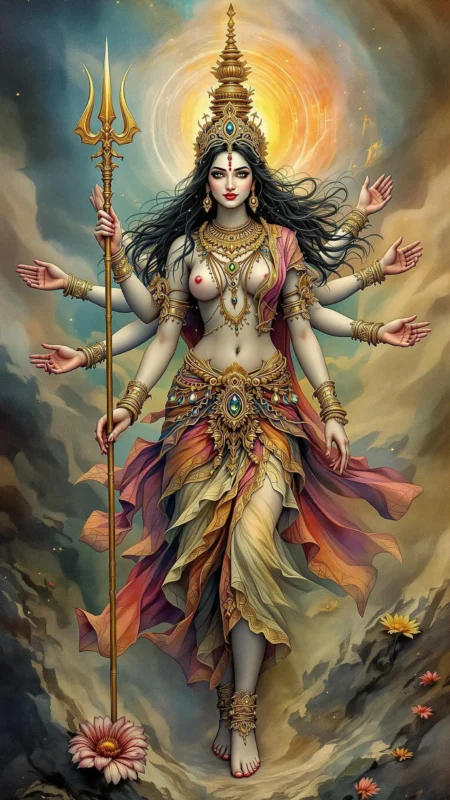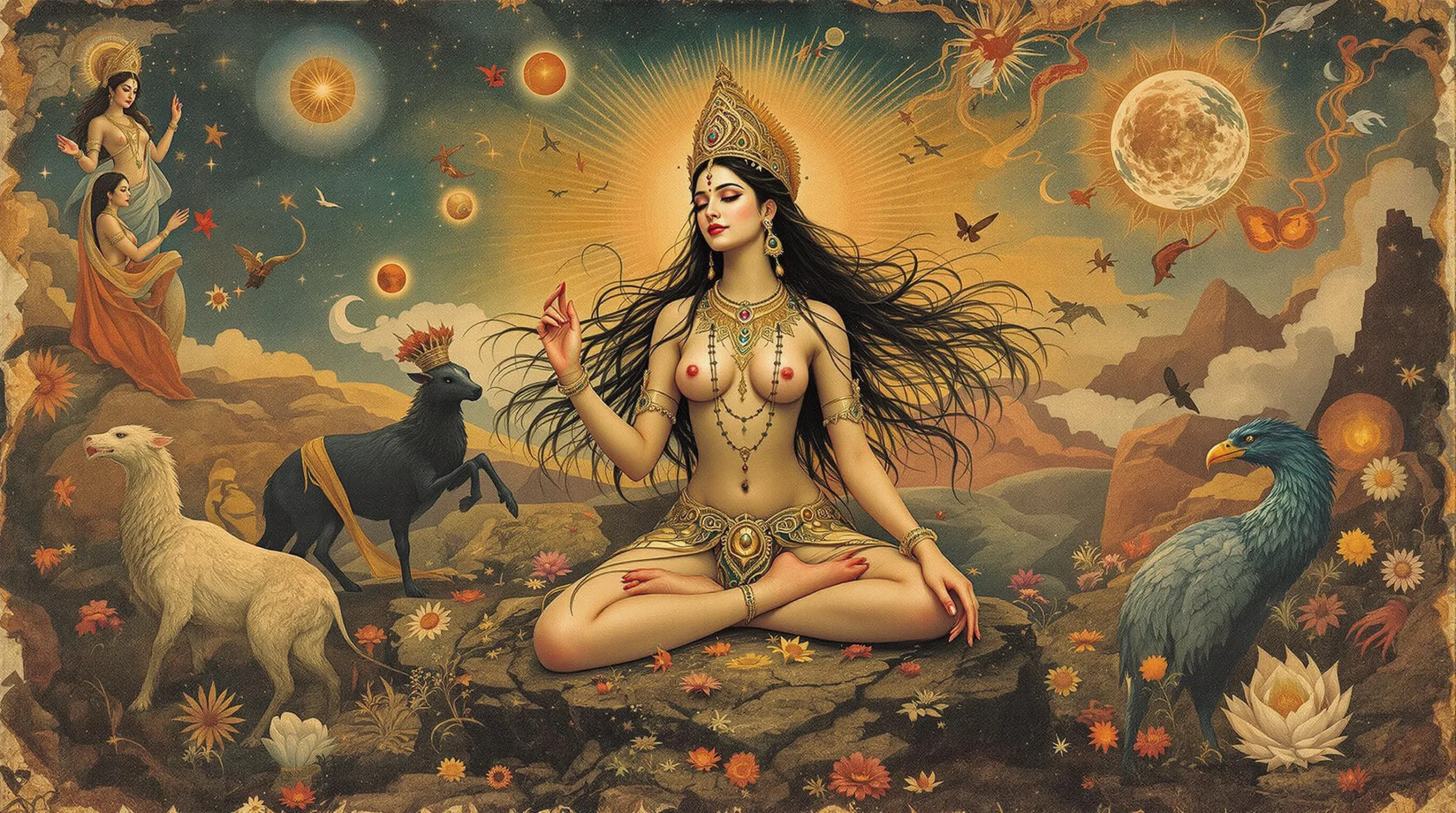


Parvati

Archetype Meaning & Symbolism

Devoted, ascetic, patient, willful, fierce, transformative, nurturing, integrated, creative, grounded

  • The universe is not something to be conquered. It is a dance to be joined, and the music is the beat of your own wild heart.

If Parvati is part of your personal mythology, you may...

Believe

  • True power is grown in stillness and silence, not seized in noise and conflict.
  • The greatest love is not found but forged, through devotion to another's highest self and your own.
  • Every part of life, from the kitchen to the boardroom, can be a sacred space if you tend to it with intention.

Fear

  • That your devotion will be unreciprocated, that you will perform your austerities for a god who never turns his gaze.
  • That you will be unable to access your ferocity when needed, leaving you and those you love vulnerable to harm.
  • That in the act of creating a home for another, you might lose the wild, untamed wilderness of your own soul.

Strength

  • An almost supernatural patience, the ability to play the long game and trust in slow, deep processes of growth.
  • The capacity to create harmony and integrate opposites, making you a natural mediator, artist, and unifier.
  • A fierce, unwavering loyalty to those you love, backed by a surprising and formidable strength when they are threatened.

Weakness

  • A tendency to wait too long for external recognition or for a situation to change, mistaking passivity for patience.
  • A potential to lose your own identity in your devotion to a partner, a family, or a cause.
  • Difficulty setting firm boundaries until a crisis point is reached, leading to jarring shifts from extreme gentleness to explosive rage.

The Symbolism & Meaning of Parvati

The archetype of Parvati reframes patience as an active, creative, and powerful force. This is not the passive waiting of a victim of circumstance but the focused, generative stillness of a mountain gathering its strength. Her long austerities symbolize the profound internal work required to become worthy of one's highest calling. In a personal mythos, this could translate to the long, unglamorous hours spent mastering a craft, the quiet dedication to a relationship's growth, or the disciplined pursuit of self-knowledge. Parvati teaches that the most profound changes are cultivated in the silent wilderness of the self, and that what appears to be stillness to the outside world is, in reality, a period of intense, subterranean transformation.

At her core, Parvati is a symbol of integration. She is the bridge between the ascetic and the householder, the spirit and the flesh, the serene and the terrible. She holds the paradox of being the gentle Gauri, the devoted wife, and the fierce Durga, the unconquerable warrior. For the modern psyche, often fractured by competing demands and identities, her story offers a path to wholeness. It suggests that one need not amputate the wild parts to be civilized, nor abandon the world to be spiritual. The goal is to contain these multitudes, to allow the loving mother and the fierce protector to be aspects of the same being, each called forth as life requires. She is the wholeness that emerges when we cease to see our inner world as a conflict to be won and instead as a dance of complementary energies.

Furthermore, Parvati embodies the concept of transformation through devotion. Her tapas was not merely to attract Shiva, but to become his equal, to transform herself into a being capable of meeting the divine on its own terms. This elevates the idea of devotion from simple affection to a path of radical self-overhaul. In personal mythology, this could manifest as a devotion to a person, an art form, or a principle of truth that is so total it reshapes the devotee. You give yourself over to a great love or a great work, and in the crucible of that commitment, you are remade. It is the faith that by focusing your entire being on a single point, you can alchemize your very essence.


Parvati Relationships With Other Archetypes

The Anchorite

The relationship with the Anchorite, a figure of profound detachment like Shiva, may be the central axis upon which the Parvati archetype turns. He is perhaps the silent, unmoving stone of cosmic indifference, lost in a meditation as deep as space. She, in turn, is not a petitioner but a force of nature as patient and persistent as the tide, which does not demand the shore's attention but simply returns, again and again, reshaping the landscape through sheer, unwavering presence. Their union, then, could be seen not as a concession but as a completion, the moment the abstract absolute is drawn into the warm, breathing world by a gravity of pure devotion, proving that the greatest power may not be to transcend the world, but to fully inhabit it.

The Mountain

As her very name suggests a filial bond with the mountains, Parvati's archetype could be said to possess a kind of geological patience. The mountain is an emblem of stability that weathers eons, its changes imperceptible, its strength foundational. One might say Parvati does not merely emulate this but embodies it; her resolve is a tectonic pressure, her endurance a form of spiritual granite. This is not the stubbornness of a closed fist, but the deep, quiet power of the bedrock that supports the entire forest. She is, perhaps, the mountain's purpose made manifest—a silent, unyielding presence that offers a foothold for life and an anchor for the wild, spinning heavens.

The Slow Fire

The Parvati archetype may find its engine in the Slow Fire, a power source wholly unlike a destructive conflagration. This is the contained, internal heat of the kiln that transforms soft clay into enduring porcelain; it is the alchemical fire of *tapas*, or ascetic practice. It smolders with intention, a deliberate, self-generated warmth that can melt the resolve of gods and forge a new reality. This fire could be understood as the focused energy of creation itself—the quiet, cellular division that builds a life, the unwavering focus that turns a chaotic draft into a masterpiece. It is the hearth that makes a home in the wilderness and the inner forge that allows the gentle maiden to temper herself into a warrior capable of defending existence itself.

Using Parvati in Every Day Life

Navigating Professional Stagnation:

When faced with a plateau in your career, the Parvati archetype suggests a strategic retreat over a frantic scramble. Instead of more networking or louder self-promotion, one could emulate her asceticism. This might mean a period of deep, quiet skill-building, a meditation on one's true vocational purpose, separate from title or praise. You cultivate your own mountain of expertise, trusting that this gravitational presence will, in time, draw the 'Shiva' of opportunity to you, not because you chased it, but because you became undeniably ready for it.

Healing from a Broken Heart:

Parvati's story offers a map for transforming the desolation of heartbreak into a period of profound self-creation. Her time in the forest was not one of lack, but of becoming. To channel this archetype is to treat the solitude following a loss as a sacred hermitage. The emotional energy, rather than being suppressed, could be poured into a disciplined practice: art, physical training, spiritual study. The goal is not merely to 'get over' someone, but to emerge from the crucible of sorrow as someone more whole, potent, and complete in your own right, having forged a new self in the fire of devotion to your own becoming.

Integrating a Divided Self:

For the individual torn between seemingly contradictory impulses—the fierce ambition and the gentle desire for home, the spiritual seeker and the worldly participant—Parvati offers a vision of integration, not compromise. She is both the serene Gauri and the terrifying Durga. Her mythos provides a framework for refusing to choose. It suggests that one might find a way to be a warrior in the boardroom and a nurturer at the hearth, seeing them as different faces of the same core strength. The work is to weave these threads together, to discover the fierceness in your love and the sacred devotion in your work.

Parvati is Known For

The Austere Devotee

Her legendary tapas, the intense ascetic practices she undertook in the wilderness to win the heart of the reclusive god Shiva. This was not an act of passive waiting but a demonstration of immense will, self-mastery, and unwavering focus, transforming her very being into a force that the divine could not ignore.

The Divine Consort and Mother

Her role as Shiva's wife and the mother of Ganesha and Kartikeya is central. She is the force that coaxes the transcendent, world-renouncing Shiva into the immanent world of family, responsibility, and dynamic partnership. She embodies the principle that brings spirit into matter, creating a home for the divine within the fabric of life.

The Fierce Protector

Her capacity to transform into her warrior aspects, Durga and Kali. When devotion and nurturing are insufficient to protect cosmic order, she becomes a terrifying, demon-slaying force. This reveals that her gentleness is not a weakness but a choice, and that beneath it lies an indomitable power reserved for the defense of the sacred.

How Parvati Might Affect Your Personal Mythology

How Parvati Might Affect Your Mythos

When Parvati informs your personal mythos, your life story may shift from a narrative of external conquest to one of internal cultivation. The defining moments of your legend are perhaps not battles won or promotions gained, but periods of intense, quiet waiting and becoming. Your personal history might be re-interpreted as a long, patient preparation for a destined union: with a soulmate, a true vocation, or the deepest parts of your own self. You might see the years of solitude or unrecognized work not as a fallow period, but as your own 'tapas' in the wilderness, the necessary trial to forge the self that could be worthy of the life that was to come. Your myth is not a hero's journey, but an ascetic's pilgrimage toward wholeness.

Your life's narrative could also become a story of integration, a constant weaving together of disparate threads. You may see your purpose as the grand project of uniting the sacred and the mundane, the fierce ambition and the quiet domesticity, the wild heart and the responsible citizen. Your story is not about choosing the mountain peak or the hearth fire, but about building a home on the mountain slope, a place where both vistas are honored. The central conflict of your mythos is not good versus evil, but fragmentation versus integration, and your triumph is the creation of a life where all your parts are welcomed and harmonized.

How Parvati Might Affect Your Sense of Self

A relationship with the Parvati archetype may cultivate a sense of power rooted in self-possession rather than outward force. Like a mountain, your strength is perceived in your presence, your stillness, your unshakeable core. You might find yourself drawn to practices that build this inner stability: meditation, disciplined craft, a deep connection to nature. Self-worth, then, is not contingent upon the shifting winds of external validation but is quarried from the bedrock of your own being, a resource you have painstakingly built through your own efforts. You feel powerful not when you are loud, but when you are centered.

This archetype could also grant you a profound permission to be multifaceted. You may no longer feel the pressure to present a single, consistent version of yourself to the world. You can be the gentle nurturer and the fierce advocate, the patient planner and the spontaneous creator, seeing these not as contradictions but as a full palette of appropriate responses to the complexity of life. The self is not a static monument but a landscape that has many kinds of weather. This acceptance of your own inner multiplicity, from the serene Gauri to the formidable Kali, is a source of immense freedom and resilience.

How Parvati Might Affect Your Beliefs About The World

Your worldview, shaped by Parvati, may begin to see the world less as a chaotic battlefield and more as a cosmic dance of complementary forces. The strict dualities of sacred and profane, spirit and matter, work and life begin to dissolve. You might find the divine not just in prayer or meditation, but in the rhythm of chopping vegetables, the challenge of a difficult conversation, or the patient tending of a garden. The material world ceases to be an obstacle to spiritual life and instead becomes the very stage upon which spirit performs its dance. Life's purpose is not to transcend the world, but to fully inhabit it with sacred intention.

Consequently, your perception of time itself could undergo a profound shift. The frantic, anxious pulse of modern life may recede, replaced by an alignment with a more geological or cyclical sense of time. You may develop a deep trust in slow, organic processes, believing that the right things will unfold in their own season if you provide the right conditions through steady, patient effort. Patience ceases to be a passive virtue and becomes a form of profound wisdom, a way of synchronizing your personal rhythm with the unhurried, inexorable rhythm of the universe itself. You learn to wait, not with anxiety, but with faith.

How Parvati Might Affect Your Relationships

In the realm of relationships, the Parvati mythos may frame love as a sacred, transformative practice: a shared tapas. A romantic partnership, in this view, is not merely for comfort or companionship but is a vehicle for mutual awakening. The aim is a union so profound it calls forth the divine potential in each partner. You might find yourself drawn to relationships that challenge you to grow, that require you to become more than you are. The partner is a mirror, a 'Shiva' who represents a principle you seek to integrate, and the messy, beautiful work of the relationship is the spiritual work of your life.

This archetype could inspire a quality of connection marked by immense devotion and patience. You may be willing to do the slow, unglamorous, foundational work that deep intimacy requires, seeing it as a sacred craft. This devotion, however, has a dual nature. While gentle and nurturing toward those within your circle of love, it can transform into an astonishing fierceness when they are threatened. You embody the seamless shift from Gauri to Durga, your love and your wrath being two sides of the same protective coin. The boundaries of your relationships are thus both permeable to love and impermeable to harm.

How Parvati Might Affect Your Role in Life

Your perceived role in life, through the lens of Parvati, may be that of a unifier and a bridge-builder. In your family, community, or workplace, you might naturally become the person who connects disparate elements: mediating disputes, fostering collaboration between siloed departments, or translating esoteric ideas into practical, everyday wisdom. You are the one who gently reminds the ascetic of their body and the worldly person of their soul. Your purpose feels less like achieving a specific title and more like holding the space for wholeness, creating a container where seemingly opposite energies can coexist and create something new.

Alternatively, you may see your role as that of a quiet catalyst. Like Parvati, whose devotion drew the great ascetic Shiva back into the world, your power may lie in your ability to gently and persistently awaken the latent potential in others. You don't lead with pronouncements or force; you lead with unwavering faith. Your role is to see the dormant god in a person, a project, or a community and to tend to that possibility with such patient, loving focus that it has no choice but to eventually awaken and emerge. Your influence is gravitational, not aggressive.

Dream Interpretation of Parvati

In a positive context, to dream of Parvati—perhaps seeing her meditating serenely on a mountainside, or as a loving mother surrounded by light—could signify a powerful integration occurring within your psyche. The dream may be an affirmation from your unconscious that a long period of patient effort, your personal 'tapas', is nearing fruition. It can suggest an impending harmonious union, whether with a partner, a creative project, or a part of yourself you have long felt alienated from. Such a dream speaks of self-possession, readiness, and the quiet triumph of inner work. It is a sign that you have become the mountain, stable and whole.

In a negative context, a dream of Parvati might carry a warning. Dreaming of her as a distant, unreachable figure on a peak you cannot scale, or as a goddess who ignores your devotion, could reflect a deep-seated fear that your efforts are in vain, that your patience is merely passivity in disguise. It may point to a co-dependent pattern where your devotion is not being reciprocated. If she appears in her terrifying forms, Durga or Kali, in a way that feels personally threatening, it might symbolize a repressed part of your own power. It could be the righteous anger you have swallowed, or the fierce boundaries you have failed to set, now turning inward or threatening to erupt in a destructive, uncontrolled manner.

How Parvati Archetype Might Affect Your Needs

How Parvati Might Affect Your Physiological Needs

The Parvati archetype could tie your most basic physiological needs—for food, water, shelter, rest—to a narrative of sacred discipline. Your approach to the body might become less about indulgent pleasure and more about creating a worthy vessel for your spirit and purpose. You may find strength in periods of simplicity, like fasting or adopting a clean diet, viewing this not as deprivation but as a way of honing the instrument. Physical health is the foundation of spiritual endurance. Your body is not a distraction from your higher self; it is the temple where your higher self resides, and you tend to it with the reverence of a priest.

There may also be a profound sense of connection between your physical body and the body of the Earth. You might feel most nourished and alive when your physiological rhythms are in sync with nature's: eating what is in season, sleeping and waking with the light, feeling the ground beneath your feet. This archetype consecrates embodiment. It counters any impulse to reject the physical world in favor of the spiritual, instead suggesting that true divinity is found in their seamless union. To be healthy, in this mythos, is to be in right relationship with the material world.

How Parvati Might Affect Your Ideas of Belonging

Belongingness, as filtered through the Parvati archetype, transcends mere social acceptance; it is a quest for profound, soul-level union. The drive for connection is a drive to find a 'Shiva,' a counterpart that mirrors, challenges, and completes your own essence. This counterpart may be a person, but it could also be a community, a landscape, or a life's work. You do not wish to simply belong *to* something; you yearn to merge *with* it, to become so integral to a greater whole that the boundaries of the individual self soften. Love and belonging are not a comfortable harbor, but a transformative fire.

This archetype may also position you as the creator of belonging for others. Like Parvati, who creates a home and a family that can contain the wild, transcendent energy of Shiva, you might be the one who initiates the gatherings, nurtures the friendships, and builds the culture that allows a group to become a community. Your love is not passive but generative. In the act of building a container for others to feel seen and held, you forge your own sense of belonging at the very heart of the world you have made.

How Parvati Might Affect Your Feelings of Safety

Within the Parvati mythos, safety is not a passive state you find, but an active environment you create. It is the home built with intention, the community nurtured with care, the boundaries defended with conviction. You may locate your sense of security less in external structures like alarms or bank accounts, and more in the resilience of your inner world and the strength of your relationships. True safety is the mountain of your own being, a refuge you have constructed stone by stone through patient practice. It is an internal fortress of self-possession that cannot be breached by external chaos.

This archetype deeply understands that safety sometimes requires ferocity. The gentle, nurturing hand must know how to become a fist. When a genuine threat arises against what you hold sacred, the Parvati energy allows for a swift and total transformation into the protective warrior, Durga. Your sense of security, therefore, might be intimately linked to your trust in your own capacity to access this righteous power. Safety is not just the absence of threat; it is the absolute, bone-deep conviction that you possess the necessary strength to face and neutralize any force that would dare to harm your world.

How Parvati Might Affect Your Views of Esteem

When the Parvati archetype is active, your esteem may become untethered from external praise and anchored in the internal process of self-cultivation. Self-worth is earned in the long, quiet hours of practice. It is forged in the discipline you maintain when no one is watching and the commitment you uphold to your own growth. Like Parvati, whose power was born from her solitary austerities, you might feel the most profound sense of pride not when you receive an award, but when you complete a difficult, long-term project of self-improvement. Your esteem is a measure of your own dedication to your becoming.

Your sense of self-worth is also deeply connected to your capacity for integration. You may value your ability to hold complexity, to be both yielding and unshakeable, both nurturing and fierce. Esteem comes from the deep knowing that you are not a static, one-dimensional character but a dynamic being capable of embodying the full spectrum of human potential. You respect yourself because you are not fragile. You know that whatever life demands, you can call upon the necessary aspect of your multifaceted self to meet the moment. You are worthy because you contain multitudes.

Shadow of Parvati

The shadow of Parvati's devotion can manifest as a consuming, erosive co-dependency. The patient, focused ascetic becomes the perpetual waiter, the doormat, her sacred tapas twisted into a pattern of self-neglect in service of an unworthy object. This shadow aspect may choose a 'Shiva' who is not a meditating god but an emotionally unavailable partner, an exploitative job, or an impossible ideal. The beautiful story of transformative love becomes a justification for an unhealthy dynamic, a belief that one's sacrifice alone can 'fix' or 'awaken' another, leading to a profound loss of self in a vortex of fruitless giving.

The other shadow emerges when the integration of her aspects fails. One may become stuck in the gentle, nurturing Gauri form, repressing all anger and personal power until it builds into a reservoir of resentment. This can lead to passive-aggression or, when the dam finally breaks, an eruption of uncontrollable, destructive rage—a Kali unmoored from purpose. Conversely, one might become stuck in the Durga aspect, seeing threats everywhere and becoming a smothering, controlling force in the name of 'protection.' The sacred balance is lost, leaving only the dysfunctional extremes: a powerless nurturer or a tyrannical protector.

Pros & Cons of Parvati in Your Mythology

Pros

  • You possess a profound wellspring of patience and resilience, allowing you to weather personal and professional storms that would break others.
  • You have a unique ability to create spaces of warmth, belonging, and deep connection, often acting as the heart of your family or community.
  • You are deeply connected to both your nurturing instincts and your protective power, making you a balanced, effective, and formidable presence.

Cons

  • Your powerful capacity for devotion can sometimes border on self-abnegation, risking the loss of your own needs and identity for the sake of a person or goal.
  • You may be slow to act against injustice or mistreatment, waiting for a situation to become dire before unleashing your fierce, protective side.
  • There is a risk of becoming trapped in a domestic or nurturing role, causing you to neglect the wild, ascetic, and solitary power that is also your birthright.