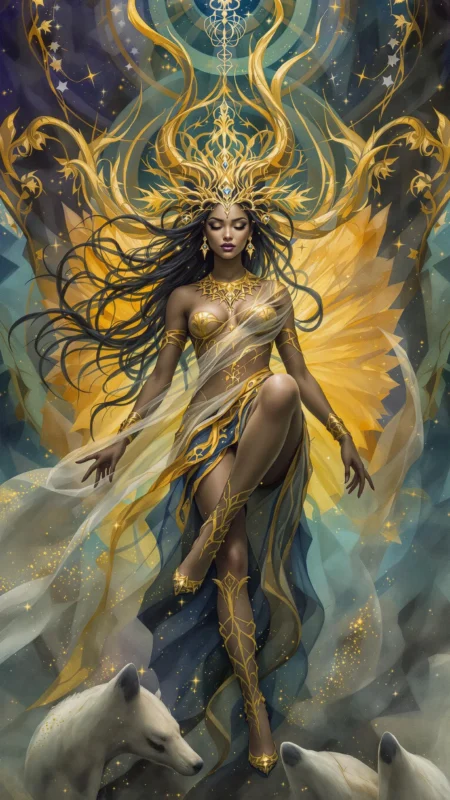
Oshun

Archetype Meaning & Symbolism

Sensual, Diplomatic, Generous, Vain, Creative, Abundant, Alluring, Capricious, Strategic, Healing

  • Do not mistake my sweetness for weakness. Honey can preserve, but it can also ensnare. The choice is yours.

If Oshun is part of your personal mythology, you may...

Believe

  • Beauty is not frivolous; it is a divine language and a fundamental human need.
  • The sweetest path is often the most powerful one.
  • My pleasure, my joy, and my creativity are sacred offerings to the world.

Fear

  • Ugliness, bitterness, and emotional sterility.
  • Being unseen, unappreciated, or taken for granted.
  • The stagnation of my own creative and emotional river; becoming a stagnant pond.

Strength

  • Uncanny diplomatic skill and the ability to persuade where others fail.
  • A deep well of creativity and the ability to manifest beauty in the world.
  • A magnetic charisma and a generosity of spirit that builds powerful alliances.

Weakness

  • A tendency towards vanity or superficiality if the inner work is neglected.
  • An aversion to direct, necessary conflict, preferring to charm or manipulate instead.
  • A vulnerability to flattery and a potential for vindictiveness when scorned.

The Symbolism & Meaning of Oshun

To find Oshun in one's personal mythology is to understand life as a river. Your story is no longer a series of mountains to be climbed or battles to be won, but a current to be navigated. You may find yourself drawn to the path of least resistance, not out of laziness, but out of a deep wisdom that recognizes the futility of fighting the flow. This archetype sanctifies emotion; feelings are not weaknesses but vital, directional information carried by your inner waters. Success is measured in flow, in the ease with which you move through the world, drawing opportunities to you as a river draws tributaries.

The symbolism of honey rewrites the script of power. In a world that often prizes the loud, the brutal, and the confrontational, the Oshun mythos whispers a profound truth: nothing is more powerful than that which is desired. Sweetness becomes a strategic tool, diplomacy an art form. You may learn to persuade with pleasure, to lead by allure, to conquer with generosity. This is not about manipulation in its base sense, but about understanding a fundamental human dynamic. You catch more flies, as they say, with honey. You build more empires with beauty, connection, and joy.

The mirror, often dismissed as an icon of vanity, is reclaimed as a tool of radical self-possession. To gaze into it is not an act of narcissism but of consecration. In the modern context, this translates to a profound acceptance of one's physical self and a commitment to adornment as a spiritual practice. Choosing your clothes, applying perfume, caring for your skin: these may become rituals of self-love. It is the belief that making yourself beautiful is making yourself a worthy vessel for the divine spark you carry. It is looking at your own reflection and seeing not a flawed human, but a deity in the making.


Oshun Relationships With Other Archetypes

The Mirror

The relationship between the Oshun archetype and the Mirror is perhaps less one of user and tool, and more of a co-existent identity, a conversation between surface and depth. The mirror, in this sense, may not be a silvered pane of glass held in the hand, but the very surface of the river itself—a shimmering, liquid boundary between two worlds. It could be said that the Oshun archetype does not pass judgment but simply presents a reflection, polished to a brilliant clarity, of whatever soul chooses to gaze into her waters. This act of perfect mimesis is her great power and her potential tragedy. For one, it offers the profound gift of self-knowledge, a truth unadorned. For another, it can become a devastating weapon, forcing a narcissist to drown in his own image or a penitent to find a long-forgotten grace within their own features. The mirror, then, is a portal to a truth that can either liberate or annihilate.

Honey

Honey, in its slow, amber viscosity, might be seen as the very bloodstream of the Oshun archetype’s influence. It is a substance that seems to operate outside of time—a preserved sweetness, a memory of summer's full bloom captured in a gilded tear. This sweetness, however, is not without its own profound gravity. It could be the gentle persuasion that resolves a conflict, a balm on a fevered brow, the subtle diplomacy that wins a war without a single sword being drawn. Yet, it may also be the sticky, deliberate trap of seduction, a current of pleasure so potent it pulls one under, not with violence, but with an irresistible, cloying embrace from which one may have no desire to be freed. The love and beauty that Oshun offers is, like honey, a potent medicine and an intoxicating poison, its nature decided entirely by the intention of the one who dares to taste it.

The Forge

The Forge, with its percussive rage and its heart of white-hot violence, would seem the antithesis of Oshun’s cool, flowing dominion. And yet, their relationship may be the central alchemy of civilization itself. The archetype of the forge—representing raw ambition, industry, and the violent transformation of matter—could be seen as a force of pure, untempered power. It is the river, the essence of Oshun, that is needed to quench the blacksmith’s incandescent work, to temper the blade of passion into something of lasting strength and purpose. Without her cooling, deliberate touch, that power is merely a destructive tantrum. Conversely, the forge’s untended heat could turn the river to vapor, a passion that threatens to dissolve Oshun’s measured grace into a formless, hissing cloud. Theirs is a dance of mutual necessity, a precarious union where creation and destruction are separated by the barest margin of temperature.

Using Oshun in Every Day Life

Navigating a Professional Impasse

When faced with a stonewalling colleague or a bureaucratic knot, the Oshun approach forsakes the battering ram for the offering of honey. It could manifest as a strategically timed compliment, an invitation to coffee not to debate but to connect, or the sharing of a resource that benefits them first. This is not submission: it is the redirection of currents. You are not demanding they move, you are making the path you desire the most appealing one to travel.

Healing from Creative Stagnation

When the wellspring of ideas runs dry, the mythos of Oshun suggests the problem is not a lack of discipline but a lack of pleasure. The solution may lie in sensory immersion: a walk through a botanical garden, the deliberate tasting of a perfect piece of fruit, adorning your body in fabrics and colors that make you feel radiant. Creativity, in this view, is a response to the stimulus of beauty. You must fill your own river with beautiful things before it can flow outward.

Rebuilding Self-Worth After a Loss

After a rejection or failure, the instinct can be to hide. The Oshun archetype demands the opposite. It calls for the ritual of the mirror: not to scrutinize flaws, but to deliberately find and admire what is beautiful. It is the act of buying yourself flowers, of wearing your favorite jewelry just for yourself, of dancing in your living room. It is a declaration that your value is inherent and is not determined by the approval or disapproval of others; it is a force of nature, like a river, that exists for its own sake.

Oshun is Known For

The River

Her domain is the fresh, flowing water that gives life, carries secrets, and reflects the sky. It represents the unstoppable, ever-changing current of emotion, creativity, and destiny.

Honey and Sweetness

The symbol of her persuasive power and her essence. Honey is offered to her and is the medium of her magic

a metaphor for the strategic use of charm, pleasure, and irresistible attraction to achieve one's ends.

The Mirror

Her tool for self-knowledge and, some say, vanity. It represents the importance of reflection, of seeing oneself clearly, and of understanding that the cultivation of external beauty can be a sacred act of honoring one's inner divinity.

How Oshun Might Affect Your Personal Mythology

How Oshun Might Affect Your Mythos

When Oshun flows into your personal narrative, the plot itself may change. The heroic quest for a holy grail could be replaced by the artist’s quest to manifest a singular vision of beauty. The tragedy of circumstance might be re-written as a story about the redirection of a powerful river around an unexpected obstacle. Your life story ceases to be about what you endure and becomes about what you attract. The major turning points in your mythos might not be battles, but moments of profound connection, creative breakthrough, or the successful diplomatic navigation of an impossible social situation.

Your personal legend might be one of the quiet diplomat who reshapes a family or a company from within, the artist whose work brings sensuous joy to a drab world, or the lover who teaches others the sacredness of pleasure. The villains in your story may be those who represent bitterness, rigidity, and the denial of beauty. Your allies are those who appreciate the gentle arts, who speak the language of emotion, and who are unafraid of their own desires. Your mythos becomes a testament to the idea that the softest things in the world can overcome the hardest.

How Oshun Might Affect Your Sense of Self

With this archetype coloring your self-perception, you may see yourself as a source. A source of creativity, of pleasure, of healing. Your very being feels like a flowing current, and your primary responsibility is to keep that current clean, moving, and vibrant. This could lead to a deep attunement to your own emotional and physical needs, not as selfish indulgences, but as necessary maintenance of the sacred river that is you. You might grant yourself permission to feel, deeply and without apology, seeing your emotions as the lifeblood of your intuition and power.

Consequently, the relationship with your own body could be transformed. It may be viewed less as a vehicle to be disciplined and more as a landscape to be cherished. Sensuality becomes a primary mode of being. This could foster a form of self-love that is unabashedly aesthetic. You may find deep satisfaction in your own reflection, not from a place of ego, but from a place of genuine appreciation for the unique form you inhabit. Your worth feels inherent, effervescent, and not contingent on the approval of others, much like a river does not ask for permission to flow.

How Oshun Might Affect Your Beliefs About The World

To see the world through the eyes of Oshun is to see it as a vast, interconnected waterway of relationships, energies, and possibilities. Problems are not fortresses to be sieged; they are dams or blockages in the flow, to be navigated with cleverness and grace. You might lose faith in brute force and develop a profound belief in the power of attraction. The most effective way to change the world, you may surmise, is not to protest against what is ugly, but to relentlessly create what is beautiful, making it so alluring that others cannot help but be drawn to it.

This worldview prioritizes the aesthetic and the emotional. A society, a business, or a home without beauty and joy may be seen as fundamentally unhealthy, regardless of its material wealth or efficiency. You might believe that diplomacy, art, and the cultivation of pleasure are not peripheral activities but are essential to human survival and flourishing. The world is not a machine to be optimized, but a garden to be tended, a lover to be courted. The fundamental cosmic principle is not conflict, but desire.

How Oshun Might Affect Your Relationships

In the realm of relationships, this archetype casts you as both the river and the honey. You may give love and affection generously, even extravagantly, seeking to create a current of mutual pleasure and delight that envelops you and your beloved. Relationships could be seen as a dance of reciprocity, an exchange of sweetness. You are drawn to partners who appreciate sensory beauty, emotional depth, and the art of courtship, and you may have little patience for those who are emotionally stingy or aesthetically blind.

There is also a deep understanding of value. You offer the honey of your affection, your creativity, your time freely, but you expect your river to be respected. You expect your sweetness to be savored, not taken for granted. If a relationship becomes a place of bitterness, disrespect, or neglect, the Oshun mythos provides a clear mandate: the river must change its course. It does not do so with loud confrontation, perhaps, but with a quiet, decisive turning away, seeking a new landscape that is worthy of its life-giving waters.

How Oshun Might Affect Your Role in Life

Your perceived role in your family, community, or workplace might shift from that of a worker or a soldier to that of a connector or a beautifier. You could feel that your primary function is to be the person who smoothes tensions, who brings people together, who reminds everyone of the importance of joy and celebration. You might be the keeper of social rituals, the one who never forgets a birthday, who insists on a beautiful centerpiece, who knows how to turn a tense meeting into a collaborative conversation.

Your power is influential rather than authoritative. You may not seek to be the one in charge, but the one whose favor is sought by those in charge. Your role is to be the current that subtly shapes the shore. In any group, you might be the unofficial minister of culture, the one who ensures that human connection and aesthetic pleasure are not sacrificed on the altar of productivity. You bring the honey to the hive, the water to the desert, understanding that this is not a frivolous role, but a vital one.

Dream Interpretation of Oshun

In a positive context, to dream of Oshun—or her symbols like a clear, sunlit river, combs of golden honey, or shining brass—may signify an alignment with your deepest creative and emotional truths. It could be a message from your psyche that your path of charm and attraction is working, that you are in a state of grace and flow. Such a dream might be an encouragement to lean further into pleasure, to trust your powers of diplomacy, and to celebrate your own beauty and worth. It can be an affirmation that your life-giving waters are flowing in the right direction.

Conversely, a dream of this archetype in a negative light could be a potent warning. Dreaming of a polluted or stagnant river, a broken mirror, wasps swarming your honey, or Oshun turning her back on you might suggest a dangerous disconnect from your core self. It could point to the shadow aspects: vanity that has become toxic, charm that has curdled into manipulation, or generosity that has been soured by a lack of reciprocity. Such a dream may ask you to examine where your flow is blocked, where you are using your sweetness for bitter ends, or where you have neglected the fundamental need for genuine, not performative, self-love.

How Oshun Archetype Might Affect Your Needs

How Oshun Might Affect Your Physiological Needs

When Oshun is a part of your mythos, your basic physiological needs may be interpreted through a lens of aestheticism and pleasure. The need for food is not just for calories, but for flavor, texture, and beauty: a meal should be a sensual experience. The need for shelter extends to a need for a harmonious and beautiful environment. An ugly, sterile, or discordant space could feel physically draining, like a genuine threat to your well-being. Your body doesn't just need fuel; it needs delight.

This translates to a deep connection with your own senses. The need for clothing is also a need for the feeling of certain fabrics against your skin, for the psychological lift of wearing a color that makes you feel alive. Your physiological baseline for health might include not just the absence of pain, but the presence of active, vibrant sensation. Touch, scent, sound—these are not luxuries, but nutrients. A lack of sensory stimulation could register as a kind of starvation, a thirst that water alone cannot quench.

How Oshun Might Affect Your Ideas of Belonging

Love and belonging, in this mythological frame, are cultivated and attracted, not demanded. You may create belonging by hosting, by gathering, by being the warm, gravitational center around which a social circle forms. Your method is invitation and allure. You make your life, your home, and your presence so full of pleasure and beauty that others naturally want to be a part of it. Belonging is the feeling of being wanted, desired, and celebrated, not just tolerated.

Intimate relationships and friendships are treated as works of art, to be co-created with care and attention to detail. Love is expressed through sensory means: thoughtful gifts, beautiful experiences, words of adoration, and a generous spirit. You feel you belong when your 'sweetness'—your unique essence and your gifts—is received with gratitude and reciprocated in kind. When this exchange flows freely, a profound sense of being 'at home' in your relationships is established.

How Oshun Might Affect Your Feelings of Safety

From the perspective of the Oshun mythos, safety is not primarily a matter of physical barriers or defensive force. It is a product of social grace and strategic appeal. Your security may be built upon a web of relationships, upon being so charming, valuable, and beloved that a community forms a protective circle around you. You create safety by making yourself indispensable, by ensuring that others have a vested interest in your happiness and prosperity. Your greatest defense is your desirability.

This does not imply helplessness. The river, while typically gentle, can become a devastating flood when its path is blocked or its sacred space is violated. The anger of Oshun, when finally provoked, is legendary. Thus, a sense of safety may also come from knowing you possess a hidden reserve of power, a capacity for overwhelming force that is all the more shocking for being so rarely displayed. Safety is the confidence that you can handle threats, first with honey, but with a flood if necessary.

How Oshun Might Affect Your Views of Esteem

Self-esteem, for one with Oshun in their mythos, may be inextricably linked to self-love as an active, daily practice. It is not a static state but a cultivated one, nurtured by rituals of self-adornment and appreciation. Esteem comes from the deep, embodied knowledge of your own beauty and desirability, independent of external validation. It is the confidence that comes from looking in the mirror and deciding to be in love with what you see.

Esteem for others and from others is also central. You may feel most valued when your gifts of creativity, diplomacy, and beauty are recognized and celebrated. You, in turn, may be masterful at bestowing esteem on others, possessing an innate ability to see and articulate the beauty in them. This creates a virtuous cycle: by generously reflecting the light of others, you enhance your own radiance and strengthen the bonds that hold your world together. Esteem is a river that flows both ways.

Shadow of Oshun

The shadow of Oshun rises when the river sickens. Flow becomes stagnation, and generosity curdles into a transactional, score-keeping bitterness. Here, charm is not an expression of grace but a baited hook, used to manipulate others into serving a fragile, insatiable ego. The love of beauty devolves into a desperate vanity, a terror of aging, and a contempt for anything or anyone deemed flawed or imperfect. This shadow archetype can be capricious and cruel, lashing out with shocking venom when slighted. It hoards its sweetness, demanding tribute and adoration, yet is never satisfied because the source of its inner radiance has been extinguished, leaving only a polished, empty surface.

A second shadow appears as a radical aversion to life's necessary difficulties. This is the tyranny of toxic positivity. In an effort to inhabit a world of pure beauty and light, the archetype may refuse to engage with pain, conflict, or decay—both in the world and in the self. The river becomes shallow, refusing to carry the messy debris of a real existence. This can lead to profound spiritual immaturity, an inability to handle hardship, and a way of relating that feels disingenuous. This is Oshun forgetting that the vulture, the consumer of the dead, is also her sacred creature, and that true beauty requires the courage to embrace the entire cycle of life, not just the pretty parts.

Pros & Cons of Oshun in Your Mythology

Pros

  • Life feels richer, more sensual, and is more likely to be filled with moments of intentional beauty and pleasure.
  • You possess a natural ability to navigate complex social landscapes with grace and to attract opportunities and allies through charisma.
  • You likely enjoy a deep, intuitive connection to your own wellspring of creativity and a high degree of emotional intelligence.

Cons

  • You may be perceived as frivolous, manipulative, or superficial by those who value overt strength, directness, and austerity.
  • A deep-seated aversion to discord may lead you to avoid necessary confrontations, allowing toxic situations or resentments to fester under a pleasant surface.
  • Your self-worth can become dangerously entangled with your physical appearance and the admiration of others, creating insecurity and a fear of aging.