Believe
 Fear
Fear Strength
 Weakness
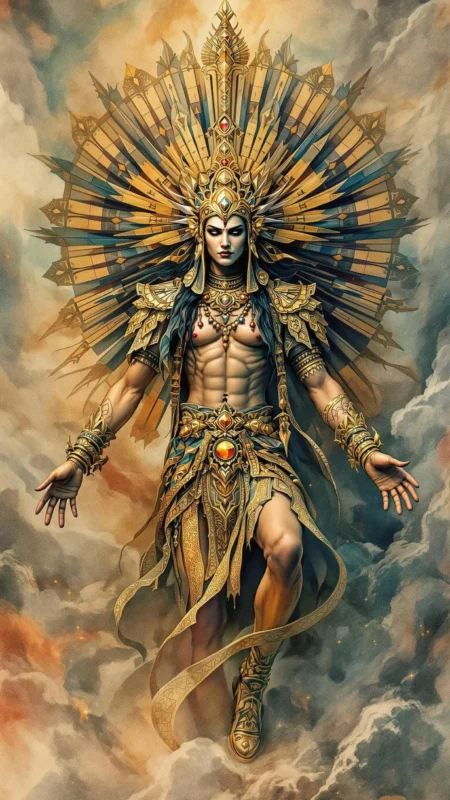
To carry the Huitzilopochtli archetype in one's personal mythology is to understand that consciousness is a daily, deliberate act of war against entropy. The sun is not guaranteed to rise. Your purpose, your vitality, your very sense of self must be fueled by a conscious, disciplined effort, a daily sacrifice. This sacrifice is no longer of others, but of the lesser parts of oneself: the lethargy, the doubt, the desire for easy comfort. Your myth becomes a solar narrative, where you are both the sun and the priest tasked with keeping it alive. Every dawn is a victory, earned through the vigilance of the night. It is the profound, unsettling wisdom that life is not a gift to be received, but a fortress to be maintained.
The hummingbird, so central to this deity, recasts the nature of power. It is not brute force, but relentless, high-frequency energy. It is the power of the soul, small and iridescent, yet capable of epic migrations and fierce defense. In a modern context, this could symbolize the immense influence of a focused, disciplined will, even when it seems one's resources are slight. The Huitzilopochtli archetype suggests that your greatest weapon is not your might, but your metabolic rate: the speed and intensity with which you convert intention into action. It is a call to be swift, precise, and dazzlingly alive.
This archetype is also inextricably linked to the idea of a promised land, a Tenochtitlan of the soul. It is the relentless quest for the place where one's own symbolic eagle can alight upon the cactus: the place of rightness, of destiny fulfilled. For the individual, this may manifest as a life-long project, a magnum opus, or the founding of a family or community that feels divinely ordained. This is not a casual search, but a sacred migration, often demanding the abandonment of old comforts and known territories. It is the drive to build a world that reflects a deep, inner, mythic order, to create a center that will hold against the chaos.