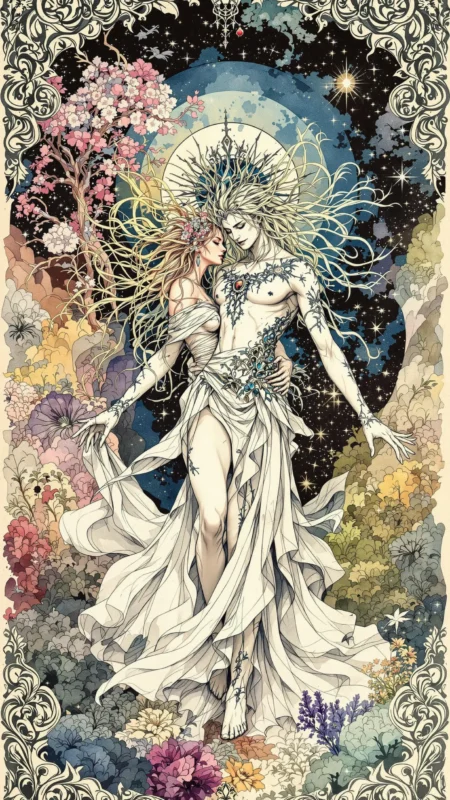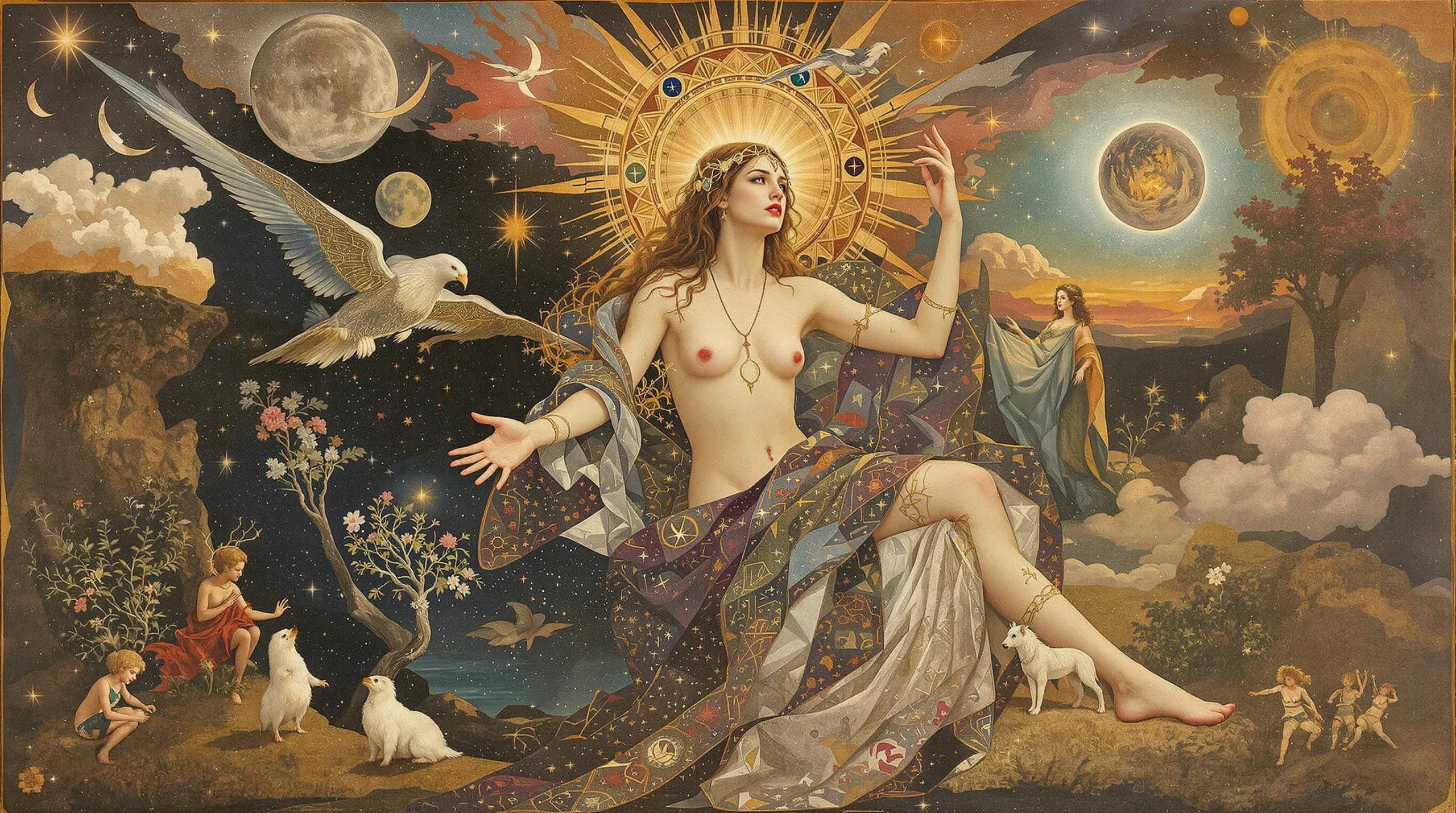


Demeter

Archetype Meaning & Symbolism

Nurturing, generative, grieving, patient, bountiful, stubborn, earthly, overbearing, cyclical, fierce

  • Tend to what is yours to grow, but remember: even the most barren winter prepares the soil for spring.

If Demeter is part of your personal mythology, you may...

Believe

  • You may believe that love is not a passive feeling but an active verb: an act of patient, devoted cultivation.
  • You may believe that true wealth is not accumulation but abundance: a full pantry, a warm hearth, and a table with enough room for everyone.
  • You may believe that every winter, no matter how bleak, holds the quiet promise of spring, and that fallow periods are necessary for growth.

Fear

  • You may fear barrenness above all else: a creative, emotional, or physical inability to make things grow.
  • You may fear the sudden, uncontrollable loss of what you have so carefully nurtured, the abduction by the underworld that leaves you powerless.
  • You may fear becoming irrelevant or unneeded, a silent winter where those you sustained no longer require your warmth.

Strength

  • Your patience is legendary. You possess the wisdom to wait through the longest winter, trusting in the cycle and the eventual return of life.
  • Your generative power is immense. You have a profound capacity to create and sustain, whether it is a family, a community, an artwork, or a garden.
  • Your loyalty is a force of nature. Your love is so fierce and protective it can feel capable of challenging the gods or stopping the world in its tracks to protect its own.

Weakness

  • You may over-identify with those you nurture, blurring the lines between their identity and your own until you lose yourself in the role of caregiver.
  • Your grief has the potential to be a destructive force. When wounded by loss, you might punish the whole world, creating a bitter winter for yourself and those around you.
  • Your resistance to change can be immense. You may struggle profoundly with letting go, viewing the natural separation required for growth as a personal betrayal.

The Symbolism & Meaning of Demeter

In the modern psyche, Demeter symbolizes the profound, untamable force of generative love. She is the archetype of the nurturer, the creator, the mother in all its forms: not just of children, but of art, of communities, of gardens, of ideas. To have Demeter in your personal mythology is to understand love as an act of cultivation. It is the patient tending of a seed in the dark, the fierce protection of the sprouting green, the joyous celebration of the harvest, and the deep, abiding grief when the field is empty. She represents a connection to the earth that is not abstract but visceral, a wisdom that flows from the body and the seasons rather than the intellect alone.

Her story is also one of life's most essential and painful bargains: the dance between connection and separation. Demeter's love is powerful enough to stop the world, yet she cannot prevent her daughter's journey into the underworld, into her own life. This archetype speaks to the part of us that must learn to let go of what we have created so it can become itself. The meaning of Demeter today is perhaps found in this tension. She is the anchor and the harbor, but she must also bless the ship that sails for unknown shores. She embodies the truth that the most powerful form of creation involves an eventual, necessary loss of control.

Furthermore, Demeter is the keeper of cycles. She teaches that life is not a linear progression towards a single goal but a recurring rhythm of growth, decay, and regeneration. A fallow period is not failure; it is preparation. Grief is not an end; it is the winter that makes spring possible. This could manifest as a deep, intuitive trust in life's processes, an ability to find meaning not just in the bloom but in the decomposition that enriches the soil. Your personal mythology might be less about a hero's journey to a single treasure and more about a gardener's lifelong relationship with a plot of land, finding divinity in the turning of the seasons within and without.


Demeter Relationships With Other Archetypes

Persephone

The relationship with Persephone is perhaps not one of two separate entities, but the story of a single soul learning to inhabit two worlds at once. She is the echo in the cavern, the reflection in the well—a part of the self that must journey into darkness to find its own sovereignty. The bond may be seen as a kind of sacred cord, stretched but never broken, humming with a melody of both presence and profound absence. For Demeter to remain whole, she must learn the rhythm of this separation, to understand that the flower must know the underworld of the root. In this, Persephone’s journey could be the crucible that transforms Demeter’s nurturing instinct from a simple, sunlit garden into a vast and complex landscape, capable of weathering the harshest of winters for the promise of a spring return.

The Seed

The Seed may be the ultimate paradox for the Demeter spirit: a vessel of life that must be surrendered to the dark, a promise of a future harvest that demands an act of burial. This archetype represents a compact of faith. In its small, hard casing, it holds the memory of sunlight and the potential for rebirth, yet it can only fulfill this destiny through a descent into the unknown earth. The relationship is thus a profound lesson in trust and release. Demeter’s power is not merely in the sprouting, but in the letting go; in placing this capsule of hope into the very soil that feels like a grave, she is perhaps practicing for a greater loss and a more miraculous return, learning that true nourishment requires a period of gestation in the silent, unseen depths.

The Threshold

More than a place, the Threshold could be a perpetual state of being for Demeter; it is the shimmering, painful membrane between what is and what is lost. It is the frozen riverbank in winter, the doorway to an empty room, the coastline where the ocean of grief meets the land of memory. Her archetypal journey is a constant negotiation with this liminal space. It is not an enemy to be conquered but a geography to be known. Her power, it seems, is not in erasing the threshold but in learning to stand upon it, to call across it, and to cultivate a patience so deep it can command life to return from the other side. The Threshold, then, is the site of her greatest sorrow and the source of her most resilient, world-altering strength.

Using Demeter in Every Day Life

Navigating Profound Loss

When grappling with a loss that feels like it has plunged your world into winter, the Demeter mythos offers a map. It doesn't rush the grieving process. Instead, it suggests that grief can be a powerful, world-altering force. You may find yourself withdrawing, your creative or social energies lying fallow. This archetype gives you permission to honor this barren season, not as an end, but as a necessary part of a cycle. Your task isn't to 'get over it' but to wander through your internal winter, searching for the lost part of yourself, knowing that this journey itself is what eventually coaxes the spring.

Cultivating a Long-Term Project

For the creative endeavor or career path that requires immense patience, the Demeter archetype provides a model of slow, deliberate cultivation. You may learn to see your project not as a machine to be built, but as a field to be tended. There are seasons for plowing and preparing the soil (research and planning), seasons for planting seeds (the initial creative burst), seasons for patient watering and weeding (the long, hard work of revision and refinement), and finally, a season of harvest. This perspective could help you weather periods of creative drought, understanding them as a natural fallow time that replenishes the soil for future growth.

Redefining a Parental Role

As children grow and require independence, the Demeter within you may struggle with letting go. The story of Demeter and Persephone is a lesson in this necessary separation. You could use this mythos to reframe your role: from the all-providing source to the wise elder who trusts the cycle. Your purpose may shift from direct cultivation to holding sacred space, becoming the home base your children can return to, a place of unconditional love that doesn't smother. It teaches that the ultimate act of nurturing is to allow the seedling to become its own forest, separate from your own.

Demeter is Known For

The Grieving Mother

Her anguish over the loss of her daughter, Persephone, is so profound it halts the world, creating the seasons of autumn and winter until her child is returned.

The Bountiful Harvest

As the goddess of agriculture and grain, she represents the planet’s capacity for nourishment, the miracle of the seed, and the life-sustaining abundance of the earth.

The Eleusinian Mysteries

Her secret rites, held at Eleusis, were famous throughout the ancient world, promising initiates a vision of the afterlife and a deeper understanding of the cycles of life, death, and rebirth.

How Demeter Might Affect Your Personal Mythology

How Demeter Might Affect Your Mythos

When Demeter is a central force in your personal mythos, your life story may not read as a tale of conquest or adventure, but as one of cultivation and stewardship. The major chapters of your narrative could be marked by seasons of planting, tending, harvesting, and lying fallow. A period of intense creativity or building a family becomes your 'summer,' a time of abundant growth. A painful loss, a career change, or a period of depression might be your 'winter,' a time when you withdraw your generative power from the world, a necessary grief that honors what was lost. Your epic moments are not battles won, but harvests gathered and winters survived.

Your mythos may also cast you in the role of the Source. You are the one from whom nourishment flows, the keeper of the hearth, the creator of the feast. The central conflicts in your story might revolve around threats to your 'field': the illness of a loved one, the potential failure of a beloved project, or the departure of those you have sustained. Your greatest quest may not be for a golden fleece, but for the return of a lost part of yourself or another, a journey into the underworld of grief to bargain for the return of life. Your life's meaning, in this story, is measured by what you have helped grow.

How Demeter Might Affect Your Sense of Self

Your sense of self may be deeply intertwined with your capacity to nurture and provide. You might see yourself as a gardener, and your self-worth could bloom or wither based on the state of your 'garden,' be it your family, your friendships, or your creative work. When things are thriving, you may feel a profound sense of purpose and a grounded, earthy competence. You are the one who makes things grow. This can be a source of immense strength and stability, a self-concept rooted in tangible acts of creation and care.

Conversely, your identity could feel terrifyingly fragile in the face of loss or change. If your self-worth is tied to being the provider, you may feel erased or invisible when your children leave home, a project ends, or you are unable to 'fix' someone's pain. The barren field becomes a mirror for a barren self. This can lead to a desperate clinging, a fear of emptiness that drives the shadow aspect of this archetype. The journey for a Demeter soul is often to discover an intrinsic sense of self that exists beyond the role of nurturer, to find value in the field even when it lies fallow.

How Demeter Might Affect Your Beliefs About The World

With a Demeter lens, you may view the world not as a marketplace of competing interests, but as a vast, interconnected ecosystem that requires tending. Success is not defined by accumulation or dominance, but by sustainable, regenerative cycles. You might see the rhythms of growth and decay everywhere: in the rise and fall of businesses, in the evolution of communities, in the flow of your own energy. This perspective could foster a deep ecological consciousness, a feeling of personal responsibility for the well-being of the whole, not just your own small plot.

This worldview could also be skeptical of narratives of endless progress and quick fixes. You understand that true growth takes time and that periods of rest and even decay are essential for long-term health. You might be more interested in building resilient systems than in achieving explosive but unsustainable results. Justice, for you, might look like ensuring everyone has access to the 'grain': not just food, but education, safety, and the resources needed to thrive. Your philosophy is one of earthly abundance, grounded in the belief that there is enough for everyone if we only learn to tend the garden together.

How Demeter Might Affect Your Relationships

In relationships, you may operate from a place of profound, patient investment. You don't just fall in love; you cultivate it. You are the person who remembers the small things, who provides steady emotional nourishment, who creates a space of warmth and safety for others to be vulnerable and to grow. Friendships and partnerships may feel like gardens you tend with care over many seasons. You likely derive immense joy from witnessing the flourishing of those you love, seeing their happiness as the ultimate harvest of your affection.

However, this deep investment can carry a heavy weight. The lines between your own well-being and the well-being of your loved ones might become blurred. You may have a tendency to over-give, to pour so much of yourself into the soil of another's life that your own roots wither. The shadow of Demeter in relationships is a love that can become possessive, a nurturing that subtly smothers independence. The departure or separation from a loved one could feel catastrophic, a personal winter that threatens to freeze your entire world. Learning to love without owning, and to nurture without controlling, is often the central relational lesson.

How Demeter Might Affect Your Role in Life

You may naturally gravitate towards the role of the steward, the caretaker, the one who ensures the foundations are strong so that others may build upon them. This may not be a role of overt leadership but one of quiet, essential influence. In a family, you might be the emotional anchor. In a workplace, you may be the one who fosters a healthy team culture, ensuring everyone feels supported and valued. Your perceived purpose is not to be the star, but to be the fertile ground from which stars can emerge.

This role can be deeply fulfilling, providing a powerful sense of purpose. You are the keeper of the hearth, the weaver of the safety net. Yet, it can also be a heavy burden, one that is often invisible and uncelebrated in a world that prizes individual achievement. You may feel that the well-being of the entire system rests on your shoulders, leading to exhaustion and resentment if your own needs for nourishment are ignored. Your life's work may involve learning to nurture yourself with the same devotion you offer to others, and to understand that even the most fertile ground needs its own season of rest.

Dream Interpretation of Demeter

In a positive context, dreaming of Demeter or her symbols—a field of golden wheat, a cornucopia overflowing, the act of baking bread—could be a potent affirmation from your subconscious. It may signify a period of immense fertility in your life. This might relate to creative projects coming to fruition, the deepening of nurturing relationships, or a newfound sense of inner abundance and security. The dream suggests your efforts at cultivation are paying off, and you are in a season of harvest. It can be an encouragement to trust in your generative power and to celebrate the bounty you have created in your inner or outer world.

In a negative context, a dream of a grieving Demeter, a barren or blighted field, or spoiled grain could be a warning from your deeper self. It might point to a state of creative block, a 'winter' of the soul where you feel unproductive and empty. This dream could also symbolize a profound and unresolved loss, with the barren landscape mirroring your inner state of grief. It may also reflect the shadow aspect of the archetype: a nurturing impulse that has become smothering, leading to decay instead of growth. The dream could be asking you to examine what part of your life you are clinging to too tightly, or what grief you must move through to allow for new life to begin.

How Demeter Archetype Might Affect Your Needs

How Demeter Might Affect Your Physiological Needs

The Demeter archetype anchors your personal mythos in the most fundamental of physiological needs: food, warmth, shelter. For you, these are not mere practicalities; they are sacred. The act of preparing a meal could be a ritual, a tangible expression of love and care that nourishes you as much as it does the recipients. You might feel a profound sense of rightness and calm when your home is warm, your pantry is full, and those you love are safe and sound. Your body's own rhythms—hunger, energy, fatigue—may be seen as important signals, a personal ecosystem that needs to be tended.

A disruption to these basic needs can feel like a spiritual crisis. An empty refrigerator might not just be an inconvenience; it could trigger a deep, archetypal fear of barrenness and famine. You may feel a powerful, almost primal drive to ensure these foundational needs are met, not just for yourself but for your entire 'tribe.' This can manifest as a deep satisfaction in providing physical comfort and a profound anxiety when that ability is threatened, as the stability of your entire mythological world rests upon this fertile ground.

How Demeter Might Affect Your Ideas of Belonging

Belongingness is the very air the Demeter archetype breathes. Your role in your personal myth is often to be the creator of belonging for others. You are the gravitational center of the family, the community, the friend group. You foster intimacy and connection through shared meals, consistent presence, and unconditional support. You build the 'home' that others come home to, whether it's a physical place or an emotional state. Your gift is making others feel seen, valued, and fundamentally a part of something larger than themselves.

Your own sense of belonging, however, may be contingent upon being needed in this role. You feel most a part of the group when you are actively nurturing it. This creates a potential vulnerability: if the group's needs change, if your children grow up, if your friends become self-sufficient, you might feel a terrifying sense of exile. It can feel as though your purpose, and thus your place, has vanished. The challenge for the Demeter soul is to cultivate a sense of belonging that is inherent, not earned through caretaking, and to learn to receive love as openly as you give it.

How Demeter Might Affect Your Feelings of Safety

For the Demeter archetype, safety is not about fortifications and weapons; it is about creating a stable, predictable, and nurturing environment where life can flourish without fear. Your focus on safety may be less about preventing a sudden attack and more about warding off the slow dangers of chaos, neglect, and scarcity. You might build 'safety' through establishing reliable routines, creating a welcoming home, ensuring financial stability, and cultivating strong, dependable relationships. The ultimate safe space is a well-tended garden, protected from blight and frost.

The greatest threat in this worldview is not a visible enemy, but the unpredictable underworld that can swallow what you cherish. This could be a sudden illness, a job loss, or a betrayal—anything that introduces chaos and loss into the world you have so carefully cultivated. Your efforts to create safety are a constant negotiation with the forces of entropy and decay. Consequently, you may have a low tolerance for unnecessary risk-taking or instability, as it threatens the very soil from which your and others' well-being grows. Your quest for safety is a quest for a reliable spring.

How Demeter Might Affect Your Views of Esteem

Esteem, within the Demeter mythos, is directly tied to the fruits of your labor. Your self-worth is not measured by applause or status, but by the tangible evidence of your nurturing power. A thriving garden, a successful project, a happy and well-adjusted child, a warm and lively dinner party—these are your trophies. You feel competent and valuable when you see the concrete, positive results of your care and effort in the world. This provides a very grounded, reality-based form of self-esteem, built on contribution rather than ego.

This also means your esteem can be perilously dependent on external outcomes you cannot fully control. A project that fails despite your best efforts, a child who struggles, a relationship that ends—these can feel like profound personal failures that strike at the core of your self-worth. It may be difficult to separate your value as a person from the success of what you nurture. The deeper journey for your esteem needs is to learn to value the act of cultivation itself—the effort, the intention, the love—regardless of the final harvest, and to find worth in your own being, not just in your doing.

Shadow of Demeter

The shadow of Demeter emerges when nurturing curdles into control. This is the Devouring Mother, whose love becomes a cage and whose nourishment is a poison that stunts growth and prevents independence. In this shadow aspect, you may refuse to let your 'children'—be they actual offspring, creative projects, or protégés—enter their own 'underworld' of experience and trial. You might create a world so perfectly managed and safe that it becomes a gilded prison, sabotaging any attempt at separation because their departure feels like a personal death. Your care becomes a means of ensuring they never leave, which ultimately prevents them from ever truly living.

The other face of the shadow is the Queen of Perpetual Winter. When faced with a loss she cannot control, the shadow Demeter does not move through her grief; she weaponizes it. She pulls all her generative energy back from the world and declares that if she must suffer, then everything must suffer with her. This can manifest as a deep, intractable depression that starves all joy and creativity in her vicinity. She refuses to let new seeds sprout because she is fixated on the one that was lost. The entire world, internal and external, is made barren to reflect her pain, and she rejects any attempt to coax her back into the cycle of life.

Pros & Cons of Demeter in Your Mythology

Pros

  • You are a source of profound stability, comfort, and nourishment for others, creating a safe harbor in a chaotic world.
  • You possess a deep, intuitive wisdom about the cycles of life, allowing you to navigate periods of growth and loss with patience and grace.
  • Your capacity for love is immense, generating fierce loyalty and a protective instinct that can be a powerful force for good in the lives of those you care about.

Cons

  • Your sense of self can become dangerously enmeshed with your role as a nurturer, leading to a loss of personal identity.
  • Your grief over loss can be all-consuming, potentially leading to a 'winter' of depression that negatively impacts yourself and those around you.
  • You may resist change and the independence of others, inadvertently smothering the very things you wish to see grow.