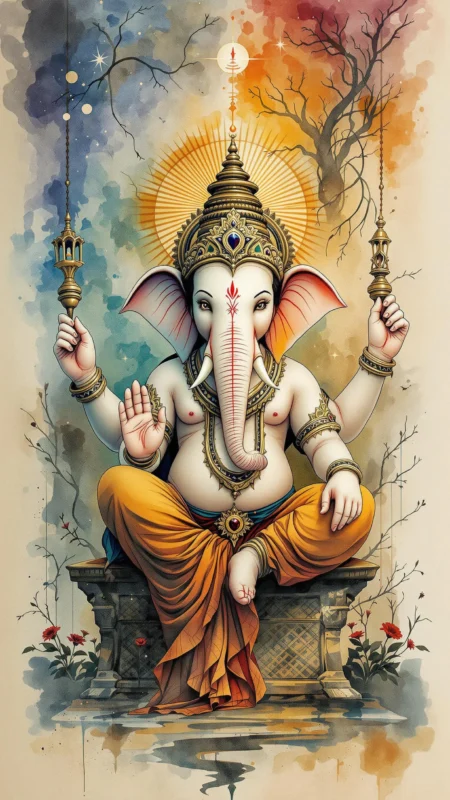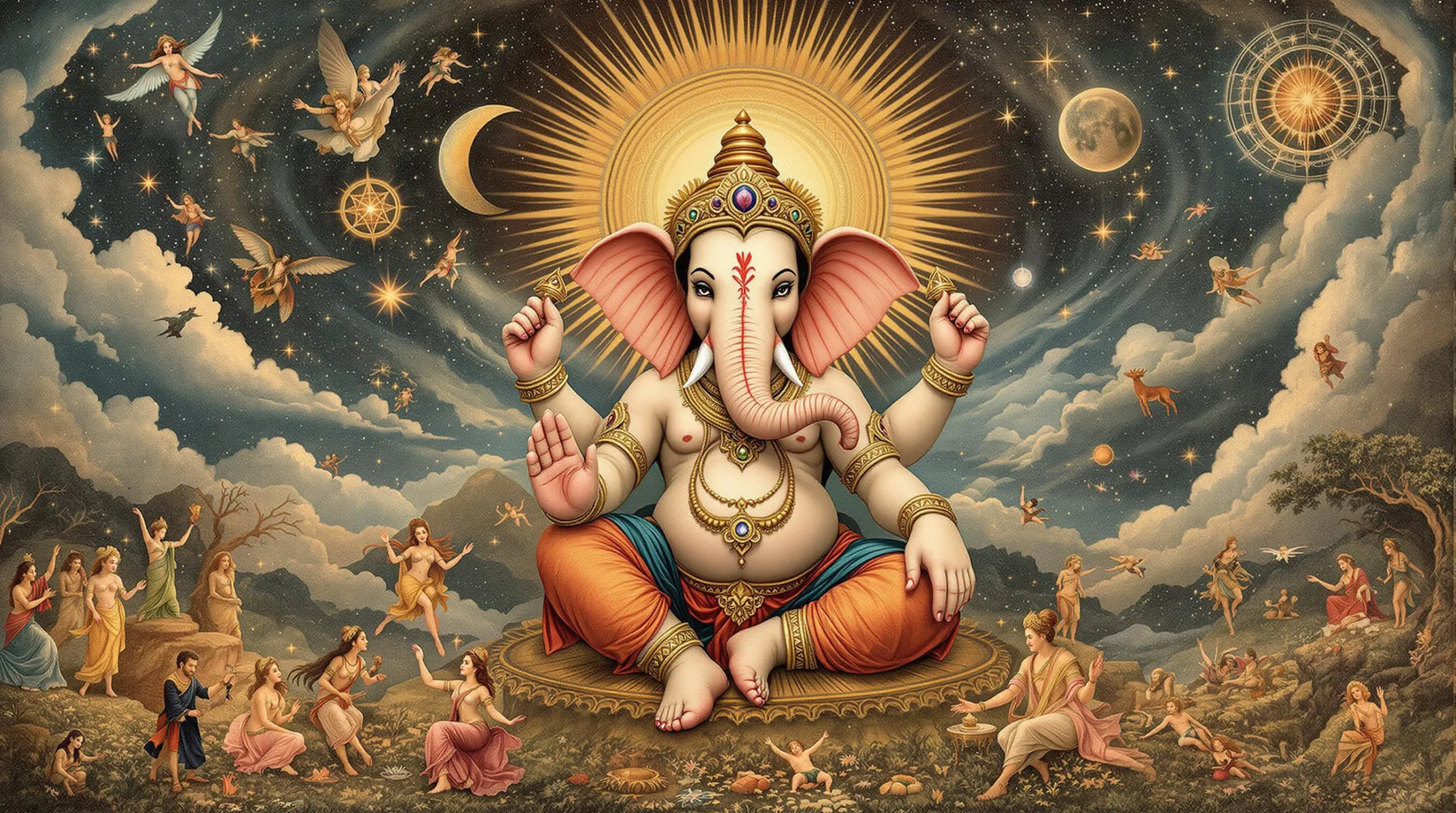


Ganesha

Archetype Meaning & Symbolism

Scholarly, patient, jovial, auspicious, strategic, protective, sweet-toothed, loyal, methodical, gatekeeper

  • The path is not blocked. You have simply not yet learned to read the map it offers. Look closer: every stone is a word, every turn a sentence.

If Ganesha is part of your personal mythology, you may...

Believe

  • That every obstacle is a form of divine architecture, designed to be understood, not destroyed.
  • That the most powerful act is the one that precedes all others: the sacred, intentional act of beginning.
  • That wisdom is the sweet reward of a life lived with attention, and joy is its most natural expression.

Fear

  • An illogical, chaotic force that cannot be reasoned with or planned for; a problem with no elegant solution.
  • The paralysis that comes from over-analysis, where the process of preparing for the journey prevents it from ever beginning.
  • Losing your intellectual sharpness or creative spark, the very tools you rely on to navigate the world.

Strength

  • A preternatural ability to remain calm and strategic in the face of daunting complexity.
  • A deep reverence for knowledge and process, leading to well-executed and successful endeavors.
  • An auspicious and reassuring presence that inspires confidence and trust in others.

Weakness

  • A tendency toward procrastination, disguised as the need for more research or planning.
  • A potential for intellectual arrogance, a stubborn attachment to your own solutions and a dismissal of simpler, more intuitive approaches.
  • A vulnerability to life's sweet distractions, which can sometimes divert you from your primary purpose.

The Symbolism & Meaning of Ganesha

To have Ganesha as a fixture in your personal mythology is to carry the paradox of immense power housed in a gentle form. His elephant head on a human body is not a grotesque hybrid but a profound symbol of integration: the microcosm and the macrocosm, animal instinct and divine intellect, all coexisting in a single, harmonious being. This could mean your own perceived contradictions are not flaws but your unique synthesis, your particular genius. The large ears suggest that true wisdom begins with listening, an almost passive absorption of the world’s complexities before any action is taken. The small mouth, in turn, points to a measured, deliberate use of speech. This archetype suggests that power is not in the roar, but in the knowing.

The tools he holds are further maps to this inner landscape. The axe cuts away attachments, the illusions that form our most stubborn obstacles. The noose, or pasha, is not for binding others, but for pulling a goal closer, for reining in the wandering mind. And the bowl of sweets, the modaka, is a constant reminder that the reward of wisdom is joy, that the spiritual path need not be one of grim austerity. It suggests a life where discipline and delight are not opposites but partners. The broken tusk is perhaps the most poignant symbol: the sacrifice of a part of oneself, of pride or a cherished belief, in service of a greater task, like transcribing an epic. It reframes loss as a necessary tool for creation.

At its core, the Ganesha symbolism is about process. He is the deity of the threshold, the sacred pause before the beginning. He champions the idea that how you start something determines its entire trajectory. In your personal mythos, this translates to a reverence for preparation, for understanding the terrain before taking the first step. It is the wisdom of the architect who studies the ground before drawing the blueprint, the writer who outlines before penning the first chapter. Ganesha doesn't promise a life without obstacles; he promises that you possess the inherent intelligence and perspective to see them for what they are: not blockades, but invitations to be more clever, more patient, more wise.


Ganesha Relationships With Other Archetypes

The Unhewn Stone

With the Unhewn Stone, the Ganesha archetype may share a relationship not of opposition, but of profound and patient perception. The stone is a brute fact of the landscape, a dense and silent impediment, the very definition of an obstacle. Yet Ganesha does not merely arrive to clear it away. Rather, his presence could be seen as the quiet intelligence that perceives the path latent within the rock itself, the statue sleeping in the marble. He is perhaps the divine geologist who understands the fault lines, the hidden cleavages where a gentle, persistent pressure can coax a passage into being. The relationship is one of potential recognized; the obstacle is not so much destroyed as it is persuaded to become a gateway, its stubborn mass transformed into the very lintel and threshold of a new beginning.

The Crossroads

At the Crossroads, that liminal space of frozen potential and anxious choice, the Ganesha archetype could be the quiet presiding deity. The Crossroads is a question without an immediate answer, a place where every path forward is haunted by the ghosts of the paths not taken. Ganesha’s wisdom here may not be in providing a map, but in sanctifying the very act of departure. His presence is a blessing upon the threshold, a reminder that the courage to take a first step, any first step, is a sacred act. He is the patron of the venture itself, transforming the paralysis of the dilemma into the fecundity of a beginning. This relationship suggests that the journey’s worth is not determined by the correctness of the path chosen, but by the mindful grace with which one begins.

The Scribe's Broken Quill

The Ganesha archetype’s bond with the Scribe's Broken Quill is perhaps one of the most intimate, a testament to sacrifice in the service of a greater story. When the external tool fails—when the ink runs dry, the method proves inadequate, the quill snaps mid-sentence—a crisis of creation occurs. Ganesha’s legendary response, breaking his own tusk to continue his transcription, suggests a profound truth: the ultimate instrument is the self. This relationship teaches that a limitation, when met with devotion, may be turned into a unique strength. The broken quill forces an act of invention, compelling the scribe to find a new way to make a mark. It is a metaphor for the moment the artist must give a piece of themself to the art, transforming a wound into a stylus, and proving that the story is more important than the vessel that carries it.

Using Ganesha in Every Day Life

Starting a Creative Project

When faced with the blank page or an empty canvas, the Ganesha archetype encourages a ritual of beginning. Instead of plunging in, you may find yourself preparing the space, gathering your tools with intention, and meditating on the purpose of the work. The first mark made is not a guess but a deliberate, blessed act, an invocation that sets the tone for all that follows, ensuring the endeavor is founded on wisdom, not just ambition.

Navigating Bureaucracy

Confronted by a labyrinth of paperwork or institutional red tape, your inner Ganesha does not despair or rage. It sees the system as a complex text to be deciphered. You might methodically chart the flow of information, identify the key gatekeepers, and approach them not with demands but with respect and perhaps a small, symbolic offering: a compliment, a patient explanation. The obstacle becomes a puzzle, and your intellect, the tool for its elegant disassembly.

Overcoming Intellectual Stagnation

When a line of inquiry or a personal philosophy leads to a dead end, this archetype suggests a change in perspective is the only tool required. It’s the wisdom of the broken tusk: sacrifice a cherished assumption. You might consciously set aside a core belief to see where its absence leads. This act of intellectual humility, of breaking your own instrument for the sake of a greater story, could be what clears the path for profound insight.

Ganesha is Known For

Remover of Obstacles

The primary function for which Ganesha is revered. He is not a destroyer of barriers through force, but a clearer of paths through wisdom, strategy, and auspicious influence.

Patron of Arts and Sciences

As the divine scribe who wrote down the Mahabharata, he represents the intellect, literature, and the profound power of knowledge. He is the patron of anyone who works with words, ideas, or creative expression.

God of Beginnings

His presence is invoked at the start of any new venture, be it a journey, a business, a marriage, or a new day. He is the guardian of the threshold, ensuring that new endeavors are founded on a solid and blessed footing.

How Ganesha Might Affect Your Personal Mythology

How Ganesha Might Affect Your Mythos

When Ganesha informs your personal mythos, your life story may cease to be a hero’s journey of conflict and conquest. Instead, it becomes a scholar’s pilgrimage, a narrative of intricate problems elegantly solved. The major plot points are not battles won, but puzzles deciphered. Your personal history might be framed as a series of gates, each one opened with a different key of knowledge or insight. You are the protagonist who, instead of slaying the dragon, learns its language and convinces it to move. This narrative values intellect over instinct, strategy over strength, and views an obstacle as a test of character and wit rather than a malevolent force.

The story arc is perhaps less dramatic, less marked by explosive confrontations, and more by quiet epiphanies. The climax of a chapter in your life might not be a victory, but a sudden, profound understanding that reframes the entire problem. Your mythos is populated not by enemies, but by complex systems and gatekeepers who must be understood, not defeated. Your role is that of the wise counselor, the scribe of your own epic, who knows that the most powerful weapon is a well-structured thought and the most important journey is the one that begins with a clear and patient mind.

How Ganesha Might Affect Your Sense of Self

To see oneself through the lens of Ganesha is to find peace with personal paradoxes. The combination of immense strength and gentle spirit, of animal form and divine mind, gives you permission to embrace your own contradictory nature. You may see your quirks not as weaknesses, but as the very source of your unique perspective. Self-worth might be tied less to physical appearance or social status and more to your capacity for thoughtful action and deep learning. The pot-belly, a symbol of abundance and contentment, could allow you to be at ease with your physical form, seeing it as a vessel for a rich inner life rather than an object for external validation.

This archetype may foster a deep, quiet confidence rooted in intellectual capability. You might trust your mind to navigate you through life’s complexities, fostering a sense of self-reliance that is calm and unshakeable. There could be a feeling of being an old soul, someone who understands that patience and a long view are more effective than frantic effort. This self-perception is not about being the smartest person in the room, but about being the one who best understands the room itself: its entrances, its exits, and the intricate dance of the people within it.

How Ganesha Might Affect Your Beliefs About The World

With Ganesha as a guide, the world may appear not as a chaotic and threatening place, but as a great, unfolding text rich with meaning. Every challenge, from a difficult conversation to a global crisis, is seen as a complex problem with an inherent solution waiting to be discovered. This worldview is fundamentally optimistic, not in a naive sense, but in its deep faith in the power of intellect, creativity, and order to prevail over chaos. It suggests that for every lock, a key exists somewhere, and the purpose of life is the patient, joyful search for it.

This perspective also sanctifies the act of beginning. A new day, a new relationship, a new project—all are seen as sacred thresholds deserving of intention and care. The world is not something to be conquered, but something to be engaged with, studied, and understood. There is a sense that the universe is governed by an underlying intelligence and that by aligning oneself with wisdom and thoughtfulness, one can move in harmony with this cosmic order. Obstacles are no longer frustrating barriers but simply part of the curriculum, lessons designed to sharpen the mind and deepen the spirit.

How Ganesha Might Affect Your Relationships

In relationships, the Ganesha archetype may manifest as the role of the patient listener and the wise counselor. Your large ears are always open, not just to the words but to the underlying problems your loved ones face. You might become the person friends and family turn to when they are stuck, trusting in your ability to see a path they cannot. You may approach connection with deliberation, preferring deep, loyal bonds built over time to fleeting, passionate encounters. Your affection is shown not through grand romantic gestures, but through steady, reliable support and the sweet offering of your time and wisdom.

However, this approach could also mean you are a gatekeeper to your own heart, requiring others to demonstrate sincerity and thoughtfulness before granting them entry. You might value intellectual and spiritual connection above all else, seeking partners who are fellow students of life. There is a playful, jovial quality here too: relationships should be a source of delight and sweetness, a reward for the hard work of understanding. You are loyal and protective, but your protection is offered through foresight and good advice, clearing the path for those you love.

How Ganesha Might Affect Your Role in Life

Your perceived role in life, under the Ganesha mythos, is likely not that of the king or the warrior, but of the vizier, the scribe, the architect, or the librarian. It is a role of influence rather than overt power, of wisdom rather than command. You may feel a calling to be a facilitator, a clearer of paths for others. This could manifest as being a great teacher, a mentor, a project manager who can gracefully navigate complex systems, or an artist who brings new ideas into the world with care and precision. Your purpose is found in creating order, fostering understanding, and presiding over auspicious beginnings.

You may feel a deep responsibility to be a keeper of knowledge and a synthesizer of ideas. Your role is to bridge worlds: the academic and the practical, the spiritual and the material, the creative and the logical. You are the steady presence at the gate, ensuring that what passes through is worthy and well-intentioned. This is a role of immense importance, but it is often played behind the scenes, content with the success of the venture rather than the personal glory it might bring.

Dream Interpretation of Ganesha

To dream of Ganesha in a positive light, perhaps seeing him clearing a path, offering you a sweet, or simply sitting peacefully, often signifies an imminent breakthrough. The dream may be your subconscious confirming that you have the intellectual and spiritual tools necessary to overcome a current obstacle. It can be an affirmation of a new beginning, suggesting that a project you are about to start or a path you are about to take is blessed and will unfold favorably. It is a symbol of your own inner wisdom coming to the forefront, assuring you that the solution you seek is already within your grasp. The dream is an invitation to proceed with confidence and deliberation.

Conversely, a dream featuring a damaged, angry, or obstructive Ganesha could be a potent warning from your psyche. It might symbolize an obstacle of your own making, perhaps born of intellectual pride or stubbornness. It could suggest that you are approaching a problem with brute force instead of wisdom, or that a new venture has been initiated with poor intentions and is therefore blocked. An angry Ganesha might represent your own frustration with a mental block. The dream may be urging you to reconsider your approach, to sacrifice a rigid belief (the broken tusk), or to acknowledge that your own analysis has become the very thing that traps you.

How Ganesha Archetype Might Affect Your Needs

How Ganesha Might Affect Your Physiological Needs

When the Ganesha archetype shapes your personal mythology, your physiological needs may be viewed through a lens of joyful sacrament. The body is the sacred temple for the mind, and its needs are to be met with reverence and delight, not with guilt or obsessive discipline. The need for food, symbolized by Ganesha's love for sweets, is not just about fuel; it is about pleasure, community, and the material abundance that makes intellectual and spiritual pursuits possible. You may find that you require a comfortable, stable physical environment to do your best thinking, a place where the body is at ease so the mind can roam free.

There could be a profound connection between physical well-being and mental clarity. A state of hunger, discomfort, or physical neglect may be perceived as a direct impediment to thought, an obstacle to be removed before any real work can begin. This leads to a practical, non-ascetic approach to health: the body must be well-tended, well-fed, and comfortable. It is not about achieving a certain physical ideal, but about creating a state of physical contentment that serves as the foundation for a rich inner life, much like Ganesha's stable, seated posture provides the base for his divine awareness.

How Ganesha Might Affect Your Ideas of Belonging

For one who identifies with Ganesha, belongingness is found in communities of shared intellect and purpose. You may feel most at home in a library, a classroom, a lab, or a creative studio, environments where knowledge is pursued and celebrated. Love and friendship are built on a foundation of mutual respect for each other's minds. The deepest bonds may be formed through the act of collaborative problem-solving or shared learning, where your intellect is seen, valued, and engaged. The large ears of Ganesha symbolize your role in creating this belonging: you are a master listener, and people feel seen and understood in your presence.

Love may be expressed through acts of intellectual service: helping a partner navigate a career challenge, editing a friend's manuscript, or simply offering a well-considered perspective that untangles a complex emotional knot. You create intimacy by clearing paths for those you care about, making their journeys smoother. Belonging is not about fitting in with a crowd, but about finding your fellow scribes, your co-architects, the few who understand that the most profound connection is a meeting of minds engaged in the beautiful, complex work of creation and understanding.

How Ganesha Might Affect Your Feelings of Safety

Safety, in the world of the Ganesha archetype, is primarily an intellectual construct. A sense of security may come not from high walls or powerful weapons, but from understanding, foresight, and meticulous planning. You might feel safest when you have thoroughly researched a situation, understood all the variables, and have a clear, strategic path forward. The true danger is not the unknown, but the unexamined. Safety is a state of preparedness, the quiet confidence that comes from knowing you have the mental resources to handle whatever comes your way.

The symbol of the broken tusk introduces a sophisticated layer to this idea of safety. It suggests that absolute invulnerability is not the goal, and that sometimes, safety requires sacrifice. To secure a greater good or to achieve a deeper understanding, you may have to let go of a part of yourself, be it a cherished belief, a comfortable position, or a material possession. Security, therefore, is redefined as resilience and adaptability. It is the safety of knowing you can break and still be whole, that you can give up a piece of yourself to write a much grander story.

How Ganesha Might Affect Your Views of Esteem

Esteem, both from self and others, is likely earned through intellectual competence and reliable wisdom. Your self-worth may be deeply tied to your ability to solve problems, to learn and master complex subjects, and to successfully initiate new ventures. You might feel a quiet pride not in being loud or dominant, but in being the person who simply knows what to do. Ganesha's pot-belly, symbolizing the digestion and containment of all of life's experiences, suggests an esteem born of a deep, unshakeable contentment with one's own inner resources and knowledge.

Respect from others is garnered through your reputation as a remover of obstacles. People may not see you as a charismatic leader, but they see you as indispensable, the one to consult before any important undertaking. Your esteem is built on a track record of success, not of battles, but of projects flawlessly executed, of crises calmly navigated, and of advice that proves wise. It is the esteem granted to the masterful strategist, the patient teacher, and the auspicious presence whose involvement guarantees a thoughtful, well-considered approach.

Shadow of Ganesha

The shadow of Ganesha manifests as a form of benign paralysis. The Remover of Obstacles becomes the Architect of Impediments. The need for a perfect, auspicious beginning can become an excuse for never starting at all. Every potential path is analyzed to death, every risk magnified, until the threshold itself becomes a permanent residence. Here, wisdom curdles into intellectual superiority, and the individual becomes a gatekeeper who uses knowledge not to clear the way for others, but to prove why their ideas are flawed and their paths impassable. The jovial lover of sweets becomes a glutton, seeking endless pleasure and distraction to avoid the hard work of the task at hand.

In its more active shadow, this archetype can become a subtle manipulator. Instead of removing obstacles, one might create needless complexity in a project or relationship simply to remain indispensable, the only one who holds the map. The gentle guide becomes the pedantic micromanager. The broken tusk is no longer a symbol of noble sacrifice but of a wound that will not heal, a past intellectual failure that is used as a justification for cynicism and inaction. The shadow Ganesha is the brilliant scholar who never publishes, the masterful strategist with no campaign, forever polishing the key to a door they are too afraid to open.

Pros & Cons of Ganesha in Your Mythology

Pros

  • You possess an innate capacity for navigating life’s complexities with grace and intelligence, often finding simple solutions to daunting problems.
  • You are seen by others as a source of wisdom and stability, a person whose involvement in any project or relationship is a sign of good fortune.
  • Your methodical and patient nature ensures that your endeavors are built on solid foundations, leading to sustainable, long-term success.

Cons

  • You may suffer from 'analysis paralysis,' spending so much time deliberating on the 'right' way to begin that you miss opportunities.
  • Your reputation as a problem-solver can become a burden, with others becoming overly dependent on you to manage their own challenges.
  • An over-reliance on intellect can create a disconnect from your own instincts and emotions, causing you to think your way through situations that simply need to be felt.