Believe
 Fear
Fear Strength
 Weakness
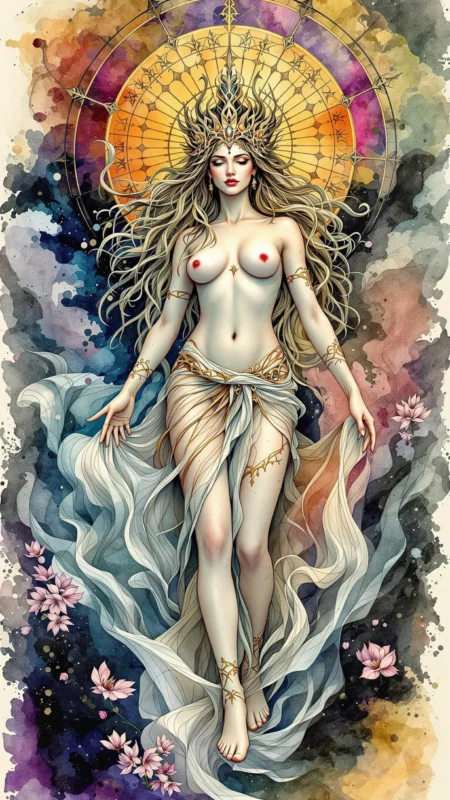
In the modern psyche, Aphrodite emerges not merely as a goddess of romantic entanglement, but as the fundamental principle of attraction itself. She is the animating force behind the artist reaching for the brush, the scientist captivated by the elegance of a formula, the gravitational pull between two strangers on a subway. Her domain is the charged space between things: the potent silence before a kiss, the magnetic field around a brilliant idea, the aesthetic harmony that makes a room feel like a sanctuary. To have Aphrodite in one's personal mythology is to be attuned to this current, to value what is compelling, beautiful, and life-affirming over what is merely practical or correct. She represents the wisdom of the senses, the intelligence of the heart, and the conviction that what we are drawn to holds the key to who we are becoming.
Her symbolism extends to the act of creation in all its forms. Born of the churning sea, she embodies the power to bring forth new life and new forms from the raw, chaotic stuff of potential. This is the fertility of the mind that births a novel, the alchemy in the boardroom that forges a new partnership, the literal and metaphorical conception that propels life forward. Her mirror is not just a tool of vanity; it is a symbol of self-awareness and the power of reflection. It suggests that to attract and create, one must first see and value the self. Her presence in a personal mythos may signal a life dedicated to the cultivation and expression of this creative, procreative, and reflective power.
Ultimately, Aphrodite stands for the profound act of valuation. She governs what we deem worthy of our love, our energy, and our attention. She is the patron of the subjective, arguing that a thing’s value is not inherent in its utility, but in the desire it inspires. In a world often obsessed with objective metrics and productivity, her archetype champions a different kind of worth: the worth of a sunset, the value of a poignant melody, the immeasurable treasure of a transformative connection. She teaches that what we love shapes us, and the conscious choice of where to place our devotion is perhaps the most significant creative act of all.