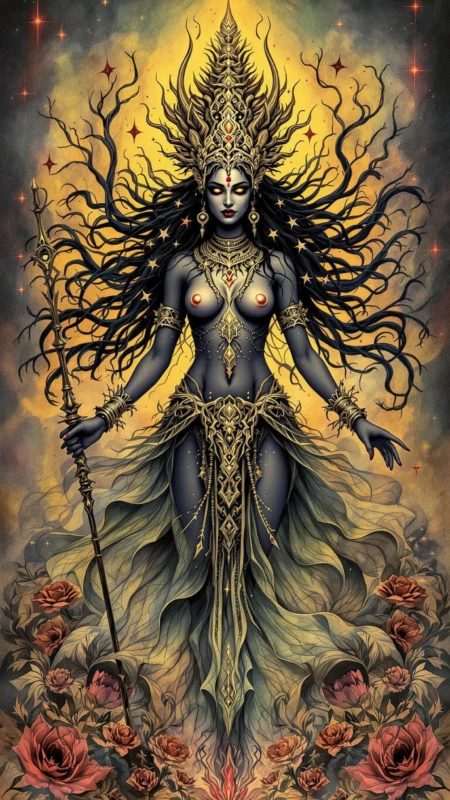
Kali

Archetype Meaning & Symbolism

Uncompromising, Liberating, Terrifying, Maternal, Cyclical, Raw, Primal, Ecstatic, Devouring, Unfettered

  • Do not decorate your cages. Burn them. Dance on the embers. The universe only knows one rhythm: create, destroy, become.

If Kali is part of your personal mythology, you may...

Believe

  • That destruction is a fundamentally creative and sacred act, clearing the way for new life.
  • That the most compassionate act is often the delivery of a painful, unvarnished truth.
  • That true freedom is found not in building a better cage, but in recognizing you were never meant for one.

Fear

  • Stagnation. The idea of a comfortable, predictable life may feel like a vision of hell, a slow death by boredom.
  • Losing control. A deep-seated fear that the destructive impulse, once unleashed, could become indiscriminate and harm the very things you intend to protect.
  • That after the burning, nothing new will grow. The moment of terror in the void, fearing that the destruction was final and you have created only a wasteland.

Strength

  • Fearless authenticity. You have the capacity to be who you are and speak your truth with little concern for the social fallout, liberating yourself and often others in the process.
  • Catalytic transformation. You possess an uncanny ability to initiate profound and necessary change, acting as a midwife to rebirth for yourself and those around you.
  • Radical resilience. Having faced numerous endings, you have a deep, embodied trust in the cycle of death and rebirth, allowing you to navigate crises with uncommon courage.

Weakness

  • Impatience with process. A tendency to reach for the sword when a gentler tool would suffice, sometimes burning down what could have been healed.
  • Relational ruthlessness. Your commitment to truth can become a blunt instrument, causing unnecessary pain and making it difficult to maintain relationships that require softness and compromise.
  • Addiction to intensity. An unconscious need for chaos and drama may lead you to sabotage periods of peace and stability, mistaking stillness for stagnation.

The Symbolism & Meaning of Kali

In the modern psyche, Kali may represent radical, uncompromising truth. She is the part of us that refuses to pretend, the voice that names the sickness in a system, the courage to face the abyss. To have her in one's personal mythology is to befriend the process of dissolution. The end of a job, a relationship, or an identity is not a failure but a sacred clearing. Her symbolism suggests that illusions, no matter how comforting, are cages. Her sword is not for cruelty but for liberation, cutting the cords of attachment that bind one to a smaller, more constricted life. She is the patron saint of the necessary ending, the fierce grace that arrives when a thing is well and truly over.

Her connection to time, or Kala, positions her as the embodiment of change. She is the chaotic, unpredictable, and often violent nature of reality itself. Her dance is the relentless unfolding of the universe, a process that inherently involves destruction. The skyscraper will one day be dust; our bodies will fail; empires will fall. A personal mythology informed by Kali does not see this as nihilistic but as a fundamental truth. It fosters a deep respect for cycles. This understanding could lead one to live more fully in the present, knowing that this moment, this form, is temporary and therefore infinitely precious. She is the reminder that only by embracing impermanence can one truly live.

Perhaps her most misunderstood aspect is her maternal nature. This is not the gentle, nurturing mother, but the she-bear who would tear apart a threat to her cubs. Her children are our souls, our truest selves, and the threat is the ego, with its vanities, fears, and delusions. Her love is a purifying fire. It may feel terrifying because it demands we surrender what we think we are in order to become what we are meant to be. She holds a severed head, a symbol of the slain ego, yet her hand is raised in a gesture of blessing: fear not. This death is a gift.


Kali Relationships With Other Archetypes

The Volcano

The relationship between Kali and the Volcano may be one of geological inevitability, a shared identity as the earth’s deep-throated scream. A volcano could be seen as the planet’s own Kali moment, a long-dormant pressure of unspoken truths and tectonic friction finally finding its violent, glorious expression. The eruption is not merely an annihilation but a terrible, fertile birthing, burying the tired landscape of the past so that new earth, rich and black and full of potential, may be born. In the same way, the force of Kali seems to rise from some molten core of reality, an incandescent love that is often mistaken for wrath, clearing the ground not with malice, but with an absolute, uncompromising necessity for renewal.

The Cremation Ground

Perhaps the Cremation Ground is Kali’s truest sanctuary, her most honest ballroom. It is a landscape stripped of pretense, the final ledger where all debts of illusion are paid and the currencies of ego, ambition, and vanity turn to ash. Her famed and fearsome dance upon this ground could be interpreted not as a morbid revelry, but as a celebration of this ultimate, liberating truth. She is the sovereign of this space because she embodies its essential lesson: that only by embracing the utter annihilation of what we *think* we are can we become receptive to the boundless reality of what we truly are. The ground itself, littered with the remnants of finite stories, seems to welcome her as the keeper of the final, clarifying fire that consumes all but the indestructible self.

Shiva, The Stillness

Kali’s relationship with Shiva, the archetype of pure, unmoving consciousness, is perhaps the central mystery that animates her being. He is the silent, snow-capped peak of awareness, the eternal witness. She is the wild, thundering storm that rages around it. In iconography, she dances upon his supine body, a gesture that might be misread as dominance but could rather be a profound depiction of their inseparability. She is the cosmic energy, *Shakti*, that can only move and create upon the silent, stable ground of consciousness, *Shiva*. He is the canvas; she is the furious, beautiful stroke. Without his stillness, her immense power might be ungrounded, chaotic, and meaningless. Without her motion, his consciousness would remain unmanifested, a potentiality forever unrealized. He is, perhaps, the only ground that can bear the full, terrifying weight of her dance and recognize it as the very pulse of life itself.

Using Kali in Every Day Life

Navigating a Creative Block

When inspiration stagnates, the Kali archetype within may suggest a controlled demolition. It is not about trying harder, but about taking the sword to the precious ideas that no longer serve. It is the courage to delete the entire manuscript, to paint over the canvas, to scrap the project and stand in the terrifying, fertile emptiness where something truly new can finally be born.

Ending a Relationship

In the face of a connection that has become a slow poison, this mythos provides the strength for a clean cut. It resists the temptation to fade away or to offer false hope. It may mean embracing the role of the “bad guy” to grant both parties the painful gift of a true ending, understanding that a swift, honest severance is a far greater act of love than a prolonged, inauthentic entanglement.

Confronting Personal Demons

For patterns of self-sabotage or addiction, the Kali energy is the uncompromising force that refuses negotiation. It is the moment of radical acceptance: this part of me must die for the rest of me to live. It is not a gentle weaning, but a ferocious battle, a primal scream of “no more,” fueled by a profound love for the self that is being born from the struggle.

Kali is Known For

The Destroyer of Illusions

Her primary role is to cut through the ego, falsehood, and attachments that prevent spiritual liberation. She wields the sword that severs the head of ignorance.

The Divine Mother

Paradoxically, her terrifying form is one of her most profound expressions of love

the fierce, protective energy of a mother who will destroy any threat to her children's true well-being.

The Dance of Time

As the consort of Shiva, who is Kala (Time), Kali represents the irresistible, all-devouring nature of time itself. She is the dynamic force of the cosmos, dancing the universe into and out of existence.

How Kali Might Affect Your Personal Mythology

How Kali Might Affect Your Mythos

When Kali is a feature of your personal landscape, your life story may not read as a steady, linear progression. Instead, it could be a saga of dramatic deaths and rebirths, a series of distinct chapters separated by fire. The narrative arc is not about building a tower brick by brick, but about inhabiting a succession of clearings, each one created by a necessary demolition. You may see your past not as a foundation but as a series of funeral pyres that illuminated the path forward. Your mythos might be defined by its ruptures: the sudden career change, the abrupt move across the country, the relationship that ended like a thunderclap. These are not plot twists but the central rhythm of your story.

In this narrative, your role may be that of the catalyst, the agent of change. You might be the character who, by speaking an unwelcome truth, brings the whole house of cards down. This can be a lonely role. You might be cast as the villain in the myths of others, the one who broke the peace or forced a painful reckoning. Yet, in your own story, you are simply honoring a fundamental law of the cosmos. Your purpose is not to build monuments but to clear the ground so that new, more authentic life can grow. Your story is not about what you accumulate, but about what you have the courage to release.

How Kali Might Affect Your Sense of Self

To see yourself through the eyes of Kali is to accept your own wildness. It is to recognize a primal, untamable force within that cannot be socialized into submission. You might feel a deep comfort with the so-called darker emotions: rage, grief, and ecstatic joy are not problems to be managed but sacred energies to be honored. Self-perception may shift from a carefully curated identity to a force of nature. You are not the manicured garden; you are the storm, the fire, the inexorable growth that cracks the pavement. This could bring a profound sense of inner authority that is not dependent on external validation.

This perspective may lead to a radical form of self-acceptance that includes the monstrous. The parts of you that are “too much”—too loud, too intense, too honest—are not flaws but the very source of your power. The severed head Kali holds is the ego, and to identify with her is to identify with the one who has power over the ego, not with the ego itself. This creates a deep, unshakeable sense of self rooted in the soul's truth, rather than in the shifting sands of social approval. You may feel you contain a terrible and beautiful power, a capacity for both ferocious destruction and fierce love, and you see no contradiction between the two.

How Kali Might Affect Your Beliefs About The World

A world-view informed by the Kali archetype may see civilization as a thin, fragile crust over a churning core of chaotic, creative energy. Institutions, governments, social norms: they are all temporary constructs, destined to be consumed by time. There is no ultimate safety to be found in them. The world is not a predictable, orderly machine to be mastered, but a wild, cosmic dance to be joined. Truth is not found in static doctrines or ideologies, but in the direct, unmediated experience of life's raw, untamable power. This can be a terrifying perspective, but also a liberating one.

This outlook could foster a strange and resilient optimism. If all structures are temporary, then even the most oppressive and corrupt systems are not permanent. Change is not just possible; it is inevitable. Decay is not a tragedy but the engine of renewal. This world-view does not shy away from suffering, decay, or death. It sees them as integral parts of the sacred whole, the necessary dissolution that precedes rebirth. It is a perspective that can find beauty in the ruins, potential in the abyss, and a deep, abiding faith in the cyclical nature of existence.

How Kali Might Affect Your Relationships

In relationships, the Kali mythos may demand a startling degree of authenticity. There could be an almost allergic reaction to pretense, polite fictions, and unspoken resentments. Connections must be rooted in a raw, vital truth, or they may feel like a tomb. This can make for profoundly deep, loyal, and transformative partnerships, where both individuals are committed to shattering their own and each other's illusions. The love here is not about comfort but about liberation. It is a shared commitment to burning away everything that is false.

Consequently, this can make for difficult and painful relational dynamics. The person embodying this archetype might initiate necessary endings with a swiftness that others perceive as cruel. They may struggle with the nuance and compromise that long-term partnership often requires, viewing it as a selling-out of the truth. They may wield honesty like a sword, sometimes forgetting that a sword can be used for surgery or for slaughter. For them, a relationship is either a crucible for transformation or it is a cage, and there is very little room for anything in between.

How Kali Might Affect Your Role in Life

If Kali informs your mythos, you may feel your role in life is to be a disruptor. You are the truth-teller, the system-crasher, the one who speaks the name of the elephant in the room until the room itself shakes. This is rarely a role chosen for its comfort or popularity; it may feel more like a sacred, and at times burdensome, duty. In a family, a community, or a workplace, you might be the catalyst who forces a necessary, albeit painful, confrontation with reality. Your function is to agitate, to disturb the peace, so that a more authentic peace can eventually be found.

This may also manifest as the role of a midwife to transformation. You might be the person others seek out when their own worlds are falling apart. Your role is not to offer platitudes or easy comforts, but to hold space for their disintegration. You are the friend who does not say “everything will be okay,” but rather, “I will sit with you in this fire.” You embody the belief that the only way out is through, and you grant others the terrible permission to fall apart, trusting in their own capacity to be reborn from the ashes.

Dream Interpretation of Kali

To dream of Kali in a positive context, especially if you meet her gaze without fear, may signal a profound readiness for liberation. She is arriving as a blessing, an affirmation of your own power. Her appearance could be a divine permission slip to finally quit the soul-crushing job, to sever ties with the toxic friend, to dismantle a limiting belief system that has kept you small. She may be dancing, signifying that this process of destruction is also one of ecstatic joy. Her presence suggests you have the strength to wield the sword of truth in your own life and clear the path for what is waiting to be born.

If Kali appears in a dream as a terrifying figure from whom you are fleeing, it could suggest you are desperately resisting a necessary and imminent transformation. The fear you feel is not of her, but of what she represents: the death of your ego, the end of a familiar reality. She may be chasing you because you are running from a truth about your life, your relationship, or yourself. Her terrifying aspect reflects your own terror of letting go. The dream is an urgent call to turn and face her, to ask what illusion she has come to destroy, and to surrender to the change you both know is required.

How Kali Archetype Might Affect Your Needs

How Kali Might Affect Your Physiological Needs

The Kali mythos may ground your experience of self firmly in the body, but not the body as a decorative object. It is the body as a vessel of primal force. Your physiological needs might orient around intense, cathartic release. There could be a deep-seated need for ecstatic dance until you collapse in sweat, for primal screaming in the woods, for exercise that pushes you to the absolute limit of your physical capacity. The need is not to look a certain way, but to feel the raw, undeniable fact of your aliveness: the pounding blood, the ragged breath, the aching muscles. It is a reclamation of the body as a wild, sacred animal.

This can lead to a re-prioritization of what the body truly requires, stripping away the superfluous. The craving might not be for gourmet food but for simple, hearty fuel that stokes the inner fire. The desire may not be for a soft mattress but for the feeling of solid earth beneath you. Comforts that create a buffer against the raw experience of being alive might be rejected. The fundamental need is for embodiment, for a direct and unfiltered connection to the life force that animates your physical form, in all its intensity, pleasure, and pain.

How Kali Might Affect Your Ideas of Belonging

When Kali is part of your inner world, the need for love and belongingness may undergo a radical purification. The desire is not simply to fit in, but to find a tribe that can witness and embrace your total, unvarnished authenticity. Superficial connections and social niceties may feel utterly unbearable. This can lead to a much smaller social circle, but one that is characterized by ferocious loyalty and profound intimacy. Belonging is not about being liked; it is about being seen, in all your terrible, beautiful complexity.

Belonging might also be found outside the human realm. A person with this mythos could feel a deeper kinship with the untamable forces of nature than with most social groups. They might feel they belong to the storm, to the ocean, to the cycle of decay and regrowth in a forest. This is a belonging that doesn't require performance or compromise. It is a primal recognition of the self in the wild, chaotic, and sacred dance of the cosmos, a feeling of being at home in the universe's great, unfolding drama.

How Kali Might Affect Your Feelings of Safety

From a Kali perspective, conventional notions of safety could appear as elaborate cages. The pursuit of security through steady paychecks, insurance policies, and predictable routines might feel like a slow suffocation. A person with this mythos may feel that true safety is a dangerous illusion, a denial of the world’s inherently chaotic nature. Therefore, they might not seek to build higher walls, but to become more comfortable with the fire. Safety is not the absence of threat, but the inner knowledge of one's own power to face, dismantle, or survive any threat.

Safety, then, is redefined as resilience. It is the deep, cellular trust in one's ability to endure dissolution and be reborn. It is the security of knowing that you can be burned to the ground and still find a way to rise from your own ashes. This might make a person paradoxically feel more secure in times of chaos and uncertainty, as their skills of radical adaptation become more valuable than anyone's fixed plans. They may find safety not in stability, but in their own capacity for transformation, which can never be taken away.

How Kali Might Affect Your Views of Esteem

Esteem, in a Kali-informed mythos, is not built on a foundation of external achievements or the praise of others. It is forged in the fire of self-confrontation. Self-worth may be measured by one's courage to face uncomfortable truths, to shatter one's own illusions, and to act with fearsome integrity. Esteem comes from the knowledge that you have not shied away from the necessary deaths your soul has required of you. It is the quiet pride of the survivor, the warrior, the one who has danced in the graveyard of her old selves and is unafraid.

This can create a formidable and unshakable sense of self-worth that is largely immune to public opinion. However, the risk is a kind of spiritual pride. The esteem comes from identifying with a cosmic, destructive-creative force, which can, if unchecked, lead to a feeling of being above the humbling, ordinary messiness of human interdependence. The challenge is to wield this power without letting it sever the threads of compassion and humility that connect you to others.

Shadow of Kali

The shadow of Kali emerges when her energy becomes untethered from sacred purpose. It is destruction for destruction's sake, rage that devolves into mere cruelty, chaos created out of a desperate boredom with peace. A person possessed by this shadow may mistake drama for aliveness, tearing down relationships, careers, and systems not because they are rotten, but because the act of destruction itself provides a momentary, addictive feeling of power. The sword of truth becomes a weapon of the ego, used to keep intimacy at bay, to punish others, and to reinforce a sense of righteous, isolated superiority. It is the terrifying force of a wildfire disconnected from the renewal of the forest, leaving only barren waste in its wake.

Conversely, the repression of this archetype is an equally potent shadow. When the fierce, liberating energy of Kali is denied, it turns inward and begins to attack the self. This can manifest as chronic depression, autoimmune disorders, or a pervasive sense of powerlessness and victimhood. The cleansing fire becomes a smoldering, toxic resentment. Instead of clean, honest confrontation, there is passive aggression. Instead of liberation, there is a life lived in a grey, suffocating fog of unspoken truths and compromises, a prison of politeness built on the grave of one's own wild, sacred power.

Pros & Cons of Kali in Your Mythology

Pros

  • You possess a profound capacity for self-reinvention, able to shed old skins and begin anew with remarkable courage.
  • You are a beacon of authenticity in a world that often rewards pretense, inspiring others to live more truthfully and bravely.
  • You have the inner resources to navigate the most profound crises of life, not just to survive them but to be transformed by them.

Cons

  • Your intensity can be perceived as intimidating, aggressive, or chaotic, making it difficult to form stable, peaceful relationships.
  • You may develop a resistance to calm and contentment, becoming addicted to the adrenaline of upheaval and crisis.
  • Your drive to dismantle illusions can be exhausting for you and those around you, and may at times lead you to destroy things that needed mending, not ending.