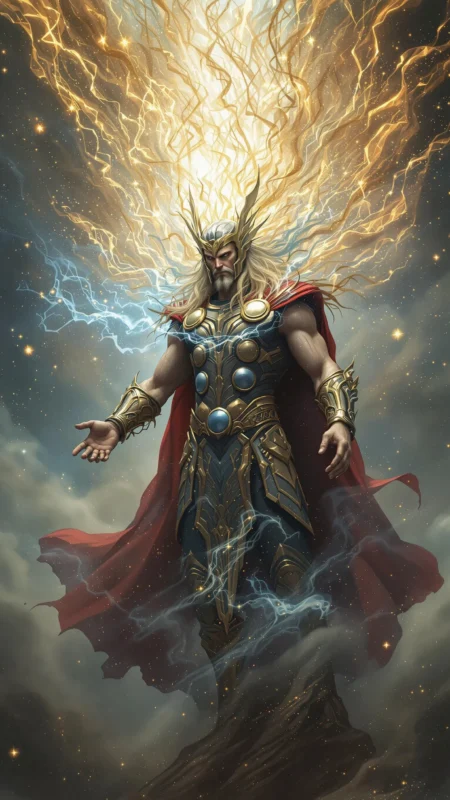
Thor

Archetype Meaning & Symbolism

Protective, boisterous, straightforward, loyal, powerful, blunt, zealous, simple, earthly, thunderous, courageous

  • The storm does not ask for permission. It arrives, clears the air, and departs. Learn from this directness, for truth has its own thunder.

If Thor is part of your personal mythology, you may...

Believe

  • That action is the most sincere form of expression.
  • That a person's worth is measured by their loyalty and the promises they keep.
  • That the simplest solution is almost always the best one.

Fear

  • Weakness, both physical and moral, as the ultimate failure.
  • Betrayal from within your trusted circle, as it bypasses all external defenses.
  • Situations of such complexity and ambiguity that they cannot be solved by direct action.

Strength

  • Unflinching courage in the face of adversity.
  • Profound loyalty and a powerful protective instinct for your loved ones.
  • A capacity for decisive action that cuts through confusion and inaction.

Weakness

  • A bluntness that can border on insensitivity or aggression.
  • A tendency to oversimplify complex problems, seeing everything as a nail for your hammer.
  • Difficulty with vulnerability, emotional nuance, and situations requiring diplomacy over force.

The Symbolism & Meaning of Thor

The Thor archetype in one's personal mythology is not about crude strength, but the raw, unvarnished energy of protection and action. It is the visceral impulse to stand between a loved one and a threat, the booming voice that speaks an uncomfortable but necessary truth. This is the part of the psyche that builds, that defends the perimeter, that finds profound satisfaction in a day's hard labor and the simple loyalty of a shared meal. It represents a kind of earthly virtue: a power rooted not in celestial abstraction, but in the soil, in the sinew, in the unwavering commitment to one's own. It's the force that says “enough” to complication, preferring the elegant finality of a well-aimed hammer blow to the endless chatter of negotiation.

To carry Thor within is perhaps to understand power as a responsibility, a tool to be wielded in service of a community, a family, a core set of non-negotiable values. This archetype doesn't seek complexity; it seeks to simplify, to cut through the tangled weeds of ambiguity with a bolt of lightning. Your inner Thor could be the engine that drives you through daunting tasks, the guarantor of your promises, the deep, resonant laugh that shakes the rafters and affirms life in its most boisterous forms. It is the champion of the common person, the defender of the hearth, finding its divinity not in a distant pantheon but in the sturdy reality of the here and now.

This mythic resonance also speaks to a connection with the elemental world. The Thor within feels the charge in the air before a storm, finds a kind of sacred rhythm in the percussive strike of a hammer on an anvil, and understands that some forces cannot be reasoned with, only weathered or channeled. It is a mythology of instinct over intellect, of heart over head, a recognition that sometimes the most profound act is a physical one. It could manifest as a sudden surge of courage in a crisis, or the unwavering stamina needed to see a long, arduous project through to its thunderous conclusion.


Thor Relationships With Other Archetypes

The Hammer

The relationship between The Thor and The Hammer is perhaps less one of wielder and tool, and more the bond between a storm cloud and its inevitable lightning. The Hammer may be the focal point of a vast, undifferentiated power, the dense, heavy anchor of purpose that keeps the thunder from merely echoing into the void. To be without it could feel like a kind of psychic amputation, a loss of the very grammar through which The Thor speaks to the world. It is the weight of a singular, undeniable talent, a gift so profound it risks becoming a cage, for the hand that holds the hammer may forget how to hold anything else.

The Trickster

The Thor’s engagement with The Trickster is a study in dialectical necessity. The Trickster, a shimmering mirage of half-truths and tangled motives, could be the very chaos that gives The Thor’s order its meaning. He is the knot that cannot be severed, only patiently, frustratingly, unpicked—a task for which the thunderer is often ill-equipped. This foil may serve as a constant, whispering reminder of the world’s infuriating complexity, a funhouse mirror reflecting The Thor’s own earnestness back as naivete. The straight line of The Thor’s force finds its purpose only in the crooked path laid by the Trickster; without the lie, there would be no glorious, simple truth to defend.

The Unmovable Mountain

Against The Unmovable Mountain, The Thor archetype finds the quiet, humbling terminus of its own power. This is not an enemy to be vanquished but a fact to be endured, a gravitational truth against which even divine force is rendered finite. The Mountain could represent the implacable reality of consequence, the slow grind of time, or a grief that cannot be smashed into submission. In its presence, the thunderous roar of The Thor may become a quiet echo, a confrontation with the unsettling notion that some battles are not won by breaking the opponent, but by accepting that one is, oneself, breakable. It is, perhaps, the final lesson in strength: knowing where it ends.

Using Thor in Every Day Life

Confronting Injustice

When witnessing a systemic issue at work or in your community, the Thor archetype provides the moral courage for direct confrontation. Instead of navigating intricate channels of anonymous feedback, you might feel compelled to call a meeting, state the problem plainly, and propose a direct solution, weathering the immediate discomfort for the sake of a just outcome. It is the energy to be the lone voice that says, “This is not right,” and to stand by that statement.

Navigating Personal Crisis

During a friend's or family member's crisis, this archetype informs a response of immediate, practical support. While others may offer thoughts and prayers, your instinct could be to show up with groceries, fix the leaking faucet, or provide a physical presence that wordlessly says, “I am here, you are safe.” This is the application of strength as a form of care, creating a pocket of stability in the midst of chaos.

Completing a Daunting Project

For the monumental task that inspires procrastination and dread, like renovating a home or writing a dissertation, the Thor within provides the raw stamina and singular focus. It is the part of you that can break the overwhelming goal into a series of tangible, physical tasks. Each nail hammered, each page written, becomes a satisfying, percussive blow against the inertia, channeling the energy of a force of nature to see the project through to its thunderous completion.

Thor is Known For

The Hammer Mjölnir

A mythical weapon of immense power, symbolizing the ability to destroy, to build, and to consecrate. It always returns to its owner's hand, representing the unfailing nature of one's core strength and conviction.

Defender of Midgard

Known as the protector of the human realm against the forces of chaos, primarily the giants. This speaks to the archetype's role as a guardian of the common, the everyday, and the established order against existential threats.

Uncomplicated Strength

Thor is celebrated not for his wit or cunning, but for his straightforward courage, immense physical power, and unwavering loyalty. He solves problems with direct action, not intricate schemes, embodying a virtue of simplicity and effectiveness.

How Thor Might Affect Your Personal Mythology

How Thor Might Affect Your Mythos

When Thor becomes a central figure in your personal mythos, your life story may transform from a subtle narrative of negotiation and adaptation into an epic of clear-cut battles and heroic defenses. Your personal history might be punctuated by moments of decisive action: the time you confronted a bully, the day you quit the soul-crushing job, the instance you physically built the bookshelf that became the centerpiece of your home. These events become the thunderclaps in your saga, the moments your hammer, Mjölnir, struck true. Your narrative arc could be less about finding your place and more about creating and defending it, carving out a space for your values in a world that often seems to favor nuance over conviction.

Your personal myth may also revolve around themes of guardianship. You might see your life not as a quest for personal enlightenment but as a series of sacred duties: to protect your family's innocence, to defend a friend's reputation, to safeguard a principle you hold dear. The villains in your story are not complex, morally grey figures; they are giants of injustice, serpents of deceit, forces of chaos threatening the ordered world you strive to maintain. Your victories are measured in the safety of your kin and the integrity of your word. This creates a mythos of profound, if simple, purpose: to be the bulwark, the storm wall, the steadfast protector of a cherished realm.

How Thor Might Affect Your Sense of Self

To see yourself through the lens of Thor is to perhaps embrace a fundamental simplicity in your identity. You may view yourself as a force of nature, direct and uncomplicated. Your self-worth might be tethered to your physical capabilities, your loyalty, and your capacity for decisive action. There is a kind of liberation in this view: you are not a creature of intricate psychological knots but a being of strength and purpose. Your body is not a mere vessel; it is a tool, an instrument of your will, and you may find a deep sense of self in its power and resilience. You might define yourself by what you can do, what you can protect, and who you stand for.

This self-perception could also foster a powerful, if sometimes blunt, sense of integrity. You may believe your word is your bond, a pact as solid as forged iron. Deception and manipulation might feel like personal affronts, violations of a natural order. Your identity could be built on a foundation of “what you see is what you get,” a rejection of artifice in favor of authenticity. This can lead to a very stable sense of self, one that is not easily swayed by external opinion or fleeting trends, but it may also struggle with situations that require subtlety, diplomacy, or the acknowledgement of one's own complex, contradictory inner states.

How Thor Might Affect Your Beliefs About The World

The world, through the eyes of the Thor archetype, may appear as a place of stark contrasts: order and chaos, loyalty and betrayal, strength and weakness. It is a realm that responds not to intricate theories but to direct force and unwavering conviction. You might see society's problems as giants to be slain, not as complex systems to be delicately re-engineered. Justice, in this worldview, is not a matter of restorative dialogue but of swift, decisive consequence. The world is a battlefield, a proving ground, where virtue is demonstrated through courage and commitment to one's tribe.

This perspective could also imbue the physical world with a raw, immanent divinity. A thunderstorm is not merely a meteorological event; it is a sacred display of power, a celestial cleansing. The effort of physical labor can feel like a form of prayer, a way of communing with the tangible reality of existence. You may possess a deep distrust for the abstract, the overly intellectual, the systems and ideologies that seem disconnected from the visceral truths of life, death, and survival. Your worldview is grounded, quite literally, in the earth beneath your feet and the strength in your hands.

How Thor Might Affect Your Relationships

In relationships, the Thor archetype manifests as a fierce, almost primal loyalty. Your love is a fortress. To be your friend or partner is to be brought inside the walls, to be under your unwavering protection. You may show affection not through poetic words or grand romantic gestures, but through acts of service: fixing the broken gate, standing up to a difficult boss on a loved one's behalf, providing a steady and unshakeable presence in times of crisis. Your bond is forged in shared struggle and mutual defense, a pact against the chaos of the outside world.

However, this protective instinct can sometimes feel overwhelming or simplistic to others. You might approach a partner's emotional distress as a problem to be solved, a monster to be slain, when what they need is a nuanced listener. Your bluntness, intended as honesty, could be perceived as a lack of tact or empathy. The Thor energy may struggle with the subtle currents of emotional intimacy that require vulnerability rather than strength, patience rather than action. You might forge incredibly strong bonds, but they could be bonds of alliance more than bonds of intricate, shared understanding.

How Thor Might Affect Your Role in Life

Your perceived role in life, under Thor's influence, is likely that of the Protector, the Guardian, the Champion. Whether in your family, your workplace, or your community, you may feel an innate responsibility to be the one who stands firm when others waver. You are the person who does what needs to be done, who takes on the difficult tasks, who shields the vulnerable from harm. This role is not sought for glory, but accepted as a natural duty, a consequence of your inherent strength. Your purpose is found in being the unshakeable foundation upon which others can build their lives.

This can lead to a life of immense purpose and fulfillment, but it can also be a heavy burden. You may feel that you are not allowed moments of weakness or doubt, as the protector cannot falter. Your identity might become so enmeshed with this role that you lose touch with other parts of yourself: the artist, the scholar, the contemplative. You might see yourself as a tool, Mjölnir itself, valued only for your utility in a crisis. The challenge for your mythos is to integrate the role of protector with a fuller, more complex sense of being, to know that you are more than just the storm wall.

Dream Interpretation of Thor

To dream of Thor, or to wield a great hammer, or to feel the rumble of thunder in a dream, may signify a connection to your own deep reserves of strength and conviction. It could be your subconscious telling you that you have the power to overcome a current obstacle through direct action. The dream might be a call to protect something you value, to speak a truth you've been withholding, or to embrace a more straightforward approach to a complex problem. Seeing a storm clear in a dream could symbolize a necessary and cleansing confrontation that will lead to peace. It is an affirmation of your power and your righteous place in the world.

A dream where Thor is raging uncontrollably, where a hammer is used for destruction, or where you are caught in a terrifying, inescapable thunderstorm, could point to the shadow aspect of this archetype. It may suggest that your directness has become destructive bluntness, your protective instinct has morphed into suffocating control, or your strength is being misapplied. Such a dream could be a warning that you are using a hammer to solve a problem that requires a scalpel. It might reflect a fear of your own anger or a feeling of being overwhelmed by a powerful, chaotic force in your life, either internal or external.

How Thor Archetype Might Affect Your Needs

How Thor Might Affect Your Physiological Needs

The Thor archetype may ground your physiological needs in the tangible and the robust. Your relationship with your body could be one of partnership in labor; you fuel it well not for aesthetic reasons, but because it is the engine for your work in the world. A hunger for hearty, simple food—the roast, the bread, the ale—may feel more pressing than a desire for delicate cuisine. There is a deep, satisfying connection between exertion and sustenance. The body's aches after a day of hard work are not seen as a failing, but as a testament to a life fully engaged with the physical world, a story told in sinew and bone.

Your need for shelter may also be expressed through a desire for the sturdy and defensible. You might find more comfort in a solid, well-built house with a strong door than in a home prized for its open-plan airiness. The home is a fortress, a hall, a place of safety carved out of the wilderness. This translates to a primal need to feel secure in your physical space, to know the walls are strong and the roof will hold against the storm. The satisfaction derived is not just comfort, but a deep, instinctual sense of having provided and protected, meeting the most basic needs with your own strength.

How Thor Might Affect Your Ideas of Belonging

Belonging, for the Thor archetype, is found in the tight-knit clan, the shield-wall of trusted comrades. It is a bond forged in shared purpose and absolute loyalty, not just casual affinity. You may seek out communities where your role as a protector is valued and needed. Love and friendship are demonstrated through unwavering support and acts of service. To be loved is to be defended; to love is to defend. The feeling of belonging is strongest when standing shoulder-to-shoulder with your people, facing a common challenge.

However, this powerful need for a loyal in-group can create a sharp out-group divide. The blunt honesty and black-and-white worldview of the Thor archetype can alienate those who value nuance and diplomacy. You may feel misunderstood or isolated in social environments that prize subtlety and indirect communication. The very qualities that create unbreakable bonds with your chosen few—your fierce loyalty and protective zeal—might be perceived by others as intimidating, aggressive, or simplistic, making it difficult to find belonging in more complex social tapestries.

How Thor Might Affect Your Feelings of Safety

Your need for safety, when filtered through the Thor mythos, is an active pursuit, not a passive state. Safety is not something you hope for; it is something you build and defend. This might manifest as a hyper-awareness of your surroundings, a need to secure the perimeter of your home, or a psychological readiness to confront threats directly. You may feel a deep, personal responsibility for the physical safety of those in your care, positioning yourself as the designated guardian. This isn't born of anxiety, but of a belief that order and safety are maintained through vigilance and strength.

This translates into a need for clear boundaries and reliable systems. Financial safety might be achieved through simple, robust strategies rather than complex investments. Emotional safety is found in relationships with clear expectations and unwavering loyalty. The greatest threat to your sense of safety is not physical danger itself, which you feel equipped to handle, but rather chaos, unpredictability, and betrayal. The unknown giant is more frightening than the one you can see and fight. Safety is a world where rules are clear, promises are kept, and threats can be met head-on.

How Thor Might Affect Your Views of Esteem

Esteem, in the context of the Thor mythos, is earned through deeds. Your self-worth is likely tied to your reliability, your strength, and your effectiveness in the world. You feel good about yourself when you have successfully protected someone, built something tangible, or honored your word in a difficult situation. Praise for your intellect or creativity may mean less than the simple, profound respect earned by being the person who can always be counted on when the storm hits. Your esteem is a solid, heavy thing, like Mjölnir itself, forged in the heat of action and responsibility.

This can also create a vulnerability. Your self-esteem might plummet if you perceive a failure in your duty, a moment of weakness, or an inability to solve a problem with direct force. You may feel valuable only for your strength, like a tool to be used, and struggle with your worth during times of rest, illness, or introspection. The challenge is to build an esteem that is not solely dependent on your role as the protector, to find value in your being, not just your doing. It is the need to know that you are worthy even when you are not actively wielding the hammer.

Shadow of Thor

The shadow of Thor emerges when strength becomes tyranny and protection turns into control. In its shadow form, the archetype is not the noble defender but the raging bully, the zealot who crushes all dissent in the name of a self-proclaimed 'order.' This is the energy of the bar-room brawler who sees insults where none are intended, the overbearing parent who suffocates their child's independence under the guise of safety, or the leader who demands absolute loyalty and punishes any form of nuance as betrayal. The hammer, once a tool for building and defending, becomes an instrument of oppression, smashing anything that is too complex, too subtle, or too different to be understood. The world becomes a terrifyingly simple place: you are either with me or you are my enemy.

This shadow also manifests as a profound intellectual insecurity, a violent rejection of anything that cannot be grasped or physically dominated. It is the thunderous voice that shouts down reason, the brute force that silences debate. A person deep in Thor's shadow may be incapable of admitting fault, as any admission would be a crack in the armor of their strength. They may become trapped in their role as the 'strong one,' unable to ask for help or express vulnerability, leading to a brittle and isolated existence. They are the raging storm that provides no cleansing rain, only destruction, leaving a wake of broken relationships and shattered possibilities.

Pros & Cons of Thor in Your Mythology

Pros

  • You possess a powerful drive to protect and provide for those you care about.
  • You are decisive and capable of taking effective action in a crisis.
  • Your loyalty is profound, making you an incredibly reliable and trustworthy friend or partner.

Cons

  • You may lack emotional and diplomatic nuance, causing unintentional harm in relationships.
  • You can be prone to seeing problems in overly simplistic, black-and-white terms.
  • Your identity may become too enmeshed in your strength, leaving you feeling lost or worthless when faced with situations you cannot physically master.