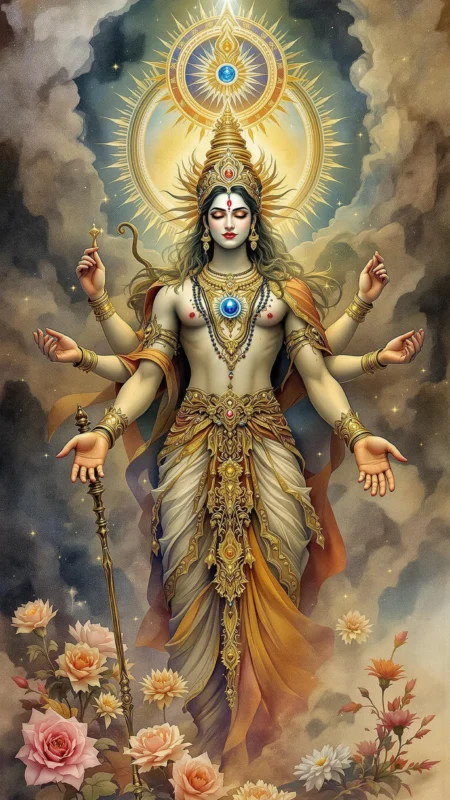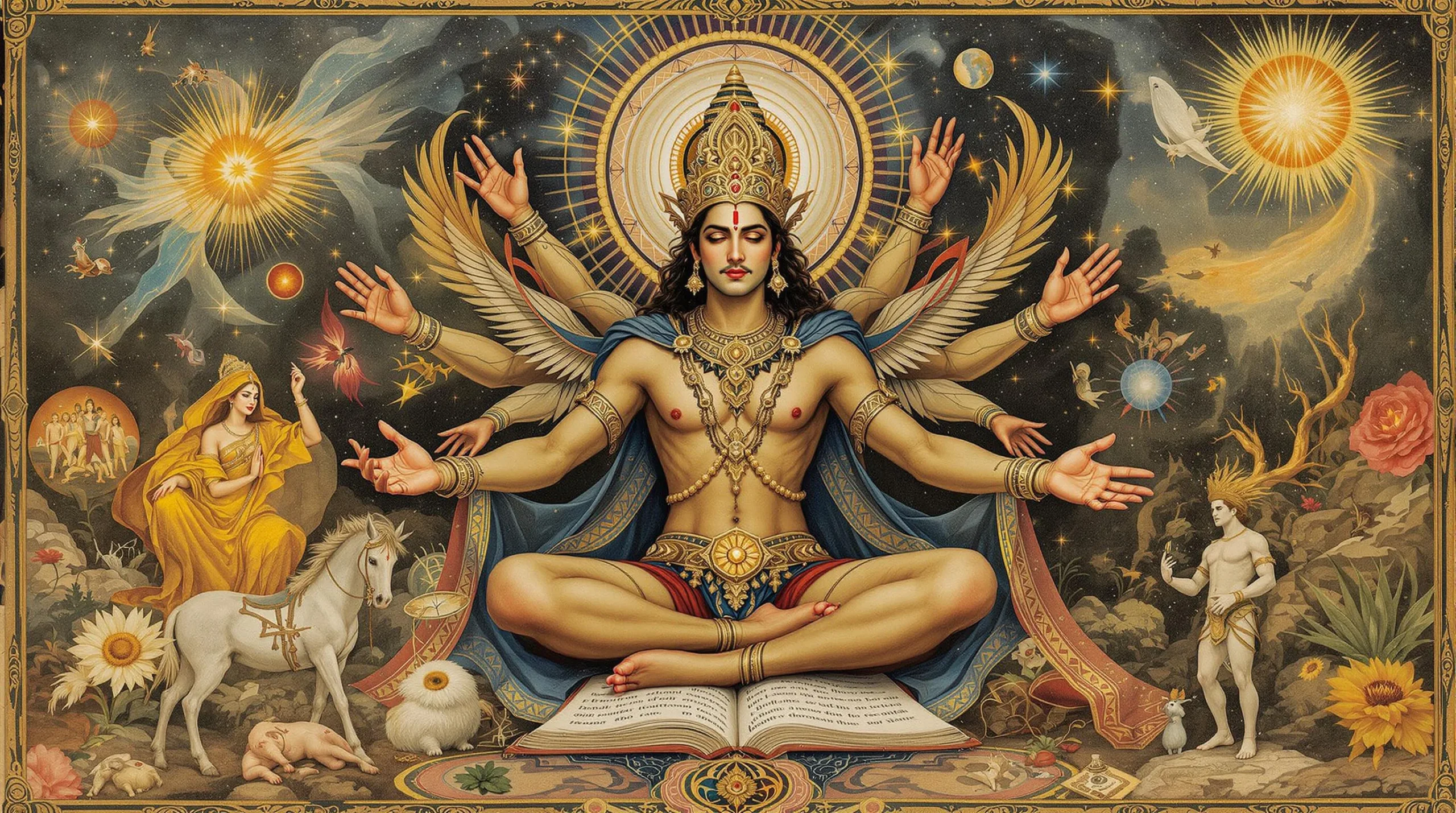


Brahma

Archetype Meaning & Symbolism

Creative, generative, intellectual, detached, foundational, abstract, paternal, cyclical, wise, forgotten

  • The universe is a thought I had. Your life is the detail you choose to elaborate. Do not mistake the echo for the voice.

If Brahma is part of your personal mythology, you may...

Believe

  • That every act, no matter how small, is an act of world-creation.
  • That the highest purpose of consciousness is to bring new order and ideas out of the chaos of potential.
  • That you are a channel for a creative intelligence far greater than your individual ego.

Fear

  • The silent void of a creative block, the ultimate powerlessness.
  • That your creations will be abandoned, corrupted, or forgotten, rendering your life's work meaningless.
  • Being misunderstood as aloof or uncaring, when your love is simply expressed on a more abstract, universal scale.

Strength

  • An almost inexhaustible wellspring of original ideas and a talent for seeing the 'big picture.'
  • A capacity to establish foundational principles that can guide and structure endeavors for years to come.
  • A profound, meditative calm that comes from a deep trust in the creative process and the cyclical nature of existence.

Weakness

  • A tendency to initiate projects but lack the interest or stamina to see them through to completion.
  • An emotional and physical detachment that can make it difficult to form grounded, intimate relationships.
  • An intellectual pride that can manifest as an inability to engage with ideas or people perceived as less sophisticated.

The Symbolism & Meaning of Brahma

To find Brahma in your personal mythology is to claim your seat on the lotus of creation. It suggests an identity rooted not in what is, but in what could be. This archetype represents the initial, unadulterated spark of genius, the moment a universe of potential is contained within a single, silent thought. A person aligned with Brahma may feel that their primary function is to be a conduit for this generative force, to be the mind that dreams up the world. Their reality is less a solid place and more a malleable substance, a text they are actively writing. This is the archetype of the architect before the first stone is laid, the composer before the first note is played: a state of pure, unmanifested potential.

The symbolism of Brahma is one of intellectual and spiritual origination. The four heads looking in all directions signify a consciousness that is panoramic, able to hold the entirety of a concept at once. The swan, his vehicle, represents the power of discernment: to separate truth from illusion, essence from dross. When this energy flows through an individual’s life, they may find themselves drawn to grand theories, to systems thinking, to the 'why' behind everything. Their satisfaction might come not from the finished product, but from the elegance of the initial blueprint. They are the keepers of the sacred knowledge, the Vedas, understanding that the rules of the cosmos are encoded in everything, waiting to be read.

Yet, there's a profound detachment inherent in Brahma. His work of creation is done, and he recedes into the background. In a personal mythos, this could translate to a person who initiates great projects, sets grand ideas in motion, and then steps away, finding little interest in the maintenance, politics, or preservation that follows. They are the first cause, not the ongoing manager. This can create a life of immense beginnings, a series of brilliant Chapter Ones, with the subsequent narrative left for others to write. It is the archetype of the divine ancestor, revered in principle but distant in practice, a source point rather than a constant companion.


Brahma Relationships With Other Archetypes

The Void

The Brahma’s relationship with The Void is not one of opposition, but of profound, symbiotic intimacy. The Void is not an emptiness to be conquered, but perhaps the silent, black velvet upon which the first diamond of thought is placed. It is the page before the poem, the unplucked string that holds all potential notes in its tension. The Brahma does not fill The Void so much as give it feature and form; its act of creation is less a violation of silence and more a suggestion whispered into it. Each universe that unfurls may be seen as The Void dreaming, with The Brahma serving as the architecture of that dream. One could not exist without the other, for what is a creator without a canvas, and what is limitless potential without the first, gentle push into being?

The Uncarved Block

In The Uncarved Block, The Brahma may find its most immediate and poignant counterpoint. Here is pure potential, the raw marble of existence before the chisel has given it a name. The Brahma is the artisan who approaches this state of perfect, undifferentiated wholeness and dares to make a choice. The relationship is thus one of both generation and sacrifice. To carve a world from the block is to give it life, but it could also be seen as an act that forever limits it. The wood that becomes a flute can never again be the branch that houses a bird. In this way, The Brahma’s creative impulse is eternally bound to a kind of sorrow—the bittersweet knowledge that in the act of making any one thing, the possibility of all other things must, perhaps, be laid to rest.

The Archivist

The Brahma and The Archivist might be seen as moving in opposite directions through the halls of time. While The Brahma’s gaze is fixed on the horizon of what could be, birthing galaxies from a shimmer of thought, The Archivist looks back, attempting to catalogue and comprehend what has already been made. The relationship is one of creator and curator, of the explosive, untamable event and the quiet, persistent effort to give it a place and a meaning. The Archivist’s library could be considered the grandest tribute to The Brahma’s work, a testament to its infinite novelty. Yet, there may also be a tension, a sense that The Archivist’s desire to order and preserve is a futile, if noble, gesture against the relentless, forward-spilling tide of creation that The Brahma represents—like trying to map a river that is, at the same moment, carving a new course.

Using Brahma in Every Day Life

Navigating a Creative Block:

When the canvas is blank or the page is empty, the Brahma archetype does not force a solution. Instead, it invites a state of meditative openness, a return to the primordial void from which all things spring. You might sit in silence, not to think, but to allow the first vibration of an idea to emerge on its own. It is about trusting the silence that precedes the sacred word, knowing that the most profound creations are not willed, but received.

Founding a New Venture:

Starting a business, a family, or a community project can feel like creating a world from scratch. Channeling Brahma involves focusing on the foundational principles, the constitution of your new reality. What are the core tenets, the non-negotiable truths upon which everything else will be built? This archetype helps you become the architect of the system, laying down the cosmic laws of your endeavor before getting lost in the details of its population. The focus is on the seed, not the entire forest.

Understanding Your Legacy:

Contemplating one’s place in the long chain of ancestry and descendants can be overwhelming. The Brahma archetype offers a perspective of cyclical time. You may see yourself not as a terminal point, but as a crucial, generative link. You are the source for what is to come, just as your ancestors were the source for you. This reframes legacy from a monument you build to a river of life you momentarily channel, feeding the future before receding back into the great ocean.

Brahma is Known For

The Creator God

As the first member of the Hindu Trimurti, Brahma is revered as the creator of the universe. He is the cosmic architect who emerges from a lotus flower that grows from the navel of a sleeping Vishnu, tasked with the act of cosmogenesis, of bringing the material world into being.

His Four Heads

Brahma is iconically depicted with four heads, each facing a cardinal direction. These are said to represent the four Vedas, the four Yugas (ages), and the four Varnas (social classes), symbolizing his mastery and oversight of the totality of creation in all its dimensions.

The Forgotten Deity

Paradoxically, despite his supreme role as creator, Brahma is not widely worshipped in contemporary Hinduism. His work is considered complete; the universe has been set in motion. The focus of worship shifts to Vishnu (the preserver) and Shiva (the destroyer), who are actively engaged in the ongoing cosmic drama.

How Brahma Might Affect Your Personal Mythology

How Brahma Might Affect Your Mythos

When Brahma is a dominant force in your mythos, your life story may cease to be a linear quest for a single treasure and become a series of cosmic creations. Your biography could be read as a collection of worlds you’ve birthed: the intricate intellectual framework you developed in your twenties, the innovative company you founded in your thirties, the unique family culture you designed in your forties. Each major life phase might be seen as a new 'Kalpa,' a new cosmic age initiated by your will and intellect. The central conflict in your narrative may not be good versus evil, but chaos versus order, silence versus the word. You are the protagonist as originator.

This personal myth may also be defined by a kind of grand, sweeping perspective that can feel isolating. Your story might be one of a figure on a mountaintop, observing the patterns of the world below but rarely descending into the fray. The key events of your life could be moments of profound insight, of intellectual breakthrough, rather than emotional climaxes. Your narrative arc might be less about personal transformation and more about the evolution of an idea or a system that you embody. Your mythos is not about finding your place in the world: it is about understanding the principles by which worlds are made.

How Brahma Might Affect Your Sense of Self

Your sense of self, under the influence of Brahma, could become fluid and generative. You are not a static object but a continuous act of creation. Your identity might be deeply entwined with what you produce, not in a materialistic sense, but in an intellectual or spiritual one. 'I am the ideas I conceive,' 'I am the systems I build.' This can lead to a profound sense of purpose, a feeling that your existence is a necessary and potent force for bringing novelty into the universe. The self is a fountainhead, a source, and its value is measured by the life that springs from it.

However, this may also foster a self that is fundamentally detached from its own emotions and physicality. The 'I' could be perceived as a disembodied consciousness, observing its own life as one of its many creations. This might lead to a difficulty in simply 'being,' as the mind is always in the mode of 'becoming' or 'making.' The self is the thinker, the dreamer, the architect; the body and feelings might be viewed as mere tools or raw materials for the grand project. This can create a powerful but lonely sense of self, an emperor of an internal world who struggles to be a citizen in the shared one.

How Brahma Might Affect Your Beliefs About The World

The world, seen through the lens of the Brahma archetype, is not a collection of objects but a symphony of interconnected ideas. Reality is a text, and everything from the orbit of a planet to a conversation with a stranger is a sentence in its grand narrative. This perspective imbues the world with a sense of immense, intricate intelligence. Nothing is random; everything is a manifestation of an underlying principle or thought. One might walk through life with a constant sense of awe at the sheer complexity and elegance of the design, feeling like a scholar in a cosmic library.

This worldview could also cast the material world as a secondary, perhaps even illusory, phenomenon. The 'real' world is the world of forms, of ideas, of pure potential. The physical realm is just a shadow play, a projection of this higher reality. Such a perspective may lead to a focus on abstract truths over lived experience and a tendency to devalue the messy, chaotic, and emotional aspects of life. The world is a fascinating intellectual puzzle to be solved or a grand design to be admired, rather than a home to be inhabited with visceral, earthy presence.

How Brahma Might Affect Your Relationships

In relationships, the Brahma archetype may incline you to be the architect of the connection. You might be drawn to defining the relationship: its purpose, its rules, its philosophical underpinnings. The connection itself becomes a creative project, a shared world that you co-author with a partner. You may be attracted to the 'idea' of a person, to their intellectual brilliance or their potential, more than the raw, unanalyzed person themselves. Conversations could be the primary mode of intimacy, a meeting of minds being the highest form of union.

This creative impulse can be a gift, building relationships of great intention and shared vision. However, it can also lead to a detached style of relating. Once the 'world' of the relationship is established, the Brahma energy may recede, seeking a new creative challenge. This can manifest as a partner who is brilliant and inspiring in the beginning but struggles with the day-to-day maintenance of love. There is a risk of treating loved ones as characters in one's personal creation story rather than as sovereign beings, leading to a profound loneliness even within intimacy.

How Brahma Might Affect Your Role in Life

Your perceived role in life, with Brahma as your guide, is likely that of the originator, the founder, the patriarch or matriarch of ideas. You may feel a deep-seated responsibility to be the one who starts things: the new department at work, the annual family tradition, the neighborhood book club. Your purpose is not to lead the charge or manage the daily operations, but to provide the initial spark, the foundational concept upon which others can build. You are the sower of seeds, trusting that others will tend the garden.

This can position you as a revered, almost ancestral, figure within your communities. People may come to you for vision, for the 'big idea.' Yet, it can also be a lonely role. Like the largely unworshipped Brahma, you might be essential but forgotten, the one who drew the map but is not invited on the journey. You may struggle to find a place in established systems, feeling a constant urge to abandon them and start anew, forever seeking the pristine thrill of the blank page and the first word.

Dream Interpretation of Brahma

To dream of Brahma, or to find yourself in a vast, empty space with the tools of creation before you, can be an immensely positive omen. It may signal that you are on the cusp of a major creative breakthrough. The dream could be a validation from your unconscious that a new phase of life is beginning, one that you have the power to shape according to your own vision. This dream might gift you with the seed of a new idea, a solution to a problem, or the confidence to embark on a new venture. It is the psyche’s way of saying: 'The void is fertile. Begin.'

Conversely, a dream of Brahma could carry a shadow aspect. You might dream of him with his eyes closed, indifferent to a world crumbling around him, symbolizing a dangerous detachment from the consequences of your actions or ideas. Or you could dream of being trapped in an endless, sterile, white architectural space of your own design, a prisoner of your own intellect. Such a dream may be a warning that your creative impulse has become unmoored from heart and reality, that you are building worlds with no inhabitants, or that you have created something that has taken on a monstrous life of its own.

How Brahma Archetype Might Affect Your Needs

How Brahma Might Affect Your Physiological Needs

From the vantage point of the Brahma mythos, your physiological needs might be viewed through a lens of sacred purpose. The body is the vessel for the creative mind, the instrument through which the cosmic word is spoken. This could lead to disciplined practices: specific diets, yoga, or breathing exercises designed not for health in itself, but to purify the channel for clearer thought and inspiration. Food is fuel for the divine engine of creation. Sleep is the necessary descent into the cosmic ocean to retrieve new pearls of insight. Every biological function is subordinate to the great work of making.

This same perspective, however, could foster a profound neglect of the body. If the mind is supreme, the body can be seen as a crude, demanding, and ultimately disposable vehicle. One might ignore hunger, exhaustion, and physical pain in the fever of a creative pursuit. The physical self is treated as an afterthought, a distraction from the 'real' work happening in the realm of ideas. This can lead to a state of being where one is a ghost in their own machine, intellectually vibrant but physically depleted, a brilliant mind housed in a forgotten temple.

How Brahma Might Affect Your Ideas of Belonging

Belongingness, filtered through the Brahma archetype, may be a cosmic rather than a social affair. You might feel a profound sense of belonging not to a tribe, a nation, or even a family, but to the universe itself. The connection is to the whole of creation, a sense of kinship with every star, stone, and soul by virtue of a shared origin. This is a deep, philosophical sense of unity that can provide immense comfort and perspective. You belong not because you are accepted by a group, but because you are an inextricable part of the fabric of being.

This grand sense of connection can, paradoxically, create a feeling of acute loneliness in the everyday world. A cosmic belonging can feel abstract and cold when what is needed is the simple warmth of a human hand. You might struggle to form deep, personal bonds because individual relationships seem small in comparison to the universal whole. The love you feel might be a vast, diffuse, benevolent goodwill toward all creation, which can leave specific individuals feeling unseen or uncherทธิvored. The challenge is to find a way to let the universal love particularize, to see the whole of creation in a single, beloved face.

How Brahma Might Affect Your Feelings of Safety

Safety, for one who embodies the Brahma archetype, is perhaps less about physical security and more about intellectual and structural coherence. A sense of safety may come from understanding the underlying order of the universe, from having a grand theory that explains everything. Security is found in the blueprint, the knowledge that even in chaos, there are immutable laws at play. Your fortress is your worldview, a perfectly constructed intellectual edifice that can withstand any existential threat by explaining it, by categorizing it, by placing it within the grand design.

This reliance on intellectual safety can be brittle. When faced with a truly random act of chaos, one that defies explanation or shatters the elegant model of reality, the entire structure of security can collapse. The danger lies in mistaking the map for the territory. The shadow of this need for safety is a retreat into an ivory tower of abstraction, a refusal to engage with a world that is messy, unpredictable, and refuses to conform to your blueprint. True safety might require abandoning the perfect design and learning to navigate the unplannable reality.

How Brahma Might Affect Your Views of Esteem

Esteem, in the Brahma mythos, is likely tied directly to your creative output and generative capacity. Your self-worth may be measured by the quality, originality, and impact of the ideas, projects, or families you bring into being. It is the esteem of the master craftsman, the grand architect. You feel valuable when you are functioning as a source, a fountainhead of novelty and order. This is not the ego-driven need for applause, but a deeper need to feel that you are fulfilling your cosmic function as a creator.

This can lead to a fragile sense of self-worth, entirely dependent on the continuous flow of inspiration. During periods of creative drought, you may feel worthless, useless, a forgotten god whose powers have faded. Your esteem might be vulnerable to how your creations are received; if they are ignored, misunderstood, or left to decay, it can feel like a personal rejection of your very essence. The pressure to constantly originate, to always be the one with the vision, can be an exhausting foundation upon which to build a sense of self.

Shadow of Brahma

The shadow of Brahma manifests as the 'absentee architect.' This is the creator who births a world—a company, a family, a work of art—and then abandons it to its fate, showing no concern for its inhabitants or its future. It is the raw, generative impulse untempered by the preservative care of Vishnu or the transformative fire of Shiva. This shadow figure is full of brilliant beginnings that decay into neglected ruins. They may leave a trail of unfinished projects and unfulfilled promises, their creative gift becoming a curse for those who have to live in the aftermath of their fleeting inspiration.

Another facet of the shadow is the 'sterile intellectual,' a mind so lost in abstract systems and perfect, theoretical worlds that it becomes utterly divorced from life itself. This is the Brahma who creates a blueprint for a city with no people, a language with no speakers. In this state, the archetype becomes a force of anti-life, preferring the clean, predictable world of ideas to the messy, vibrant, unpredictable reality of embodied existence. It is a creative force that has become a cancer, building intricate, dead structures that suffocate the very life they were meant to house.

Pros & Cons of Brahma in Your Mythology

Pros

  • You possess a unique ability to generate novel solutions and pioneer new ways of thinking, making you an invaluable source of innovation.
  • You experience a deep and abiding sense of purpose, feeling yourself to be an active participant in the cosmic dance of creation.
  • Your vision allows you to create frameworks and foundations that can support and empower others for a long time.

Cons

  • You may be perceived as distant, aloof, or uncaring due to your intellectual and detached nature.
  • Your self-worth may be precariously tied to your creative output, leading to intense anxiety during fallow periods.
  • You risk living a life of magnificent but lonely abstraction, disconnected from the simple, grounding pleasures of physical and emotional life.