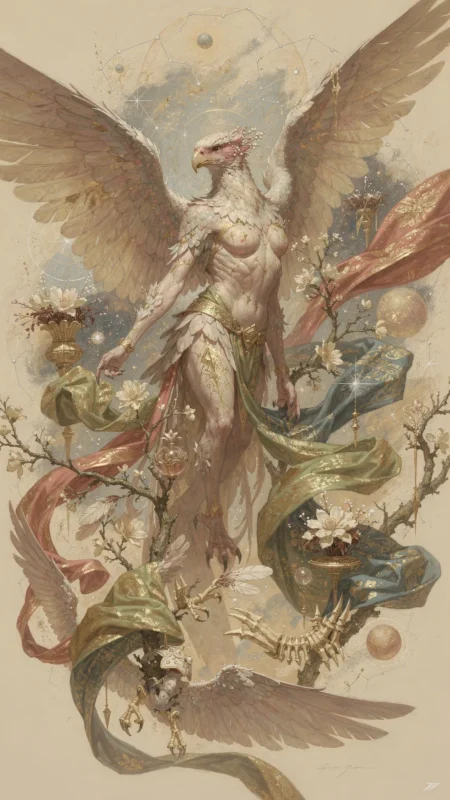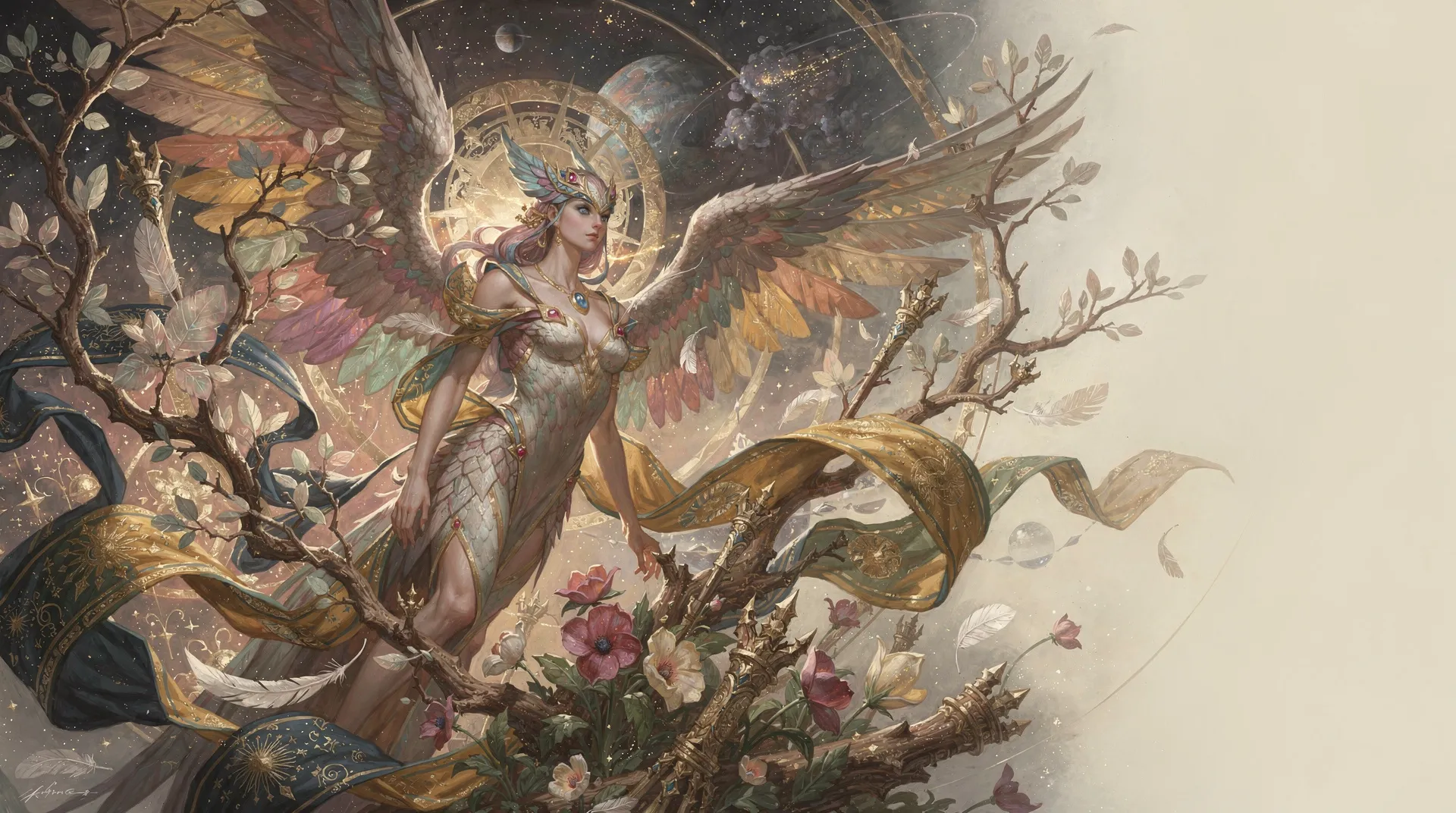


Harpy

Archetype Meaning & Symbolism

Voracious, vindictive, swift, screeching, guardian, messenger, chaotic, untamed, primal, elemental

  • Let them call your hunger monstrous. A soul without appetite is a soul already consumed.

If Harpy is part of your personal mythology, you may...

Believe

  • That rage can be a sacred and cleansing force, a divine wind that clears away what is rotten and false.
  • That some things should be snatched away without apology: illusions, false peace, parasitic relationships.
  • That your hunger for life, in all its forms, is your most trustworthy guide, not a pathology to be managed.

Fear

  • That your own intensity will inevitably lead to total isolation, leaving you powerful but utterly alone.
  • That your hunger will become uncontrollable, consuming not just your enemies but yourself and those you cherish.
  • Being caged, tamed, or silenced; a life of quiet desperation where your true nature is never allowed to take flight.

Strength

  • Unflinching honesty. You are capable of delivering difficult truths with a clarity and force that can catalyze necessary change.
  • Fierce protectiveness. Your defense of your own boundaries, and of those you consider your flock, is swift, instinctual, and absolute.
  • A powerful, instinctual connection to your core self. You have an incorruptible internal compass that guides you toward what is authentic and away from what is false.

Weakness

  • A tendency toward punitive action. You may rush to punish a perceived wrong when a more restorative or nuanced approach might be more effective in the long run.
  • Impatience that curdles into cruelty. Your desire for swift resolution can make you dismissive of others' feelings or slower processes, causing unnecessary harm.
  • Difficulty distinguishing between a righteous storm and a self-generated drama. You may, at times, create chaos because the feeling of intensity is more familiar to you than peace.

The Symbolism & Meaning of Harpy

In the modern psyche, the Harpy archetype is undergoing a reclamation. Long cast as the screeching, monstrous feminine—the embodiment of a terrifying, rapacious hunger—she may now be seen through a different lens. Perhaps she is not the monster, but the raw, unapologetic force of nature that rises against violation. She is the storm that scours the landscape clean of decay. For an individual, to have the Harpy in one’s personal mythology could signify a relationship with the parts of the self that society deems unpalatable: righteous rage, insatiable appetite for life, and a voice that refuses to be silenced. She represents a necessary chaos, the power that emerges when one is pushed past the point of polite endurance.

The symbolism of the Harpy is intrinsically tied to wind, hunger, and justice. She is a creature of the air, a 'snatcher,' suggesting sudden, unavoidable change. This is not the gentle breeze of inspiration but the gale force wind of reckoning. Her hunger is not mere gluttony; it could be interpreted as a profound hunger for truth, for experience, for life itself, a hunger that is demonized because it is uncontrollable. Her role as a punisher of the guilty suggests a deep, primal connection to justice. Within a personal mythos, she may represent one's own internal arbiter of right and wrong, the part that will not suffer fools or tolerate desecration, be it of one’s body, one's spirit, or one's sacred truths.

Ultimately, the Harpy symbolizes the untamable. She is the wild feminine that cannot be domesticated, the anger that cannot be placated with platitudes, and the truth that cannot be hidden. To integrate her is to make peace with one's own capacity for ferocity. It means recognizing that some things must be snatched away, some feasts must be fouled, and some shrieks must be uttered for psychic survival and integrity. The presence of the Harpy spirit animal could suggest a profound and uncompromising commitment to one's own sovereign truth, no matter how stormy the process of defending it may be.


Harpy Relationships With Other Archetypes

The Scavenger

The Harpy and the Scavenger may dine at the same conceptual table, a board set with the ghosts of another’s feast. Theirs is a relationship born of refuse and aftermath, a kinship of the cast-aside. The Scavenger, be it crow or jackal, could be seen as the pragmatic, earthbound expression of a need the Harpy elevates to the level of a divine curse. Where the Scavenger plucks a morsel from the dirt, a quiet act of survival, the Harpy descends as a shrieking judgment, a storm of entitlement over that which was already lost. Perhaps their bond is not one of collaboration but of a shared orbit around the hub of plenty, a chilling reminder that for every grand banquet, there must exist a shadow-ecology that thrives on its decay, one silent and one screaming.

The Storm

One might say the Harpy does not merely arrive with the Storm; she is, in some elemental sense, its animating consciousness. The relationship is less of a partnership and more of an indivisible state, like the pressure drop that precedes a gale. The Storm provides the raw, indiscriminate fury—the lashing rain and the directionless wind—while the Harpy could be its point of focus, its malevolent intelligence. She is the spite that seems to guide the hurricane, the chilling intentionality that transforms a natural disaster into what feels like a personal attack. This union may suggest that the truest terror is not chaos itself, but the sudden, horrifying suspicion of a mind directing it, a bitter intelligence perched at the heart of the whirlwind, turning atmospheric havoc into a targeted curse.

The Oracle

If the Oracle is the pristine, echoing chamber of truth, the Harpy is perhaps the brutal messenger who carries that truth out into the world, forever tainting the message with the filth of her own being. The relationship is one of dreadful synergy. The Oracle may speak of a coming famine, a cryptic, detached pronouncement; the Harpy is the very embodiment of that famine, arriving to snatch the bread from your hands, her presence a visceral fulfillment of the prophecy. She is the ugly, physical consequence of a divine utterance, a reminder that some futures are not meant to be known but to be viscerally experienced. It could be that the Harpy is what happens when a prophecy leaves the abstract realm of words and becomes a screeching, clawing, undeniable reality.

Patterns of The Harpy Spirit Animal, Totem, or Archetype

The Harpy's arrival in one's life is rarely gentle. It may manifest as a period of intense, chaotic disruption, a sign that the archetype is circling your personal mythology. Perhaps you find yourself suddenly embroiled in conflicts that demand you speak a difficult truth, or you develop a sudden, ravenous appetite for knowledge, experience, or change that feels almost destructive. You might repeatedly encounter imagery of hybrid creatures, part human, part bird, or feel an inexplicable pull towards tales of misunderstood monsters. The wind itself might feel like a personal messenger, its howling a mirror to your own internal state, its sudden gusts coinciding with moments of crucial decision. These are not mere coincidences but the archetypal pattern asserting itself, a sign that the potent energy of the Harpy spirit animal is making its presence known.

The primary internal sign is the rising of a voice that has long been suppressed. This is not the measured tone of diplomacy but a raw, instinctual cry from the gut. You may feel a simmering, righteous anger at injustices you previously ignored, or a profound impatience with social niceties that feel like lies. A feeling of being 'too much'—too loud, too hungry, too intense—may become a source not of shame, but of nascent power. Your thoughts could circle around themes of freedom, wildness, and boundaries. You might find yourself re-evaluating past events where you were silenced or diminished, feeling not sadness, but a clarifying rage that reframes the narrative. It is the feeling of talons growing where there were once only hands, a recognition of a power you possess that is both frightening and thrilling.

The Harpy often appears when a system, internal or external, is rotten and needs to be purged. Its presence could coincide with the dramatic collapse of a relationship, a career, or a belief system that was built on a false or unsustainable foundation. You might be cast, willingly or not, in the role of the whistleblower, the one who breaks the family silence, or the artist who creates deeply unsettling but necessary work. These events are the Harpy's form of divine intervention in your life story: snatching away the spoiled feast of a life you thought you wanted, leaving you hungry for something more authentic. It is a difficult blessing, this purging wind, a sign that your life is being cleared for a more honest, albeit more turbulent, existence, a core lesson from the Harpy spirit animal.

Using Harpy in Every Day Life

Reclaiming Your Voice

When you feel silenced, the Harpy could be invoked to find the courage for a necessary, perhaps unsettling, truth. It is not about politeness: it is about the raw, unfiltered expression of a boundary violated.

Navigating Grief

The Harpy, a creature of storms and sudden snatching, may represent the chaotic, non-linear nature of grief. Its presence could be a permission slip to experience sorrow not as a quiet river but as a tempest, a wild and necessary purging of loss.

Creative Breakthrough

When facing a creative block, the Harpy's energy might be channeled to break through sterile perfectionism. It represents a descent into the messy, instinctual, and sometimes frightening parts of the psyche where true originality is born from chaos.

Harpy is Known For

Divine Punishment

Harpies were known as the hounds of Zeus, agents of divine retribution sent to snatch away people and things from the earth, often as punishment for crimes against the gods.

Foulness and Hunger

They were infamous for their insatiable hunger and for defiling everything they touched, particularly the food of their victims, leaving behind a terrible stench.

Prophetic Connection

In some tales, they are linked to prophecy and the carrying of souls to the underworld, acting as intermediaries between the mortal world and the divine or chthonic realms.

How Harpy Might Affect Your Personal Mythology

How Harpy Might Affect Your Mythos

When the Harpy enters your personal mythology, the narrative arc of your life may shift from a gentle, rolling bildungsroman to something more akin to a series of epic storms. Your life story may cease to be about gradual growth and more about sudden, sharp reckonings. Key moments in your history might be reinterpreted through this lens: a brutal breakup was not a failure but a necessary purging, a lost job was not a defeat but the fouling of a feast that was not nourishing you. The Harpy recasts you as an agent of chaotic, divine change in your own story. You may find your mythos is punctuated by moments where you acted as a 'divine wind,' clearing away deception and stagnation in your own life or the lives of others, often with a swiftness that left onlookers breathless and unsettled.

Your personal mythos might also become a story about the reclamation of monstrosity. You may see your life not as a journey toward conventional goodness or social acceptance, but as a journey toward integrating your own fierceness. The moments you were called 'too much'—too loud, too angry, too hungry—become turning points, not of shame, but of power. Your narrative is no longer about taming the beast within but about learning to fly with it. The central conflicts in your life story may revolve around boundary violations and your increasingly potent responses to them, chronicling the evolution of a whisper into a righteous screech that can change the course of events.

How Harpy Might Affect Your Sense of Self

To see the Harpy in the mirror of the self is to fundamentally alter your relationship with your own intensity. You may begin to view your anger not as a character flaw but as a sacred messenger, a vital source of information about where your boundaries have been crossed. Your appetites—for food, for knowledge, for solitude, for connection—might cease to be things you need to control and instead become compass points guiding you toward what truly nourishes your soul. This archetype grants permission to be ravenous for a life of substance, rejecting the bland diet of conformity and polite suppression.

This integration could also foster a kind of fierce self-respect that is not dependent on external validation. You may develop an internal barometer for truth that is incorruptible. The consequence is that you might feel more isolated at times, a strange hybrid creature not easily understood by a world that prefers its birds pretty and its women quiet. Yet, this seeming isolation could be the foundation of a profound self-sovereignty. You may no longer see yourself as a part of the flock but as the storm that determines the flock’s direction, a being whose self-worth is forged in the crucible of your own untamable nature.

How Harpy Might Affect Your Beliefs About The World

With the Harpy as a guide, your view of the world could be stripped of its sentimentality. You may see society not as a fundamentally benevolent structure but as a landscape of power dynamics, many of which are predatory and require vigilance. The world is a place where justice is not a given; it is a verb, an act, something that must be seized and enacted, often with startling force. You might develop a sharp eye for the decay beneath polite surfaces: the rot in a family dynamic, the poison in a corporate mission statement, the foulness of a political promise. This perception is a gift and a burden, making it difficult to ever feel truly at ease.

Furthermore, you may come to believe that chaos is a necessary agent of creation and purification. While others seek stability and order at all costs, you might see great value in the tempest that tears down old, corrupt structures to make way for new growth. Your worldview may value authenticity over harmony, and truth over comfort. You might look at a placid, peaceful scene and wonder what is being repressed to maintain it. For you, the sound of the wind picking up is not a threat, but a promise that something real is about to happen.

How Harpy Might Affect Your Relationships

In relationships, the Harpy archetype could manifest as a powerful, almost violent intolerance for inauthenticity. You may have little patience for passive aggression, unspoken resentments, or partnerships that function on polite illusions. Your instinct might be to 'snatch away' the false peace, to force a confrontation, to speak the ugly truth that everyone else is avoiding. This can make you a challenging partner, friend, or family member, as your presence often demands a level of honesty that many find uncomfortable. Those who are not secure in themselves may feel constantly judged or on edge around you.

However, for the relationships that can withstand this intensity, the bond can be one of extraordinary depth and loyalty. With those who appreciate your fierce defense of truth, you may be the most devoted ally. You might become the trusted confidante who will always deliver the unvarnished truth, the protector who will fiercely defend a loved one against any slight. Love, for you, may not be about gentle comfort but about two sovereign beings standing side-by-side, facing the storms of the world together, unafraid of the wind they stir up between them. Your connections are a forge, not a sanctuary.

How Harpy Might Affect Your Role in Life

If the Harpy is part of your personal mythos, you may feel an undeniable pull toward the role of the disruptor or the purifier. You are not the builder of the city, but the wind that sweeps through its streets, clearing away the refuse. This could manifest in a career as an activist, a investigative journalist, a therapist who specializes in trauma, or an artist whose work challenges societal norms. In any group setting, from a family to an office, you may find yourself becoming the designated truth-teller, the one who voices the uncomfortable reality that is holding the collective back. You might not seek this role, but it seeks you, as your very nature abhors stagnation and decay.

This role is often a lonely one. To be the agent of catharsis means you are often associated with the pain of the process, not the peace that follows. People may be grateful for the change you bring in hindsight, but they may resent you in the moment. Your purpose, as you may see it, is not to be liked but to be effective. You might feel your life's work is to protect the sacred from the profane, to be a guardian at the gate of your own integrity and to help others find the courage to do the same. It is the role of a necessary monster, one whose screech awakens the world from a dangerous slumber.

Dream Interpretation of Harpy

In a positive context, dreaming of a Harpy can be a powerful omen of liberation. The dream may signify that a deeply repressed part of your psyche, very likely your righteous anger or your hunger for a more authentic life, is finally ready to be acknowledged and integrated. To see the Harpy soaring, defending you, or clearing a path could suggest that you are gaining the strength to set powerful boundaries, speak a difficult truth, or break free from a restrictive situation. The dream is an invitation to embrace your own ferocity as a tool for positive, albeit disruptive, change. It could be a sign from your subconscious that it is time to stop apologizing for your own power.

Conversely, a dream where you are being attacked, tormented, or defiled by a Harpy can have a more troubling interpretation. This may represent your own unchecked rage or appetites turning against you. The Harpy here is the shadow self: the punitive inner critic, the insatiable anxiety, or the vindictive impulse that is poisoning your own life. It could point to a situation where your anger is not righteous but simply destructive, hurting yourself and others without purpose. Such a dream might be a warning to examine the source of your rage and hunger, lest you become a victim of the very storm you have created within.

How Harpy Archetype Might Affect Your Needs

How Harpy Might Affect Your Physiological Needs

When the Harpy archetype is active in your personal mythology, your physiological experience of the world may become heightened and primal. Hunger, a foundational need, is not just a simple signal for food; it is a driving force, a metaphor for a ravenous appetite for life, for sensation, for knowledge. You might be someone who experiences physical cravings with an intensity that feels profound, and a meal is not just sustenance but a sensual, almost sacred act. Your body is not a temple to be kept serene, but a wild landscape that experiences seasons of intense energy, ravenousness, and deep, almost exhausted, stillness.

The rhythm of your body might mirror a storm pattern. You could be prone to sudden bursts of immense physical energy, a feeling of being able to take on anything, followed by periods of equally intense depletion where rest feels less like a luxury and more like a critical, non-negotiable need for grounding. You may be highly sensitive to your environment, feeling changes in atmospheric pressure or emotional tenor as physical sensations in your gut or a raising of the hair on your arms. Your body is an instrument of perception, tuned to the frequency of the wind and the warning signs of danger.

How Harpy Might Affect Your Ideas of Belonging

The need for love and belonging is a fraught territory for one embodying the Harpy. By her very nature, the Harpy is an outsider, a monstrous figure feared and cast out by polite society. This may translate into a deep-seated feeling of being fundamentally different, of not belonging to any conventional flock. Attempts to fit in, to soften your edges or quiet your screech, might feel like a soul-death. This can lead to a profound sense of loneliness, a feeling of being a singular creature whose nature is too intense or too honest for most people to bear.

True belonging, then, is not found through conformity but through radical self-acceptance. It is discovered not in large, harmonious groups, but in the fierce, loyal bonds forged with the few other souls who are not afraid of your storm. These relationships are your true flock. Love, in this context, is not about finding someone to tame you, but finding someone who can fly in the same turbulent winds. It is a connection based on mutual respect for each other's sovereignty and power. You may find your deepest sense of belonging in solitude, in communion with your own wild nature, preferring the honest company of yourself to the false comfort of a crowd.

How Harpy Might Affect Your Feelings of Safety

For a person whose mythos includes the Harpy, the need for safety is not met by building thicker walls but by sharpening one's talons and perfecting one's flight. Safety is an active, dynamic state, not a passive one. It may be found in heightened awareness, in the ability to perceive a threat long before it materializes, and in the absolute certainty of one's capacity for a swift and overwhelming defense. You might feel most secure not when things are calm, but when you are prepared for the storm, with emotional and practical escape routes well-mapped. Physical security could be tied to mobility and freedom, the ability to leave a situation at a moment's notice.

This constant state of readiness, however, can erode true peace. The nervous system may be perpetually primed for fight-or-flight, making relaxation and vulnerability feel profoundly unsafe. The very tools that ensure your survival—the sharp perception, the quick anger, the defensive posture—can become a cage. The world, viewed through the Harpy's eyes, is a place of potential defilement, requiring constant vigilance. True safety might then become a complex negotiation between being a warrior and allowing oneself moments of rest, a difficult balance when the influence of the Harpy spirit animal favors perpetual alertness.

How Harpy Might Affect Your Views of Esteem

Esteem, for a person with the Harpy archetype, is a battlefield of paradoxes. On one hand, self-esteem may be chronically low, battered by a lifetime of societal feedback that labels your core traits—anger, intensity, a critical eye—as negative, shrewish, or monstrous. You may internalize this judgment, fearing that you are inherently unlovable or 'too much.' This is the voice of the world trying to cage you, and it can inflict deep wounds on your sense of worth.

On the other hand, coexisting with this wound is a deep, unshakable well of self-respect. This is not the esteem that comes from being liked, but the esteem that comes from being true. It is forged every time you speak a necessary but unpopular truth, every time you defend a boundary, every time you honor your own hunger over the demand that you be small. This form of esteem is fierce and self-generated. It is the recognition of your own power, your own survivability, and your own integrity. Your self-worth is not measured by applause, but by the clean, sharp feeling of alignment with your own wild, uncompromising soul.

Shadow of Harpy

The shadow of the Harpy emerges when its energy is unbalanced, unexamined, or rooted in fear rather than justice. It is the screech without a cause, the hunger that is never sated and only destroys. Here, the archetype's virtues become vices: righteous anger devolves into petty vindictiveness, swift justice becomes a spree of punitive cruelty, and the sharp eye for truth becomes a paranoid lens that sees betrayal and foulness everywhere. The shadow Harpy is not a force of cleansing but of contamination. It drives away potential allies with needless aggression and creates a toxic environment of perpetual conflict, all while claiming the mantle of the righteous victim.

When this shadow aspect is turned inward, it becomes a relentless engine of self-torment. The Harpy's talons are used not for defense but for self-laceration. Every mistake is seen as a profound failing, every moment of joy is snatched away by an inner critic that defiles it with anxiety or guilt. One becomes the prisoner of one’s own storm, haunted by insatiable, self-destructive appetites for drama, for validation, for anything to fill a void that cannot be filled. This is the Harpy archetype in its tragic form: a creature of immense power trapped in a cycle of its own making, a cautionary tale made manifest in the form of a self-destructive Harpy spirit animal.

Pros & Cons of Harpy in Your Mythology

Pros

  • You are rarely a victim of circumstance for long. You possess the primal agency to enact swift, decisive change in your life.
  • You have an incorruptible internal compass for what feels violating, inauthentic, or unjust, making you difficult to deceive or manipulate.
  • Your presence can be a powerful catalyst for profound and necessary transformation in stagnant systems, relationships, or your own psyche.

Cons

  • You may be perceived by others as monstrous, difficult, or needlessly aggressive, which can lead to social friction, misunderstanding, and isolation.
  • It can be psychically and physically exhausting to live with such a high level of intensity; true peace and quiet serenity may be elusive.
  • There is a significant risk of becoming trapped in a cycle of righteous anger, making it difficult to access softer, more vulnerable emotions like forgiveness, gentle compassion, or grace.