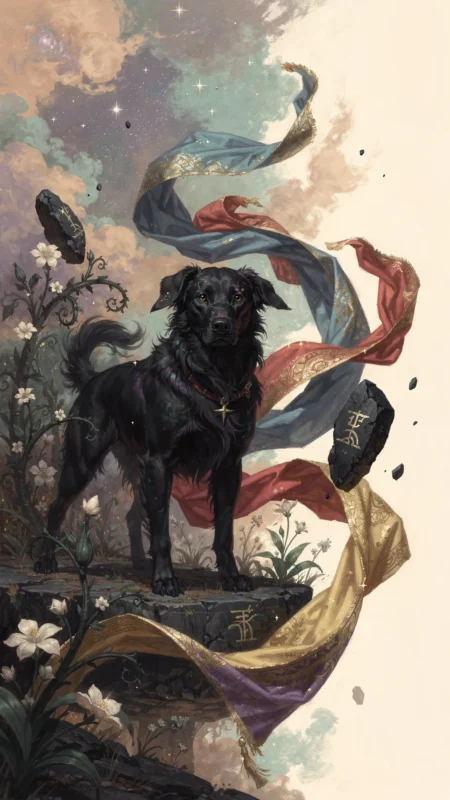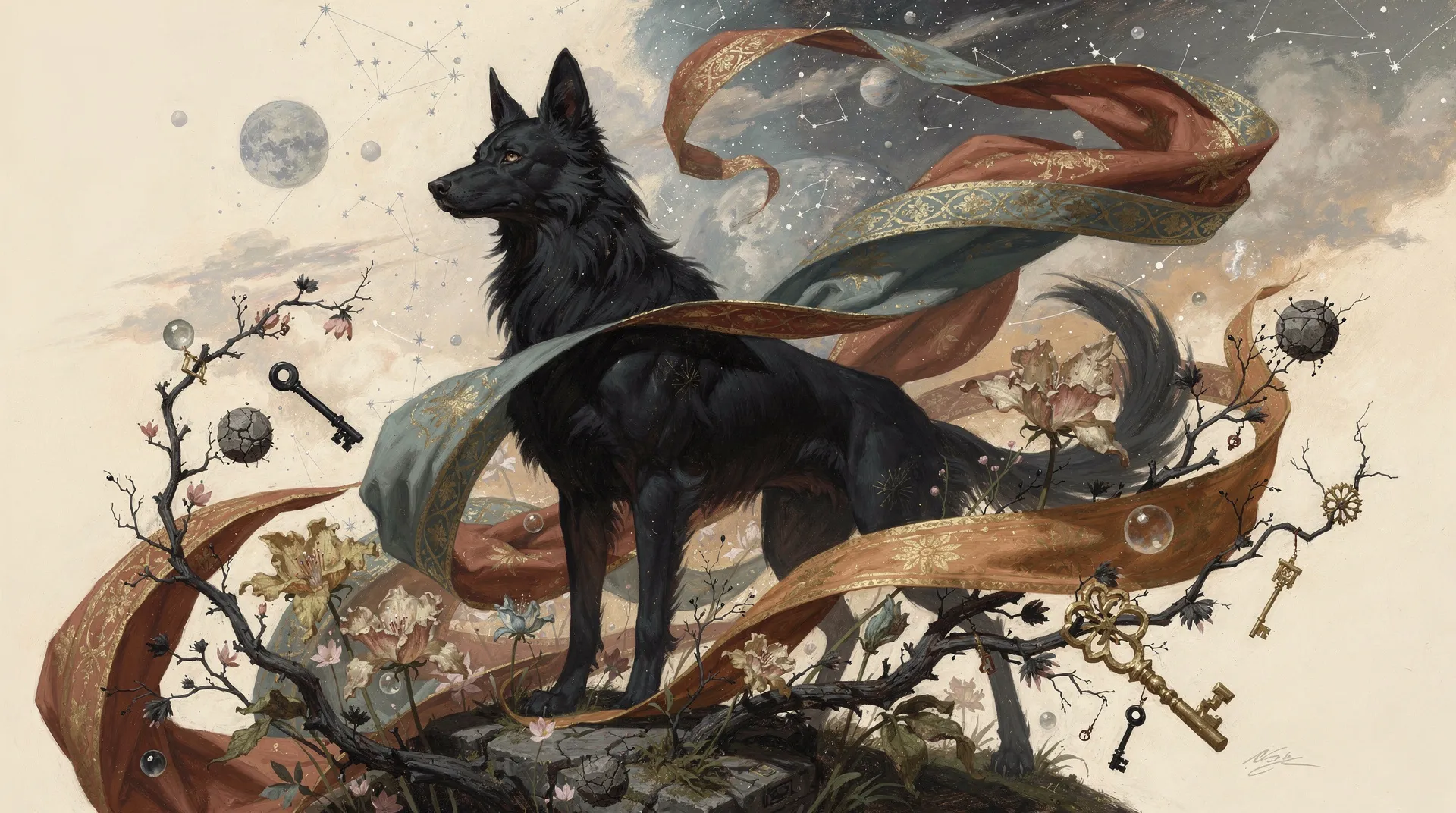


Black Dog

Archetype Meaning & Symbolism

Melancholic, loyal, protective, misunderstood, shadow, keeper, guide, liminal, steadfast, harbinger

  • Cease your frantic search for the light. Sit with me here, in the quiet dark: everything you need to see is illuminated from within.

If Black Dog is part of your personal mythology, you may...

Believe

  • • Darkness is not an absence of light, but a presence with its own form of wisdom.
  • • The most profound loyalty is silent, steadfast, and proven in times of trouble.
  • • Some essential truths can only be discovered by walking through the valley of the shadow.

Fear

  • • That your natural melancholy will curdle into a permanent state, swallowing all joy.
  • • Being fundamentally and permanently misunderstood by those who live only in the light.
  • • That the protective growl meant for threats might turn into an isolating bite, driving away those you love.

Strength

  • • Unshakeable resilience: the ability to endure hardship and find deep meaning within it.
  • • Profound empathy: an intuitive, non-judgmental understanding of the pain and complexity of others.
  • • A deep well of creativity, sourced from the rich, fertile ground of the subconscious and the shadow.

Weakness

  • • A gravitational pull towards isolation and depressive states of being.
  • • Difficulty engaging with or finding value in lighthearted, casual, or superficial social situations.
  • • A potential for cynicism or a grim outlook if the shadow aspect is not balanced with moments of grace and connection.

The Symbolism & Meaning of Black Dog

The Black Dog walks the mist-shrouded crossroads of the modern psyche, a figure of profound duality. On one path, it is the form given to our deepest despair, the heavy cloak of depression, the silent stalker of our joy. Yet, on the other, it is a symbol of unshakable loyalty, a guardian who chooses to sit with us in our darkest moments rather than abandon us to them. In personal mythology, its presence suggests a life that does not shy away from the abyss. It represents the courage to confront the shadow self: the parts of us we have disowned, the grief we have buried, the anger we have suppressed. This archetype teaches that these parts, when met with acceptance rather than fear, become sources of immense power and wisdom.

To have the Black Dog as a feature of your personal landscape is to understand that wholeness is not achieved by purging the darkness, but by integrating it. It symbolizes a journey inward, a descent into the personal underworld to retrieve lost pieces of the soul. The Dog is your psychopomp, your guide in this eerie terrain. Its presence may signify a comfort with ambiguity and a rejection of easy answers. It is the patron of rainy afternoons, forgotten histories, and the bittersweet beauty of impermanence. The meaning it offers is not one of happiness, but one of depth: a quiet, resonant understanding of life's full spectrum.

This archetype asks you to befriend what you fear, to find sanctuary in what others flee. It is the recognition that loyalty is tested in darkness, not in light, and that the most profound protection comes from a source that understands the nature of the threat. The Black Dog’s symbolism is not about succumbing to melancholy, but about mastering it, transforming the lead weight of sadness into the ballast that keeps your ship steady in a storm. It suggests a life lived with a quiet, powerful integrity, grounded in the acceptance of all that you are, shadow and all.


Black Dog Relationships With Other Archetypes

The Lighthouse

The relationship between the Black Dog and the Lighthouse is one of elemental opposition, a dialogue between the abyss and the beacon. The Dog, a creature of shadow and interior fog, may find its own form defined by the Lighthouse's solitary, piercing beam. It does not necessarily flee the light; rather, the light gives the creature's edges a stark, undeniable reality against the churning sea of the psyche. The Lighthouse, perhaps, represents a singular, unwavering principle—a distant hope, a clinical truth, a memory of clarity—that does not banish the Dog but merely offers a fixed point in its bewildering landscape. For the soul haunted by the Dog, the Lighthouse is not a promise of rescue, but the cold comfort of a single, navigable star in an endless night.

The Empty Chair

The Black Dog could be seen as the loyal, heavy companion to the Empty Chair. Where the chair signifies a specific, carved-out absence—a person, a future, a former self—the Dog is the creature that comes to inhabit that void. It may curl at the foot of the vacant seat, its weight a constant, physical pressure that gives substance to the nothingness. The two exist in a kind of symbiotic stillness; the silence of the chair seems to deepen the silence of the Dog's presence. It is the animal born of a vacuum, the quiet beast that guards a space that can never again be filled, its dark form a living monument to what is gone.

The Muffled Drum

In the inner world, the Black Dog’s slow, deliberate padding may keep time with the beat of a Muffled Drum. This is not the vibrant pulse of life, but its opposite: the slow, funereal cadence of endurance, the heartbeat of a spirit under wraps. The Drum is the body’s own quiet protest, the physiological translation of the Dog’s psychic weight into a dull, somatic rhythm. It is the soundtrack to the greyed-out landscape the Dog inhabits, a persistent, thudding bassline beneath the silence of apathy. This relationship could suggest how despair becomes a part of one's very pulse, a baseline rhythm so constant it is only noticed when, for a fleeting moment, it stops.

Patterns of The Black Dog Spirit Animal, Totem, or Archetype

Should you suspect the Black Dog is a guide or presence in your life, the signs are often subtle, woven into the fabric of your days rather than announced with fanfare. Look to the world around you for reflections: the recurring image of a black dog in films, literature, or a song that appears at a pivotal moment. You might notice a lone black dog crossing your path at a time of decision or uncertainty. Beyond the literal, pay attention to a pull towards liminal states: the charged quiet of dusk and dawn, the deep stillness of midnight, the melancholic beauty of an overcast sky. Synchronicities may appear as you stumble upon folklore of the Gytrash or the Church Grim, or read of Churchill's “black dog,” precisely when you are wrestling with a congruent mood or situation.

Internally, the signs are felt more than seen. It is the presence of a persistent melancholy that feels distinct from simple sadness: it is layered, philosophical, a weighty quiet that seems to hold ancient knowledge. It is the recurring thought that there must be more to darkness than just an absence of light. You may recognize within yourself a fiercely protective instinct, a silent, guardian-like loyalty to those you love that feels almost primal. A key indicator is the distinct feeling, during your most solitary and difficult moments, of not being truly alone, of having an invisible, steadfast companion sitting with you. This feeling of being accompanied in your sorrow is the core signature of the Black Dog spirit animal's presence.

Events in your life can also be a signal. The archetype often makes itself most known during life's initiations: profound periods of grief, bouts of depression, creative deserts, or forced retreats into solitude. These are the “dark nights of the soul” where the guide reveals itself. If you find that these harrowing periods, in retrospect, were not merely ordeals but transformative journeys that led to profound self-discovery, resilience, and a deepening of your character, it is a strong sign that you were being guided. The Black Dog spirit animal does not promise to lead you out of the darkness, but to teach you how to see within it, and to find the strength that is only forged there.

Using Black Dog in Every Day Life

Navigating Grief

When confronted with loss, the temptation is to flee the pain, to seek distraction. The Black Dog archetype teaches a different path: to sit with sorrow as one sits with a loyal hound at one's feet. It is an invitation not to wallow, but to honor the depth of the emotion, to let grief be a quiet, weighty presence. By doing so, you may find that the Dog is not the sorrow itself, but the guardian of the space where sorrow can be processed, transforming a terrifying void into a sacred, silent chamber of memory and acceptance.

Creative Stagnation

For the artist, the writer, the creator facing a blank canvas, the Black Dog represents a descent. Instead of reaching upward for fleeting inspiration, you may choose to go down, into the rich, dark soil of the subconscious. The archetype encourages an embrace of the melancholic, the unsettling, the unresolved. It suggests that true creativity is not always a bright flash but often a slow, quiet excavation of one's own shadows, a process of finding beauty not in perfection, but in the profound texture of the imperfect and the unknown.

Setting Boundaries

The Black Dog is a creature of thresholds, a guardian of what is sacred. When you feel your personal space, energy, or emotional well-being is being encroached upon, you can call upon its protective nature. This is not about aggression, but about a deep, resonant growl that says “this far, and no further.” It is the quiet confidence to occupy your own territory, to define your own needs, and to stand, silently and immovably, in defense of your own soul's geography, knowing the Black Dog spirit animal stands with you.

Black Dog is Known For

Omen of Change

Traditionally appearing as a portent of significant, often difficult, life transitions or even death, signaling the end of one chapter and the beginning of another.

Guardian of Thresholds

It is known for haunting liminal spaces like crossroads, bridges, and graveyards, places that are neither here nor there, symbolizing its role as a guide between worlds or states of being.

Embodiment of Melancholy

Most famously articulated by Winston Churchill, the “black dog” has become a powerful metaphor for the experience of depression, a persistent, shadowy companion.

How Black Dog Might Affect Your Personal Mythology

How Black Dog Might Affect Your Mythos

When the Black Dog pads silently into the narrative of your life, the story itself changes shape. Your personal mythos ceases to be a straightforward, sunlit epic of ascent and achievement. Instead, it becomes a chthonic tale, a story of depth, descent, and return. The defining moments of your life may not be the public victories but the solitary nights of the soul, the periods of profound introspection where you met your own darkness and learned its name. The plot is no longer linear; it is cyclical, marked by seasons of withdrawal and quietude that are as crucial as periods of action and engagement.

Your life story, under this influence, may be one of a misunderstood figure, one who carries a weight that others cannot see. The central conflict of your mythos is perhaps not against an external foe, but an internal one: the struggle to integrate the shadow, to keep the dog as a companion rather than letting it become the master. Your narrative is transformed into a search for authenticity over approval, for wisdom over simple happiness. The climax of your story might not be finding the light at the end of the tunnel, but realizing you can build a home within the tunnel itself, illuminated by the steady, quiet glow of self-knowledge.

How Black Dog Might Affect Your Sense of Self

Your perception of self may be one of quiet complexity. You might see yourself as a keeper of depths, possessing an inner world that is rich, shadowed, and largely invisible to others. There could be a sense of being older than your years, carrying a form of ancestral or existential melancholy that gives you a unique perspective. This doesn't necessarily mean you see yourself as sad, but rather as someone who is unafraid of sadness, viewing it as a valid and informative part of the human experience. The presence of a Black Dog spirit animal in your life could foster this profound self-view.

You may not derive your self-worth from conventional metrics of success. Instead, a sense of self might be rooted in your resilience, your capacity to endure hardship, and your loyalty to your own truth, even when it's unpopular. This can lead to a quiet, unshakeable self-reliance. You may see your moods not as enemies to be conquered but as weather systems to be navigated, understanding that the fog and rain are as necessary as the sun. This perspective can create a deeply authentic, integrated sense of self, one that is not fragmented into “good” and “bad” parts but is accepted as a whole, complex landscape.

How Black Dog Might Affect Your Beliefs About The World

Your view of the world may be filtered through a lens of profound realism, tinged with a poetic appreciation for the somber. You might see the world not as a battlefield between good and evil, but as a place where light and shadow are forever intertwined, each giving the other meaning. This could foster a deep empathy for the broken, the outcast, and the misunderstood, recognizing the shadow in others because you are so familiar with your own. You may find beauty in decay, wisdom in silence, and comfort in the gray areas that make others uneasy.

This archetype might lead you to question societal narratives that push for constant positivity and relentless optimism. You may see such a worldview as not only unrealistic but shallow, missing the richness and learning that can only come from confronting difficulty. Your worldview could be one that values authenticity above all else, seeing life not as a problem to be solved or a prize to be won, but as a mystery to be lived. Challenges are not obstacles to your happiness; they are integral parts of your journey, each holding a kernel of profound, if sometimes painful, truth.

How Black Dog Might Affect Your Relationships

In relationships, you may seek depth over breadth. You might not have a wide circle of casual acquaintances, but the bonds you do form may be intensely loyal and profoundly intimate. You are likely drawn to people who are not afraid of silence, who can sit with you in a shared mood without needing to fix it. Your presence can be a source of immense comfort to friends in crisis, as you are unafraid to descend into their darkness with them, offering not platitudes, but a steady, grounding companionship.

However, this same depth can present challenges. You might struggle with superficial interactions, finding them draining or inauthentic. Others may sometimes perceive you as overly serious, intense, or even morbid. The unspoken need is for a partner or friend who understands that your quietness is not emptiness and your melancholy is not a sign of weakness. You offer a rare kind of love: a steadfast, protective loyalty that has been tested in the shadows and will not falter when the inevitable storms of life arrive.

How Black Dog Might Affect Your Role in Life

Your perceived role in life, in your community, or in your family may be that of the quiet guardian or the keeper of secrets. You might not be the one at the center of the stage, but the one standing silently in the wings, observing, understanding, and providing a subtle, grounding force. You may feel a pull towards being a confidante, a safe harbor for the confessions and troubles of others, because you have the capacity to hold emotional weight without breaking. Your role is not one of overt leadership but of quiet influence, like a psychopomp guiding souls through difficult transitions.

This may lead you to professions or roles that involve deep listening and holding space for others: a therapist, a writer, a hospice worker, an artist who explores the liminal. You might feel a profound, unspoken responsibility to explore the darker aspects of the human condition, not out of morbidity, but out of a sense that someone must, in order to map these territories for others. Your role is to demonstrate that one does not need to fear the darkness when one has a loyal companion at one's side.

Dream Interpretation of Black Dog

To dream of the Black Dog in a positive context is to receive a message of reassurance and guidance from your deepest self. The dog may appear walking calmly beside you on a dark road, leading you through a dense forest, or sleeping peacefully at your hearth. This dream suggests an integration of your shadow self. It is a sign that you are developing a healthy relationship with the parts of you that you once feared or repressed. The Dog's presence is protective, indicating that you have the inner resources and resilience to navigate a current difficulty. It is an affirmation: trust your instincts, you are on the right path, and you are not alone in your journey through the unknown.

Conversely, a dream where the Black Dog is menacing, snarling, chasing, or barring your way signifies a conflict with your own shadow. This is not the archetype as a guide, but as a warning. It suggests that suppressed emotions like grief, anger, or fear are growing dangerously powerful in your subconscious and are threatening to overwhelm you. Being chased by the Dog indicates that you are fleeing from a necessary, albeit painful, truth or a part of yourself that you refuse to acknowledge. A snarling dog blocking your path may symbolize how your own unexamined darkness is preventing you from moving forward in life. The dream is an urgent call to turn and face what you have been running from.

How Black Dog Archetype Might Affect Your Needs

How Black Dog Might Affect Your Physiological Needs

From a mythological perspective, the Black Dog’s influence can manifest in your most basic physical needs. You may find yourself requiring more rest than others, not from physical exertion, but from the psychic weight of deep emotional processing. This need for rest can feel like a form of hibernation, a necessary retreat into quiet and dark to replenish your inner resources. Your energy may be cyclical, with periods of profound stillness followed by surprising bursts of focused energy, mirroring the archetype’s connection to the rhythms of night and day, winter and summer.

There may also be a craving for physical grounding. This could express itself as a need to walk barefoot on the earth, a preference for heavy blankets, or a diet of simple, hearty, “root vegetable” foods. The body itself may seek what the soul needs: a connection to the solid, the real, the earthbound. Physical touch, while perhaps sought infrequently, is desired for its quality of deep, reassuring pressure rather than light, casual contact. It is a physiological expression of the need for steadfast, grounding presence.

How Black Dog Might Affect Your Ideas of Belonging

The need for love and belonging, when shaped by the Black Dog, is a search for a pack, not a crowd. You may feel like an outsider in many conventional social settings, where lightheartedness and surface-level connection are the currency. True belonging is not found in being popular or universally liked, but in being deeply understood by a select few. It is the feeling of finding other souls who are not afraid of your depths, who can sit with you in comfortable silence, and who recognize the loyalty in your guarded heart.

Love may be sought not as a dazzling firework display, but as a low, steady flame in a hearth, a source of warmth and light in a vast darkness. Intimacy is about revealing the shadowed parts of yourself and having them met with acceptance, not fear. Your sense of belonging is solidified in moments of shared vulnerability and mutual protection. You belong with those who have also journeyed in the dark and appreciate the value of a steadfast companion who will not flee when the night grows cold. A subtle understanding of the Black Dog spirit animal's nature in another can be a powerful bond.

How Black Dog Might Affect Your Feelings of Safety

Your need for safety is complex and deeply colored by this archetype. On one hand, the Black Dog is the ultimate protector, the spectral guardian at the gate whose loyalty is absolute. Its presence in your mythos may grant you a feeling of being watched over, of possessing an inner guardian that makes you feel safe even when alone or in intimidating situations. You may not fear solitude or darkness in the way others do, sensing a companion in the shadows.

On the other hand, the Black Dog is also the symbol of the very thing that threatens safety: the ominous unknown, the harbinger of unwelcome change, the embodiment of depression. True safety, therefore, is not found by building walls or seeking external reassurances. It is achieved through a radical act of befriending the perceived threat. Your safety lies in your ability to walk with the Dog, to understand its nature and trust it as a guide. It is the profound security that comes from knowing you have faced the worst within yourself and can survive anything the world throws at you.

How Black Dog Might Affect Your Views of Esteem

Esteem is not built on a foundation of external praise or public achievement, but on a bedrock of internal resilience. Your self-worth comes from the quiet, certain knowledge of what you have endured and integrated. It is the esteem of the survivor, the alchemist who has learned to turn the lead of sorrow into the gold of wisdom. You may feel a quiet pride in your own complexity, in your ability to hold paradox and navigate ambiguity. You respect yourself for your loyalty, your authenticity, and your courage to face uncomfortable truths.

Respect from others is valued, but only when it is earned by a genuine recognition of your true nature. You may be indifferent to praise that feels superficial or targeted at a persona you perform for the world. The esteem you seek is the sober nod of acknowledgment from a fellow traveler, someone who understands the terrain you've crossed. It is the self-respect that comes from being a trustworthy guardian of your own soul and of the confidences of others, a deep, unshakeable esteem that the judgments of the outside world cannot touch.

Shadow of Black Dog

When the shadow of the Black Dog falls too heavily, the archetype becomes distorted, its virtues turning venomous. The loyal companion becomes a possessive tyrant. The gentle melancholy that fosters introspection deepens into a clinical, suffocating depression, a perpetual twilight that blots out all color and joy. The protective guardian becomes a paranoid warden, building walls of isolation so thick that no light or love can penetrate. In this state, the individual becomes a prisoner of their own fortress, and the Dog’s warning growl is directed at everyone, severing all bonds. Wisdom curdles into cynicism, and the quiet observer becomes a bitter hermit, convinced of the world’s futility.

Conversely, a desperate rejection of the Black Dog, an attempt to live a life of relentless, enforced positivity, creates a different kind of shadow. This is the shadow of shallowness. By refusing to acknowledge the reality of pain, sorrow, and darkness, the individual becomes brittle, fragile, and inauthentic. They are terrified of silence, of solitude, of any emotion that isn't bright and cheerful. This denial leads to a life devoid of depth, empathy, and true resilience. When crisis inevitably strikes, they have no tools to cope, no companion for the darkness. They become a ghost in their own life, their forced smile a mask hiding a profound and terrifying emptiness.

Pros & Cons of Black Dog in Your Mythology

Pros

  • • Cultivates immense inner strength and a profound capacity for resilience in the face of life's difficulties.
  • • Provides access to deep wells of creativity, intuition, and authentic self-knowledge.
  • • Fosters the ability to form exceptionally deep, loyal, and meaningful relationships with others.

Cons

  • • Carries a significant risk of social isolation due to being perceived as overly intense, morbid, or serious.
  • • Involves a constant, lifelong negotiation with powerful feelings of sadness or existential melancholy.
  • • Can make it difficult to access or appreciate simple, uncomplicated forms of happiness and joy.