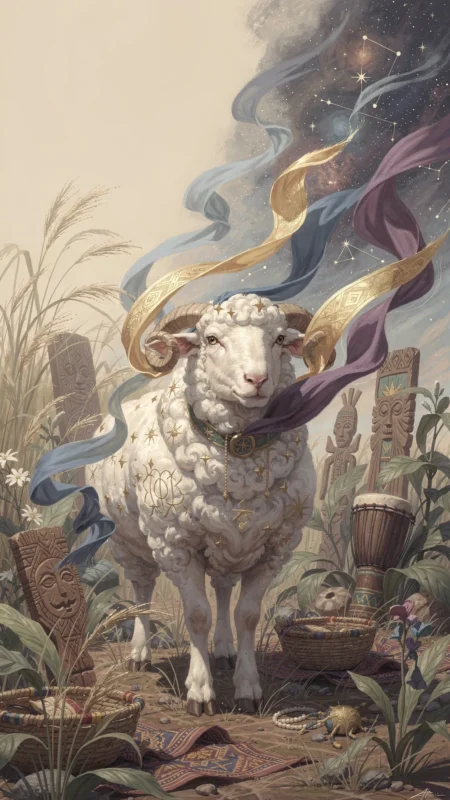
The Shepherd
The relationship between the Ewe and the Shepherd is perhaps the central compact of the pastoral world, a quiet treaty signed in the currency of vulnerability and vigilance. To the Ewe, the Shepherd may not be a master so much as a mobile feature of the landscape, a human North Star whose low whistle organizes the chaos of an open field into a comprehensible path. This bond, however, could be a profound and unsettling metaphor for faith and control. The Shepherd’s crook, seen from below, might look less like a tool of rescue and more like a question mark hooking the horizon, pulling the flock toward a destiny it cannot read. The Ewe offers up a profound, unthinking trust, and in return, receives a curated reality—a world whose sharpest edges have been sanded down, whose predators are kept at a managed distance, all in exchange for its wool, its milk, and, ultimately, its life. It is a relationship of deep, asymmetrical care, a strange and silent waltz between guidance and utility.
The Wolf
If the Shepherd represents a negotiated order, the Wolf is the wilderness that perpetually threatens to reclaim it. The Wolf is not an enemy to be fought, for the Ewe has no architecture for combat; it is, rather, an existential dread, a cold draft that slips through the coziest folds of the flock. The relationship is one of negative space, where the Ewe’s peaceful existence is defined by the terrifying outline of what waits in the blue-gray twilight. The Wolf’s howl may be the sound that gives the Shepherd’s presence its meaning and the flock’s huddle its desperate warmth. The Ewe’s spirit, a soft, pastoral watercolor, is perhaps only made precious by the ever-present possibility of the Wolf’s tooth, that sharp, unanswerable period at the end of a sentence. It is the chilling reminder that innocence is not a state of being, but a temporary, and highly fragile, jurisdiction.
The Gate
The Gate is an archetype of silent, momentous transition, and the Ewe’s relationship to it is one of profound, almost unnerving, passivity. A gate is a rigid, human-made sentence in the rambling, natural prose of a fenceline, and the Ewe does not question its grammar. It is a portal through which the Ewe is led, not one it chooses. This could symbolize a relationship with fate, or with those societal structures that dictate the passages of a life. The Ewe may not distinguish between a gate that opens onto greener pastures and one that swings shut onto the abattoir’s ramp; both are simply the next inevitable step, a current to be surrendered to. The Gate represents a threshold of consequence without comprehension, a moment where the Ewe’s journey is irrevocably altered by a mechanism it has neither the capacity nor the inclination to understand. It is, perhaps, the purest expression of the Ewe’s quiet surrender to a world larger than its own small patch of grass.


 Believe
 Fear
Fear Strength
 Weakness