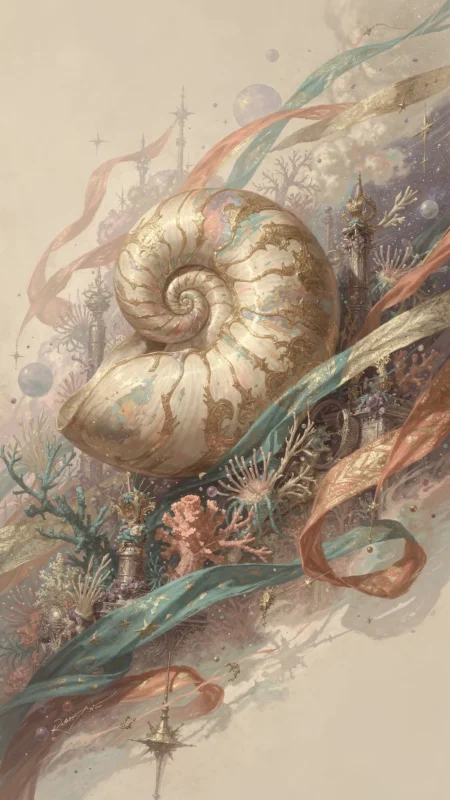
The Hermit
In the silent geometry of the soul’s withdrawal, The Nautilus and The Hermit may be seen as kindred spirits, if not different states of the same essential matter. The Hermit seeks a quiet room in the bustling metropolis of the world; The Nautilus simply carries its quiet room with it, a spiraling architecture of introspection built from its own substance. This is not the fearful retreat of the recluse, but rather a deliberate and sacred curation of self. Each new chamber of the shell could be viewed as a stage of the Hermit’s journey inward, a past life or former understanding sealed off, yet carried along as the very foundation of the present. The Nautilus, then, is perhaps the ultimate expression of the Hermit’s purpose: to create a world within a world, to find a universe in a single, self-contained form, proving that the most profound journeys are not across vast oceans, but through the spiraling corridors of the self.
The Unfathomable Deep
The Nautilus exists in a constant, poetic dialogue with The Unfathomable Deep from which it emerges. It is a pearl of logic condensed from an ocean of chaos, a perfect, crystalline thought plucked from the murmuring subconscious of the sea. The Deep represents the vast, the unknowable, the formless potential of existence, while the Nautilus is its antithesis: a finite, exquisitely ordered, and self-similar manifestation. Yet, this is not a relationship of opposition. The Nautilus does not conquer the abyss; it navigates it, its very form a whispered theorem on how to build a life of meaning amidst overwhelming mystery. It could be said that the shell’s perfect spiral is a kind of answer to a question the ocean is always asking, a testament that from the most profound and crushing pressures, a thing of serene and mathematical beauty may arise, carrying the memory of the depths within its pearlescent walls.
The Cartographer
Where the Cartographer seeks to render the external world knowable, plotting continents and currents onto a flat plane, The Nautilus engages in a more private, more profound sort of map-making. Its shell is an atlas of the interior, a living chronicle of a journey not through space, but through being. Each suture line marks a passage of time, each new chamber a new territory of the self discovered and inhabited. The Cartographer’s art is for the traveler, a guide for others to follow. The Nautilus’s map, however, may be legible only to itself—a sacred, spiraling record of its own expansion. Both are driven by an impulse to give form to the unknown, to draw a line around a piece of existence and understand its shape. The Cartographer charts the world we share, while The Nautilus charts the world we are, suggesting, perhaps, that every life is its own uncharted territory, worthy of being mapped with the same devotion and precision.


 Believe
 Fear
Fear Strength
 Weakness