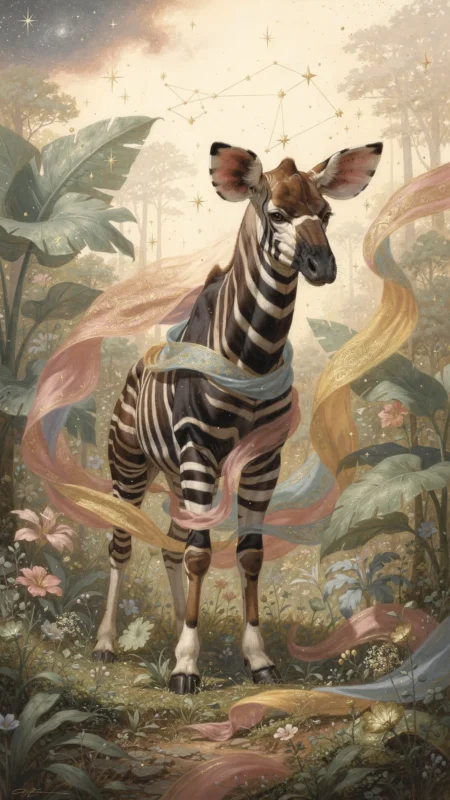
The Deep Forest
The Okapi’s relationship with the Deep Forest may be one of the most profound symbioses in the archetypal landscape. The Forest is not merely a backdrop but the very loom upon which the Okapi’s existence is woven. Its dappled light, falling through the high canopy, is the ink that patterns the creature’s haunches, a living camouflage that is less a disguise than a declaration of belonging. For the Okapi, the Forest could be a kind of external soul, a vast, breathing sanctuary whose quiet acoustics are perfectly tuned to its own silent footfalls. To leave it would be akin to a thought leaving the mind that conceived it—it would become unmoored, its logic and purpose suddenly thin and exposed under a too-bright, undifferentiated sky. The Forest offers a privacy so complete it borders on anonymity, allowing the Okapi to exist not as a spectacle, but as a secret whispered between ancient trees.
The Unsent Letter
There is, perhaps, an intrinsic kinship between the Okapi and the Unsent Letter. Both are vessels of a profound but unarticulated message, their meaning held in a state of perpetual, private potential. The Okapi moves through the world like a thought one has not yet found the courage to speak, its shy, retreating form a physical manifestation of a truth held close to the chest. Its discovery by the outside world felt like prying open a sealed envelope meant for another time, or perhaps for no time at all. The creature itself could be seen as a missive from the subconscious of the natural world, its zebra-like stripes a script in a language we can see but not yet decipher. It communicates not through sound or gesture, but through its very elusiveness, embodying the potent, resonant silence of all the things we feel deeply but never say.
The Archivist
The Okapi and the Archivist may seem worlds apart, yet they could be seen as colleagues in the quiet, solemn business of preservation. While the Archivist toils under a low lamp, surrounded by the brittle paper and fading ink of human history, the Okapi performs a similar function in the cathedral of the jungle. It is a living document, a biological manuscript bound in hide and bone, carrying within its DNA the deep, unwritten history of its ecosystem. The Archivist protects the story of who we were; the Okapi, in its "living fossil" status, *is* the story of what the world was long before our own narrative began. There is a shared devotion to the integrity of the past, a mutual resistance to the loud, ephemeral present. The Archivist curates what we must not forget, and the Okapi, simply by continuing to exist, reminds us of all that we have already forgotten.


 Believe
 Fear
Fear Strength
 Weakness