The High Altitude
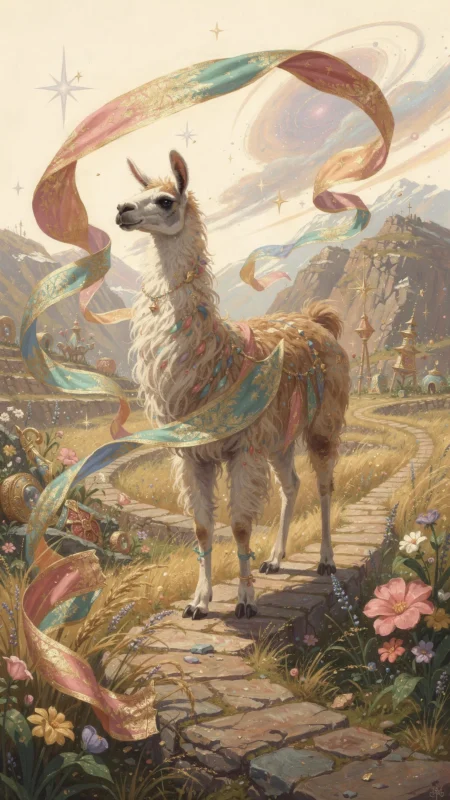
The Llama may not simply inhabit the High Altitude but could be seen as its ambulatory expression, a piece of the mountain given leave to wander. The relationship is less one of creature to environment and more of a conversation between two masters of impassivity. The thin, clean air of the peaks is perhaps the very medium of the Llama’s thought, a clarifying ether that filters out the dense and tangled priorities of the lowlands. It regards the stony escarpments and the vast, silent sky not as a harsh wilderness to be survived, but as silent, wizened peers. Its placid, cud-chewing gaze could be interpreted as a reflection of the summit’s own long view, a perspective so profound and detached that the scuttling dramas below seem merely a matter of distant, and largely irrelevant, weather.
The Heavy Burden
With the Heavy Burden, the Llama engages in a constant, delicate, and often contentious negotiation. This is not the simple relationship of a tool to its task, but something more akin to a weary philosopher roped to a demanding fool. The Llama consents to carry the load—be it a traveler’s supplies or the weight of another’s expectations—but this consent is provisional, subject to a private and inscrutable calculus of fairness and dignity. Its legendary stubbornness, that sudden, non-negotiable sitting-down, may not be an act of rebellion so much as a profound existential statement on the nature of complicity. The Llama seems to suggest that while a burden can be shouldered, it must never be allowed to crush the soul, and that the most powerful response to an unreasonable demand is a quiet, unbudgeable refusal.
The Eccentric Inventor
One might suggest that the Llama and the Eccentric Inventor are kindred spirits, operating according to a private logic that the world deems baffling but which, to them, is the very soul of reason. They share a certain magnificent disregard for convention, a commitment to a path of their own making, however peculiar it may appear. The Inventor’s workshop—a chaos of brilliant, half-finished contraptions—and the Llama’s path—a meandering line drawn by whim, weather, and an innate sense of where the grass is best—are perhaps maps of the same internal territory. Theirs is a kinship of productive absurdity; they both get the job done, but in a way that seems to gently mock the very notion of a "right" way to do things, reminding us that the most elegant solutions are sometimes born of glorious, unapologetic weirdness.

 Believe
 Fear
Fear Strength
 Weakness